

- How Much Does a 50-Year-Old 8 Point Face Lift Cost?
- Facelift Options at Age 50: Mini vs 8-Point vs Traditional
- How Long do the Results of 8 Point Facelift Last in 50 Years Old Women?
- What Is the 8-Point Facelift?
- How the 8-Point Facelift Works (Anatomy & Injection Points)
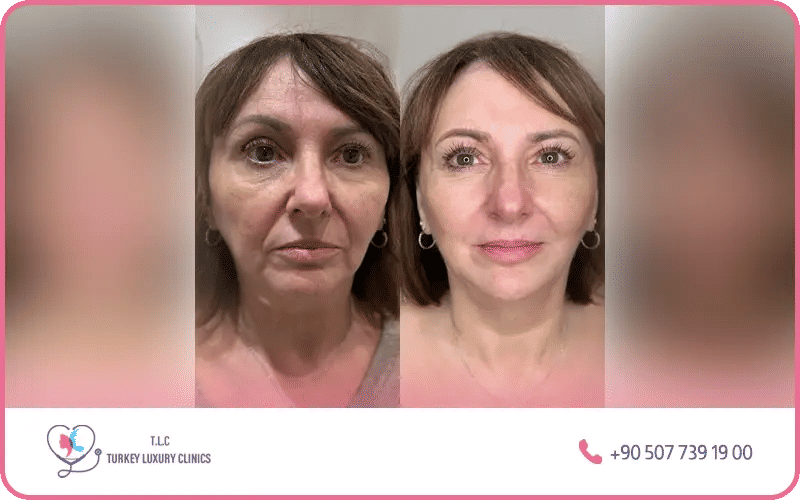
- 50 Years Old Women 8 Points Facelift Before and After Photos and Experiences
- Why International Patients Choose Turkey for 8-Point Facelift
- FAQs About 50 Years Old 8 Point Facelift Cost
An 8-point facelift at age 50 typically starts from $1,200 in Turkey and $3,500+ in the United States and United Kingdom. Most patients require around 5–6 syringes, with results lasting 12–18 months. The procedure usually takes 30–45 minutes with minimal downtime.
A Glance at 50-Year-Old 8-Point Facelift:
- Starting Price: $1,200 (Turkey) / $3,500 (US/UK)
- Average Syringes: 5–6
- Longevity: 12–18 months
- Recovery: Minimal to no downtime
Unlike surgical facelifts, which are priced as fixed procedures including operating room and surgeon fees, the 8-point facelift (liquid facelift) is priced per syringe. This makes the treatment fully customized based on facial anatomy, degree of volume loss, and aesthetic goals.
Because pricing varies from patient to patient, a personalized consultation is essential to determine the exact number of syringes required and avoid under-treatment or unexpected costs. Contact Turkey Luxury Clinics to receive a free consultation and a tailored price estimate based on your case.
How Much Does a 50-Year-Old 8 Point Face Lift Cost?
The 8-point facelift typically costs $3,500 to $5,400 in the US and UK, while in Turkey, the same premium procedure is highly accessible, averaging $1,200 to $2,500.
The price of an 8-point facelift is typically calculated per 1ml syringe. While the average global price for standard HA fillers ranges from $600 to $900, premium options—such as those using Vycross technology—can cost up to $1,000 per syringe due to their superior lifting capacity and longevity.
8-Point Facelift Costs Vary by Age Group (Why?)
Age Group | Avg. Syringes Needed | Primary Treatment Goal | Estimated Cost (USD) |
30s | 2 – 3 syringes | Prevention & subtle contouring | $1,200 – $2,000 |
40s | 3 – 5 syringes | Early sagging & tired appearance | $2,000 – $3,500 |
50s | 5 – 8 syringes | Structural lifting & jawline definition | $3,500 – $6,000 |
60s+ | 7 – 10 syringes | Full liquid facelift correction | $5,000 – $8,000+ |
The cost of an 8-point facelift varies between age groups because it is directly determined by the amount of dermal filler required, which logically increases with increasing age-related volume loss and skin laxity.
As facial aging progresses, particularly in the 50s and 60s, bone resorption and fat pad atrophy require more structural support to restore facial contours. This makes the treatment fully customizable, where younger patients typically need only subtle enhancement, while older patients require higher volumes for effective lifting and facial reshaping.
50 Years Old 8 Points Facelift Costs Vary by Location
Country | Average Cost (USD) |
United States (USA) | $3,500 – $5,400 |
United Kingdom (UK) | $2,800 – $5,200 |
Germany & France | $2,500 – $4,800 |
Poland & Hungary | $1,200 – $2,500 |
Turkey (Istanbul & Antalya) | $1,200 – $2,800 |
1. United States (USA)
In the US, 8-point facelift pricing is calculated per syringe, with one HA syringe costing around $750–$1,500. For a 50-year-old requiring 5–6 syringes, the total cost can reach up to $5,400 or more in premium locations. Compared to surgical facelift costs (around $11,000+), the non-surgical 8-point technique is more affordable but still the most expensive globally.
2. United Kingdom (UK)
In the UK, pricing typically ranges from $750–$1,000 per syringe. A full treatment usually requires multiple syringes, bringing the total to around $3,500 as the average price
Many clinics offer package deals (5-syringe bundles) with savings of 15–20% compared to individual pricing. Costs vary depending on location and expertise:
3. Europe (Germany, France, Poland, and Hungary)
Western Europe has relatively consistent pricing, with per-syringe costs averaging $550–$900. In countries like Spain and Poland, full-face restoration packages may start around $2,500, making them more affordable than Western capitals.
4. Turkey (Istanbul, Antalya, İzmir)
Turkey remains one of the most cost-effective destinations due to lower operational costs and high patient volume. Many clinics offer all-inclusive packages ranging from $1,200 to $2,800, including additional services such as consultation, transfers, and accommodation as part of medical packages.
Cities like Istanbul and Antalya are known for offering this treatment with experienced practitioners, modern clinical standards and affordable all-inclusive packages saving around 50% to 75% compared to the US.
Factors That Affect the Cost of an 8-Point Facelift
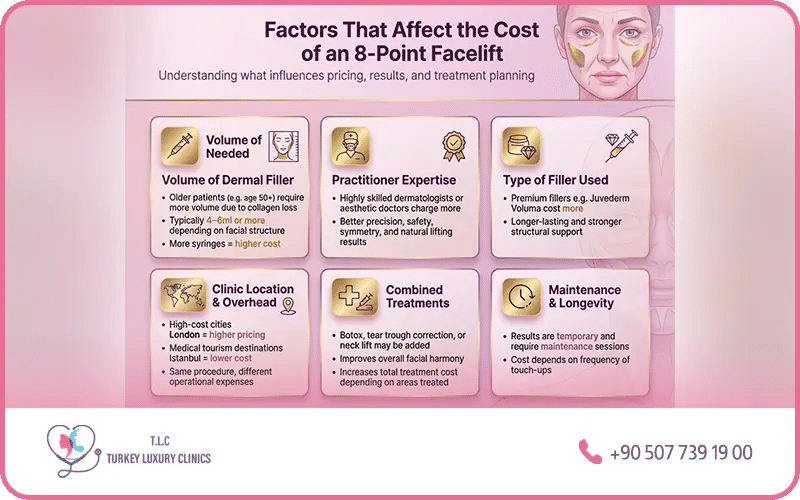
1. Volume of Dermal Filler Needed
At age 50, patients typically experience deeper collagen loss and facial volume depletion, which increases the amount of filler required. Most treatments use 4–6ml, and pricing rises directly with the number of syringes needed to achieve proper lift and structural support.
2. Practitioner Expertise
Injector skill plays a major role in both cost and outcome. Highly experienced dermatologists or aesthetic doctors charge more, but they deliver safer injections, better symmetry, and more natural lifting effects due to advanced anatomical precision.
3. Type of Filler Used
Different hyaluronic acid fillers vary in quality, longevity, and lifting capacity. Premium products such as Juvéderm Voluma or VYCROSS-based fillers are more expensive but provide stronger structural support and longer-lasting results compared to standard fillers.
4. Clinic Location and Overhead
Geographical location significantly impacts pricing. Clinics in high-cost cities like London or New York have higher operational expenses, while clinics in medical tourism destinations like Istanbul, and Antalyia in Turkey offer lower prices for the same procedure due to reduced overhead costs.
5. Combined Treatments
Many patients combine the 8-point facelift with complementary procedures such as Botox, tear trough correction, neck lift. These add-ons enhance overall facial harmony but increase the total treatment cost depending on the areas treated.
6. Maintenance and Longevity
The results are temporary and maintenance sessions are usually required to preserve the lifting and volumizing effects over time.
Facelift Options at Age 50: Mini vs 8-Point vs Traditional
Facelift Type | Estimated Cost (2026) | Best For |
8-Point Facelift | $1,200 – $5,400 | Volume loss & mild sagging (non-surgical option) |
$3,500 – $12,000 | Early jowls & moderate jawline sagging | |
Deep Plane Facelift | $20,000 – $40,000 | Severe facial laxity & structural rejuvenation |
Traditional Facelift (SMAS) | $15,000 – $30,000 | Moderate facial & neck sagging |
8-Point Facelift
This is a non-surgical option that uses fillers and injectables to restore lost volume and create a subtle lifting effect. It is best for mild sagging and early signs of aging, with results typically lasting around 12 to 18 months.
Mini Facelift
A limited surgical procedure that targets early jowls and mild lower-face laxity. It provides more noticeable lifting than non-surgical options, with results lasting approximately 5 to 8 years.
Deep Plane Facelift
An advanced surgical technique that works on deeper facial layers to reposition tissue rather than just tightening skin. It is designed for severe sagging and structural facial aging, with long-lasting results of about 10 to 15+ years.
Traditional Facelift (SMAS)
A standard surgical facelift that tightens the superficial muscular layer of the face. It is suitable for moderate facial and neck sagging, with results typically lasting 8 to 12+ years.
How Long do the Results of 8 Point Facelift Last in 50 Years Old Women?
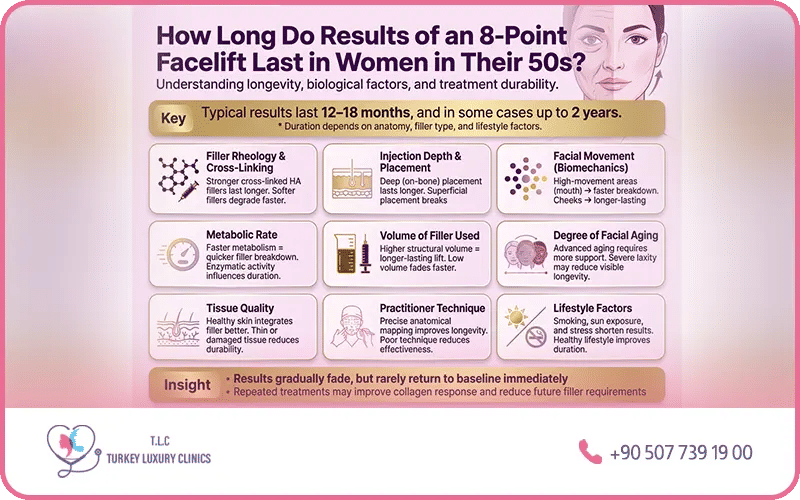
For a woman in her 50s, the longevity of an 8-Point Facelift typically ranges from 12 to 18 months up to 2 years. Because facial anatomy at age 50 involves specific structural changes, such as bone resorption and deep fat pad depletion, the duration depends heavily on the filler used and individual lifestyle factors.
1. Filler Rheology and Cross-Linking Technology
Longevity depends on how strongly the HA filler is cross-linked, which affects resistance to breakdown. Highly cross-linked fillers last longer, while softer, low-viscosity fillers degrade faster.
2. Injection Depth and Plane of Placement
Deeper injections (on bone) last longer due to lower metabolic activity. Superficial placements break down faster and provide less durable structural support.
3. Facial Movement and Biomechanics
High-movement areas (around the mouth) degrade filler quickly. Low-movement zones like the cheeks tend to maintain results for a longer period.
4. Metabolic Rate and Enzymatic Activity
Filler is naturally broken down by enzymes in the body. Faster metabolism leads to quicker degradation, especially in younger or highly active individuals.
5. Volume of Filler Used (Structural Support)
Higher volumes create stronger structural support and maintain visible results longer. Lower volumes may fade faster even if some filler remains.
6. Degree of Facial Aging (Anatomical Demand)
Advanced aging requires more volume due to bone and fat loss. Severe skin laxity can reduce the visible longevity of results even if filler is still present.
7. Product Integration and Tissue Quality
Better tissue quality allows more stable filler integration. Thin or weakened skin may show faster decline in aesthetic results.
8. Practitioner Technique and Injection Strategy
Accurate placement across structural points improves longevity and balance. Poor technique can lead to faster breakdown or uneven results.
9. Lifestyle and External Factors
Smoking, sun exposure, and intense physical activity can accelerate filler breakdown. These factors may shorten results by several months.
Even after the 18-month mark, results rarely drop back to "zero." Modern HA fillers stimulate the body's natural collagen production (neocollagenesis) .
This means that with repeated 8-point treatments, many women in their 50s find they need less product over time to achieve the same lifting effect.
What Is the 8-Point Facelift?
An 8-point facelift is a non-surgical facelift that uses dermal filler technique, such as Juvéderm VYCROSS, designed to restore youthful facial contours by strategically injecting hyaluronic acid fillers into key structural points of the face. It focuses on volume restoration and facial balance rather than tightening the skin surgically.
This treatment is particularly popular among patients in their 50s who are experiencing mid-face volume loss, jawline definition changes, and tear through hollowness and want to avoid surgical facelift while obtaining comparable visual lifting.
How the 8-Point Facelift Works (Anatomy & Injection Points)
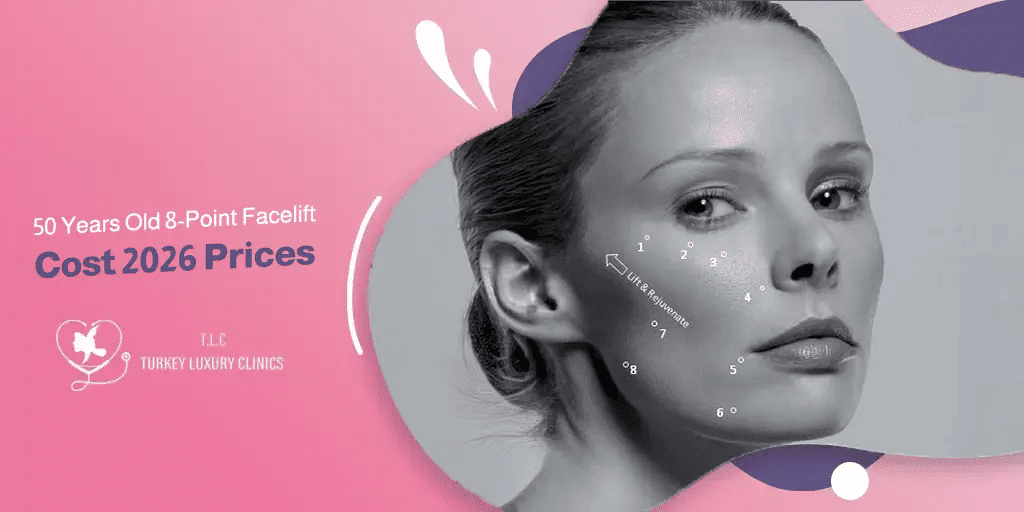
The 8-Point Facelift is a systematic approach to facial rejuvenation that treats the face as a whole rather than in isolation. By targeting specific bio-dynamic points, practitioners can restore the triangle of youth through customized volumetric support.
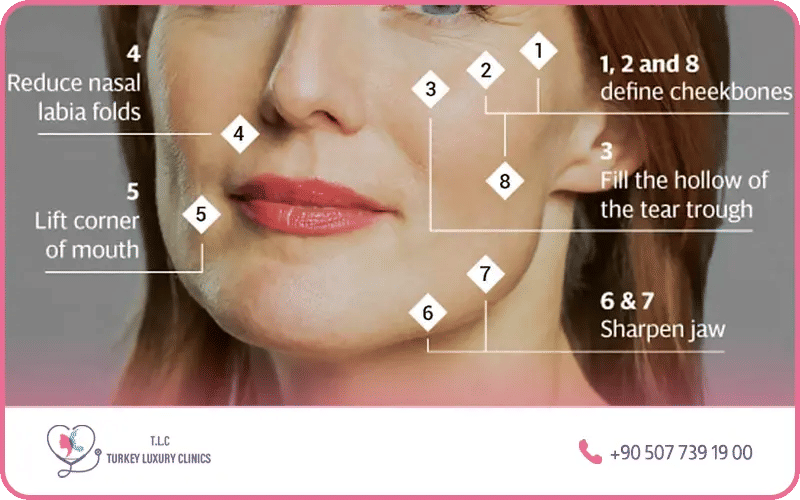
- Point 1: Zygomatic Arch (Lateral Cheek): Enhances the cheekbone and provides lateral support to lift the lower face.
- Point 2: Zygomatic Eminence (Malar Bone): Restores the "apple of the cheek" for a youthful, rounded contour.
- Point 3: Anteromedial Cheek: Addresses mid-face volume loss and helps reduce the appearance of tear troughs.
- Point 4: Nasolabial Fold: Specifically targets the deep line running from the wing of the nose to the mouth.
- Point 5: Oral Commissure (Marionette Lines): Lifts the corners of the mouth to eliminate a "sad" or drooping expression.
- Point 6: Pre-Jowl Sulcus: Fills the hollow area along the jawline to mask the appearance of sagging jowls.
- Point 7: Mandibular Angle (Jawline): Defines the angle of the jaw for a sharper, more contoured profile.
- Point 8: Sub-Zygomatic Hollow (Lower Cheek): Provides structural support to the lower cheek area, enhancing overall facial harmony.
50 Years Old Women 8 Points Facelift Before and After Photos and Experiences
Why International Patients Choose Turkey for 8-Point Facelift
Turkey attracts patients from the US, UK, and Europe not only for more accessible pricing but also for its strong combination of medical quality, safety standards, and consistent aesthetic results.
Why Choose Us?
- The JCI-accredited hospitals in Istanbul and Antalya, ensure international-level safety standards comparable to leading hospitals in the US and Europe.
- High volumes of facelift procedures give Turkish practitioners advanced clinical experience, resulting in precise techniques and naturally balanced facial outcomes.
- The fully transparent all-inclusive packages covering consultation, premium fillers, accommodation, and transfers with no hidden costs.
- Highly qualified aesthetic doctors are internationally trained in modern injection methods, focusing on facial harmony and fully personalized treatment planning.
Book your free consultation today with Turkey Luxury Clinics and receive a personalized treatment plan and exact price quote tailored to your needs.
You may like:
Best Facelift Surgeons in Turkey 2026: Board-certified Experts
See Facelift Before and After Photos in Turkey with Real Results 2026
Mini Facelift in Turkey: Prices, Packages & Real Reviews 2026
FAQs About 50 Years Old 8 Point Facelift Cost