

- How Much Do Braces Cost in Turkey? 2026 Updates
- Turkey Braces Price Comparison: Is it Really Cheaper?
- Who Is a Good Candidate for Braces?
- Dental Braces in Turkey Before and After Photos
- Types of Dental Braces in Turkey
- Metal vs. Ceramic vs. Invisalign: Which is Best for You?
- How Long Does Braces Treatment Take?
- Can International Patients Complete Braces Treatment in Turkey?
- How to Get Braces in Turkey Step by Step
- Are Dental Braces in Turkey Safe?
- Change Your Smile with Braces in Turkey
- FAQs About Braces in Turkey
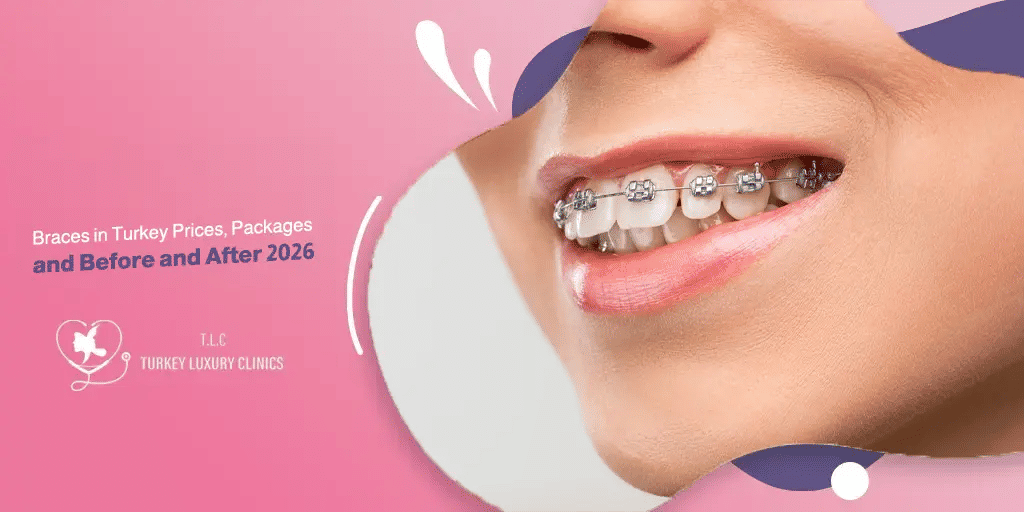
Braces in Turkey typically cost between $800 and $3,500 for a full treatment course that takes around 1 to 2 years. Getting Dental braces in Turkey is among the most popular and affordable options for dental tourism, offering high-quality orthodontic care at 50–70% lower costs than the US, UK, or Europe.
including traditional metal braces, aesthetically enhanced transparent ceramic braces. Top clinics in Istanbul, Antalya, and Izmir provide expert treatment for both adults and children, with a wide range of alignment options, including traditional metal braces, aesthetically enhanced transparent ceramic braces, advanced removable lingual braces, and Invisalign braces. All are designed to fix misaligned teeth, jaw irregularities, and improper bites, making them an effective solution for a straight, healthy smile.
How Much Do Braces Cost in Turkey? 2026 Updates
Braces in Turkey typically cost between $800 and $3,500, depending on the type of braces and treatment complexity. For most patients:
- Average Braces Cost in Turkey: $1,500–$2,500 for full-mouth orthodontic treatment.
- Cheapest Option: Metal braces cost $800–$1,500
- Most Expensive Option: Invisalign costs $1,100–$4,500, followed by Lingual braces cost $2,000–$3,500
The quoted price typically covers the full course of treatment, including consultation, digital scans, treatment planning, brace placement, and scheduled adjustment appointments until the braces are removed.
The final price depends on factors such as the type of braces selected, case complexity, treatment duration, and any additional procedures required.
Factors Affecting Braces Cost in Turkey
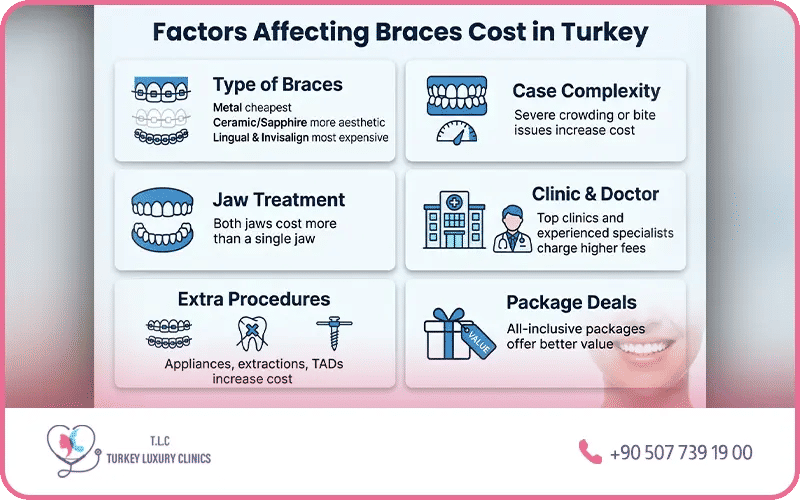
1. Case Complexity: Treating severe overcrowding, skeletal crossbites, or jaw alignment issues requires more advanced diagnostics and longer chair time.
2. Brace type and brand Selection: While metal braces are the most cost-efficient, aesthetic options like ceramic brackets or lingual braces require custom laboratory fabrication, which increases the baseline fee.
3. Single vs. Double Jaw: Treating only the upper or lower teeth can reduce the base price by roughly 20-30%.
4. Clinic and Orthodontist Experience: Prices may vary depending on the clinic’s reputation, technology, accreditation, and the experience of the orthodontist performing the treatment.
5. Treatment Duration: Cases that require longer treatment times, additional adjustment appointments, or more complex tooth movements generally cost more than straightforward orthodontic corrections.
6. All-Inclusive Packages: Many Turkish dental clinics offer international packages that bundle your braces installation with 4-star accommodation, VIP airport transfers, diagnostics, and initial X-rays.
Braces Cost by Type in Turkey
Dental Brace Type | Price (USD) |
Traditional Metal Braces | $800–$1,500 |
Ceramic Braces | $1,150–$2,000 |
Lingual Braces | $2,000–$3,500 |
Invisalign Express | $1,100–$1,800 |
Invisalign Lite | $1,800–$2,700 |
Invisalign Full mouth | $2,500–$4,500 |
Metal Braces Cost in Turkey
Metal braces in Turkey cost between $800 and $1,500, making them the most affordable orthodontic treatment option. The final price depends on treatment complexity, treatment duration, and the number of adjustment appointments required throughout treatment. Patients with severe crowding, bite problems, or treatment plans lasting more than two years generally pay more than those with minor alignment issues.
Ceramic Braces Cost in Turkey
Ceramic braces in Turkey typically cost between $1,150 and $2,000. They are more expensive than metal braces due to the use of tooth-colored ceramic brackets, which provide a more discreet appearance. The final cost depends on treatment complexity, treatment duration, and the ceramic bracket system selected.
Lingual Braces Cost in Turkey
Lingual braces in Turkey generally cost between $2,000 and $3,500. They are among the most expensive braces options because the brackets are custom-made and bonded to the back surface of the teeth, requiring advanced treatment planning and specialized orthodontic expertise. The final cost depends on the level of customization required, case complexity, and the amount of tooth movement needed to achieve the desired result.
Invisalign Cost in Turkey
Invisalign treatment in Turkey ranges from approximately $1,100 to $4,500, depending on the treatment plan. The primary factor affecting cost is the number of aligners required, which is directly related to case complexity. Minor corrections may require only a limited series of trays, while comprehensive treatment plans for moderate-to-complex cases require more aligners and longer treatment periods. Additional factors include the Invisalign package selected (Express, Lite, or Comprehensive) and the overall treatment duration.
Braces Pricing by Case Complexity
- Mild Cases: $1,000–$1,500
- Minor crowding, small gaps (diastema), or cosmetic alignment concerns. These cases typically require fewer clinic visits and shorter treatment times of approximately 6–12 months.
- Moderate Cases: $1,500–$2,500
- Noticeable crowding, tooth rotation, spacing issues, or mild bite problems such as overbites and underbites. Treatment usually takes 12–18 months.
- Severe Cases: $2,500–$4,000+
- Severe overcrowding, impacted teeth, significant overbites, underbites, crossbites, or jaw alignment problems. These cases often require longer treatment times (24+ months) and may involve additional appliances such as palatal expanders or temporary anchorage devices (TADs).
Additional Braces Costs and Hidden Fees
- Pre-Treatment Procedures: Some patients may require tooth extractions, professional dental cleaning, or other preparatory treatments before braces can be placed. These procedures may increase the overall treatment cost.
- Follow-Up Appointments: Traditional braces require adjustment appointments every 4–8 weeks throughout treatment. International patients should consider the cost and logistics of follow-up visits when comparing treatment options.
- Retainers After Braces: After treatment is completed, retainers are essential to prevent teeth from shifting back to their original position. Depending on the type of retainer, costs typically range from $150–$400.
All-Inclusive Braces Packages in Turkey
Many Turkish clinics provide all-inclusive braces packages designed for international patients seeking affordable braces abroad for tourism or vacation.
These often cover the initial consultation, X-rays, braces installation, follow-up visits, and sometimes accommodation and airport transfers. Some premium packages even integrate local tourism, making the overall treatment experience more cost-effective and enjoyable.
With high-quality materials, experienced specialists, and internationally accredited clinics, braces in Turkey offer an attractive balance between affordability, effectiveness, and convenience for patients from around the world.
What is Included in a Turkey Braces Package?
- Consultation: Meeting the orthodontist and planning the treatment.
- Diagnostics: All X-rays (Panoramic) and 3D Digital Scans.
- The Device: The brackets, wires, and the actual fitting (installation).
- Clinic Visits: All adjustment sessions that happen at the clinic in Turkey.
- Removal: Taking the braces off at the end of the 1–2 year treatment.
- Accommodation: 4 to 5-star hotel accommodation for 5 to 7 days
- VIP transportation: For clinic-airport-hotel transfer.
Does the price cover the follow-up visits?
Braces need to be "tightened" every 4 to 8 weeks. International patients who return home may need to have these adjustments performed at clinics in their own country. However, patients who remain in Turkey can have their follow-up tightening visits included within the quoted price at the same clinic.
Turkey Braces Price Comparison: Is it Really Cheaper?
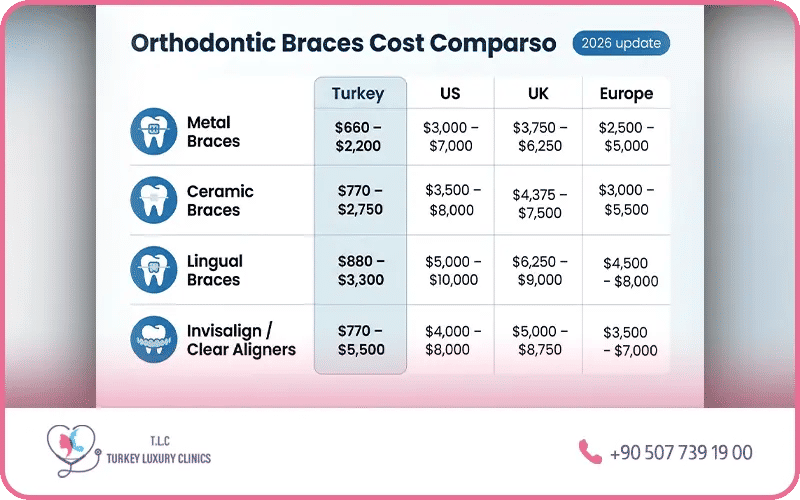
Turkey is significantly more affordable. Patients traveling from the US, UK, or Europe can save between 50% and 70% on their total orthodontic expenses. These savings are primarily driven by lower operational overheads and favorable exchange rates, rather than a compromise in material quality. Reputable clinics in Turkey utilize the same globally recognized brands (such as 3M, Damon, and Invisalign) used by high-end clinics in London or New York.
Treatment | Turkey | US | UK |
Metal Braces | $660–$2,200 | $3,000–$7,000 | $3,750–$6,250 |
Ceramic Braces | $770–$2,750 | $3,500–$8,000 | $4,375–$7,500 |
Lingual Braces | $880–$3,300 | $5,000–$10,000 | $6,250–$9,000 |
Clear Aligners | $1,200–$4,500 | $4,000–$8,000 | $5,000–$8,750 |
Why Are Braces in Turkey More Affordable?
- Significant Cost Savings: Upfront prices for braces are typically around 70% lower than in the US, UK, and Europe. This is primarily driven by lower operational costs and a favorable exchange rate, not by cutting corners on materials.
- Comprehensive All-Inclusive Packages: Most Turkish clinics specialize in international patients. Their quotes often cover accommodation (one of the biggest travel expenses) and VIP transfers between the airport, hotel, and clinic. Some premium packages even integrate local tourism, making the overall experience cheaper than just the medical work back home.
- World-Class Quality Standards: Lower prices do not compromise safety. Turkey is home to internationally accredited dental hospitals (such as JCI or ISO-certified facilities) that use global brands like 3M, Damon, and Invisalign. You are treated by highly skilled orthodontic teams accustomed to professional communication with international patients.
- The "Dental Vacation" Factor: Turkey is a top-tier global travel destination. Many patients choose to turn a medical necessity into a memorable holiday, enjoying world-famous hospitality and historic sites between appointments.
Who Is a Good Candidate for Braces?
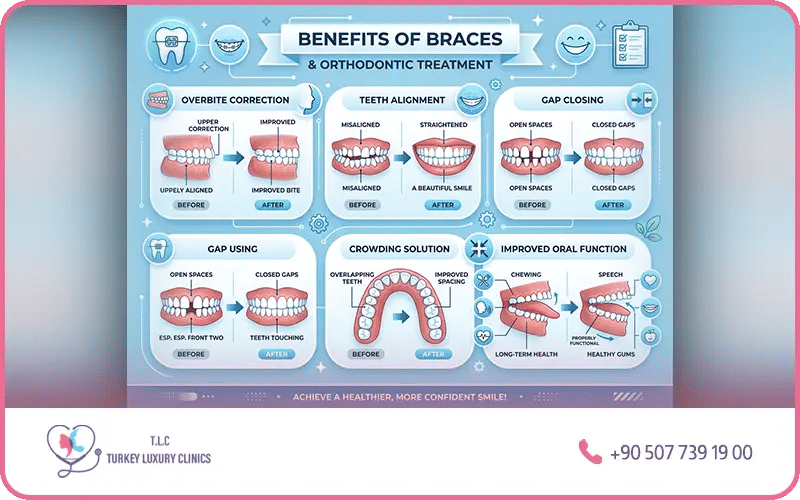
- You Have Crowded Teeth: Braces help create proper space and alignment when teeth overlap or rotate.
- You Have Gaps Between Teeth: Orthodontic treatment can close spaces and improve smile aesthetics.
- You Have an Overbite, Underbite, or Crossbite: Braces correct bite problems that may affect chewing, speech, and jaw function.
- You Have Crooked or Misaligned Teeth: Teeth can be gradually moved into a healthier and more balanced position.
- You Want Better Oral Health: Properly aligned teeth are easier to clean and may reduce the risk of cavities and gum disease.
- You are a Teenager or Adult Seeking a Straighter Smile: Modern braces and clear aligners are suitable for most age groups.
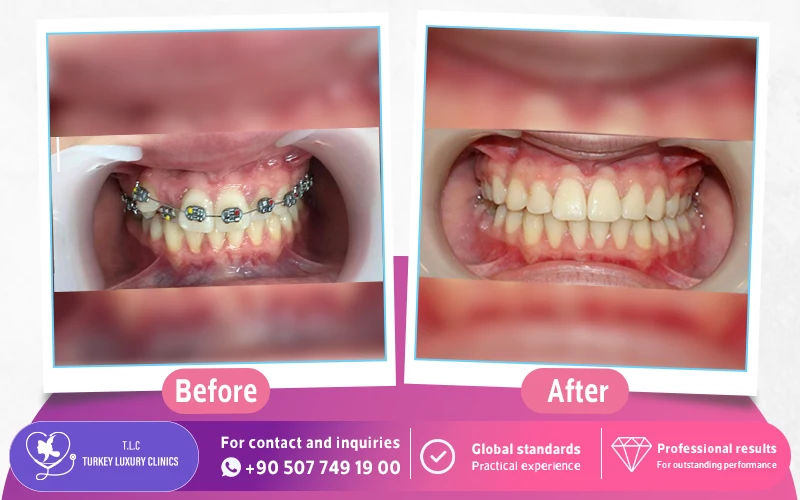
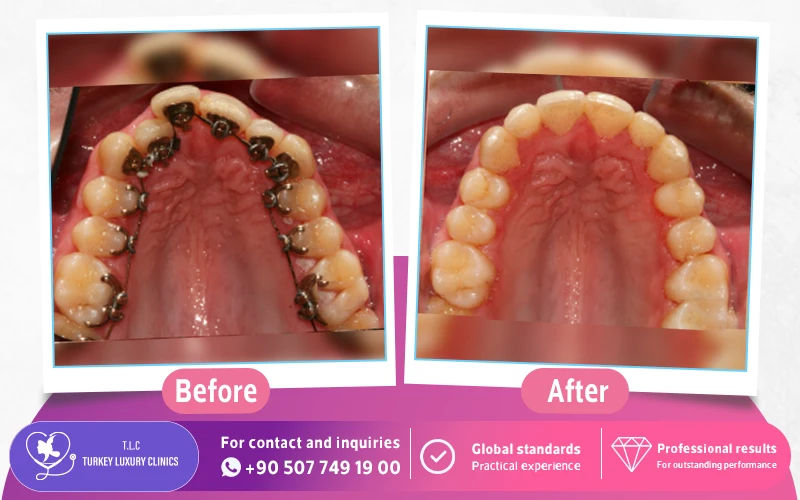
Dental Braces in Turkey Before and After Photos
Types of Dental Braces in Turkey
1. Metal Braces in Turkey
Metal braces are the most cost-effective and durable orthodontic solution in Turkey. While they are the most visible option, they are often the fastest way to correct severe overcrowding or complex bite issues.
In elite dental hospitals in Istanbul, Self-Ligating Braces (like Damon) allow longer intervals between visits (every 8–10 weeks instead of 4), which can save significant travel costs. However, they are slightly more expensive, typically +$500.
Pros & Cons of Metal Braces
Pros
- Cheapest option available
- Strongest material (rarely breaks)
- Works for all types of dental issues
- No compliance needed (unlike Invisalign)
Cons
- Most noticeable "train track" look
- High travel costs due to frequent visits
- Can cause initial mouth soreness or ulcers
- Harder to clean around brackets
2. Clear Aligners or Invisible Braces in Turkey
Clear aligners (Invisalign) are removable, transparent plastic trays ideal for mild-to-moderate, discreet, and flexible treatment. Invisible braces (ceramic) are fixed, tooth-colored brackets suitable for complex or faster correction.
Aligners provide comfort and better hygiene, while braces offer constant, precise treatment at a generally lower cost.
Clear aligners and invisible braces are highly popular among international patients in Turkey due to their discreet appearance and reduced travel needs. Unlike traditional braces that require monthly in-person tightening, clear aligners allow for remote monitoring and fewer flights.
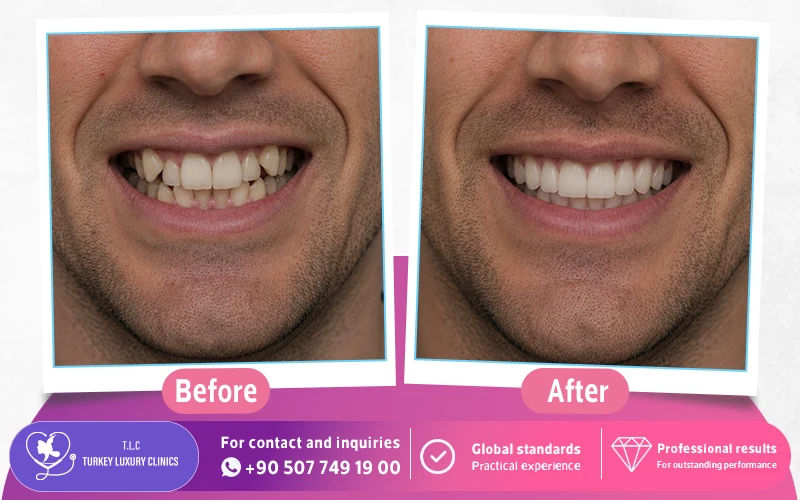
Clear Aligner Options (Invisalign & Turkey Brands)
- Invisalign Express: For very minor corrections, typically 5–7 aligners its cost is lower
- Invisalign Lite: Mild-to-moderate cases, up to 14 aligners
- Invisalign Comprehensive: Standard for moderate-to-complex cases, unlimited aligners until desired results
- Local Turkish Aligners: High-quality local brands offering similar results to Invisalign at 20–30% lower cost
3. Ceramic Braces in Turkey
Ceramic braces, commonly known as porcelain transparent braces, use tooth-colored or transparent ceramic brackets to blend with teeth. They provide a discreet alternative to metal braces while offering the same functional correction.
Popular in Istanbul and Antalya for adults, ceramic braces are usually 20–25% more expensive than metal braces and require careful hygiene to prevent staining
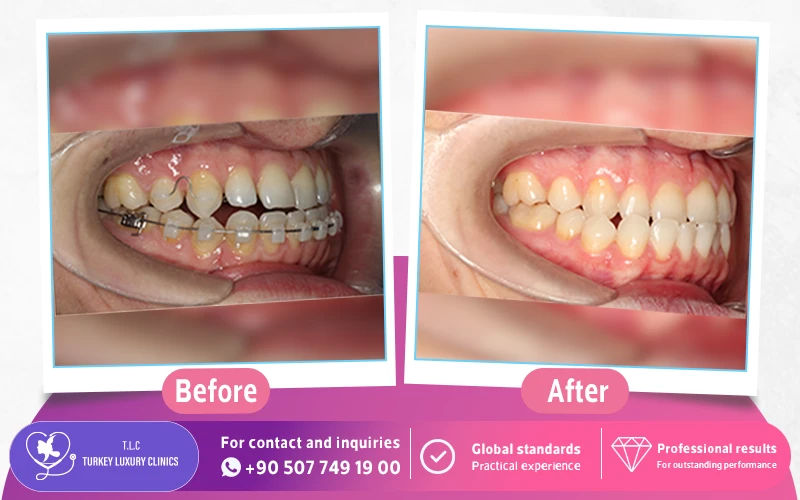
4. Lingual Braces in Turkey (Invisible Braces)
Lingual braces are a premium orthodontic solution where the brackets and wires are placed on the inside (lingual side) of the teeth. This makes them completely invisible from the outside, offering the highest level of aesthetics for adults and professionals.
Metal vs. Ceramic vs. Invisalign: Which is Best for You?
Feature | Metal Braces | Ceramic Braces | Invisalign |
Cost in Turkey | $800–$1,500 | $1,150–$2,000 | $1,100–$4,500 |
Material | Stainless Steel | Tooth-Colored Ceramic | Medical-Grade Clear Plastic |
Visibility | Highly Visible | Low Visibility | Nearly Invisible |
Removable | No | No | Yes |
Best For | Severe Crowding & Complex Bite Issues | Moderate to Severe Cases Seeking Better Aesthetics | Mild to Moderate Crowding and Spacing |
Treatment Effectiveness | Excellent | Excellent | Good to Excellent |
Patient Compliance | Not Required | Not Required | Must Be Worn 20–22 Hours Daily |
Diet Restrictions | Avoid Hard and Sticky Foods | Avoid Hard, Sticky, and Staining Foods | No Food Restrictions |
Oral Hygiene | More Difficult | More Difficult | Easier |
Follow-Up Visits | Every 4–8 Weeks | Every 4–8 Weeks | Fewer In-Person Visits |
Suitable for International Patients | Moderate | Moderate | Excellent |
Relative Cost | Most Affordable | Moderate | Highest |
The best type of braces depends on your orthodontic needs, budget, and lifestyle. Metal braces are the most affordable and effective option for complex tooth movements and severe bite problems. Ceramic braces provide similar clinical results with a more discreet appearance, making them popular among adults. Invisalign clear aligners are ideal for mild-to-moderate cases, offering nearly invisible treatment, easier oral hygiene, and fewer in-person visits for international patients.
How Long Does Braces Treatment Take?
Braces treatment typically takes between 12 and 24 months, although the exact duration depends on the complexity of the case and the type of braces used. Minor alignment issues may be corrected within 6–12 months, while more severe bite and jaw problems can require 24–36 months or longer. Traditional braces typically require adjustment visits every 4–8 weeks, whereas Invisalign often requires fewer in-person appointments.
Treatment Timeline by Case Complexity
Case Type | Estimated Duration | Clinical Description |
Minor Alignment | 6–12 months | Minor crowding, spacing, or cosmetic corrections |
Moderate Cases | 12–24 months | Overbites, underbites, and moderate crowding |
Complex Cases | 24–36 months | Severe crossbites, jaw discrepancies, or impacted teeth |
Treatment Timeline by Braces Type
Braces Type | Average Duration |
Metal Braces | 18–24 months |
Ceramic Braces | 18–24+ months |
Lingual Braces | 18–30 months |
Invisalign and Clear Aligners | 12–18 months |
What Can Affect Treatment Time?
- Case Complexity: More severe crowding and bite problems require longer treatment.
- Type of Braces: Self-ligating systems, such as Damon braces, may reduce treatment time compared with traditional braces.
- Patient Compliance: Invisalign aligners must be worn 20–22 hours per day. Missed appointments or poor compliance can extend treatment time.
- Biological Response: Teeth move at different rates from one patient to another, depending on bone metabolism and healing response.
Can International Patients Complete Braces Treatment in Turkey?
Most patients with traditional metal, ceramic, or lingual braces require follow-up adjustment appointments every 4–8 weeks. A common concern for international patients is the need for tightening appointments every 4 to 8 weeks.
- For Clear Aligners: Patients are often provided with a series of trays to use at home, significantly reducing the frequency of travel.
- For Fixed Braces: Many patients coordinate with a local orthodontist in their home country for routine maintenance, while keeping their original Turkish specialist updated through digital clinical images and teledentistry.
- Travel-Based Adjustments: Some patients prefer to schedule their tightening appointments to coincide with planned holidays or business trips to Turkey.
How to Get Braces in Turkey Step by Step
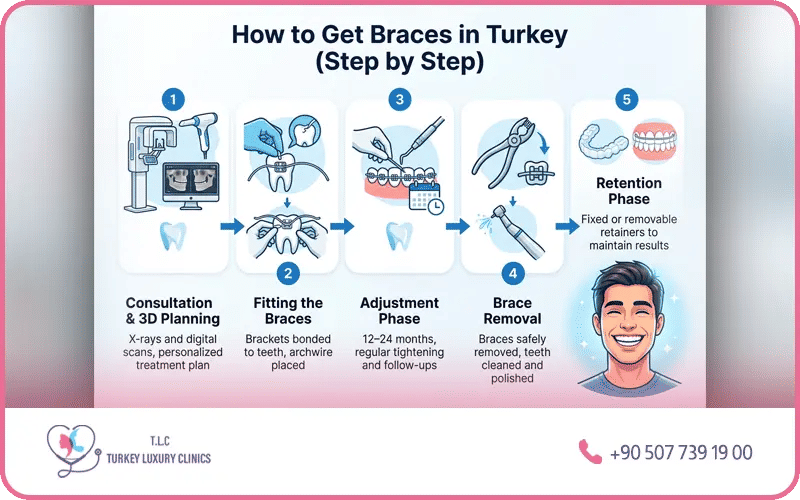
1. Initial Consultation & 3D Planning
Your journey starts with a comprehensive clinical examination, including X-rays and digital scans. Our orthodontists use this information to create a precise 1:1 digital treatment map tailored to your needs.
2. Fitting the Braces
For fixed braces, brackets are carefully bonded to the teeth using a safe, non-toxic adhesive and cured with a specialized blue light. The archwire is then secured to guide teeth gradually into proper alignment.
3. Adjustment & Tightening
The active treatment phase usually lasts 12 to 24 months, depending on case complexity. Regular adjustments ensure teeth move correctly. For international patients, follow-up schedules can be coordinated locally or during return visits to Turkey.
4. Brace Removal
Once the treatment is complete, braces are safely removed, and teeth are cleaned to restore a natural look.
5. Reinforcement (Retention)
To maintain your results, a retention phase is crucial. Patients receive either fixed lingual retainers or removable clear retainers to prevent teeth from shifting back to their original positions.
Are Dental Braces in Turkey Safe?
Orthodontic treatment in Turkey is generally safe when performed by qualified orthodontists in licensed and internationally accredited clinics. Many leading dental centers follow international quality standards such as JCI (Joint Commission International) and ISO 9001, ensuring strict sterilization protocols, modern diagnostic technology, and high-quality orthodontic materials.
Patients should choose experienced orthodontists, verify clinic credentials, and ensure that a clear treatment and follow-up plan is provided before starting treatment. Reputable clinics in Turkey commonly use internationally recognized brands such as Invisalign, Damon, and 3M, offering treatment standards comparable to those found in the US, UK, and Europe.
Change Your Smile with Braces in Turkey
At Turkey Luxury Clinics, we curate a seamless, 5-star medical experience tailored specifically to your lifestyle.
From the moment you land in Istanbul or Antalya, our dedicated team manages every detail of your visit, from VIP airport transfers and luxury accommodations to precision orthodontic treatment by board-certified specialists with over 15 years of experience.
FAQs About Braces in Turkey