

- Breast Reduction Size Chart
- How Many Cup Sizes Can You Go Down With a Breast Reduction?
- Why a Cup Size Isn't a Fixed Weight: Band and Sister Sizes
- Sizing Breast Reduction Size Chart During Consultation
- What Size Breasts Qualify for a Reduction?
- Factors Influencing Surgery Breast Reduction Size Chart
- Large Breast Reduction Size Chart
- What Do 300, 400 and 500 Grams of Breast Tissue Look Like?
Author: Dima Abed, Pharmacist and Medical Researcher
Medically reviewed by Prof. Dr. Halil İbrahim Gökçek, Plastic, Reconstructive and Aesthetic Surgeon
Last updated: November 11, 2026
A breast reduction size chart estimates how many grams of tissue removed from each breast translate into a smaller cup size. As a general estimate, removing about 150–300 g (roughly 0.3–0.7 lb) per breast takes off around one cup size.
Most women go down 1 to 3 cup sizes, often ending up in a C or small D cup.
Going from a DD to a C usually means removing about 400–500 g per breast, and going from a G to a C about 600–1,000 g or more.
These are not fixed numbers, because the same cup letter holds a different amount of tissue depending on your band size, breast density and frame: the same amount of tissue takes off more cup sizes on a 32 band than on a 40 band, and dense, glandular breasts weigh more than fatty ones of the same size.
Cup letters also differ between countries: the charts below use US sizes, where cups go D, DD, DDD, G, while UK sizes go D, DD, E, F, FF, G, so the same letter can mean a different cup. That is why surgeons plan your new size in grams and in proportion to your shoulders, chest and hips rather than by a letter.
Size charts are used for two different things: estimating your cup size after surgery from the grams removed, and, for insurance, the Schnur Sliding Scale, which sets the minimum weight of tissue needed for the surgery to count as medically necessary.
Breast Reduction Size Chart

A breast reduction size chart isn't a standard, this chart evaluates how much tissue removal in grams is performed during breast reduction, therefore changing cup size.
Insurers use a different tool, the Schnur Sliding Scale, which sets a minimum weight of tissue to remove for medical necessity. It does not predict your cup size.
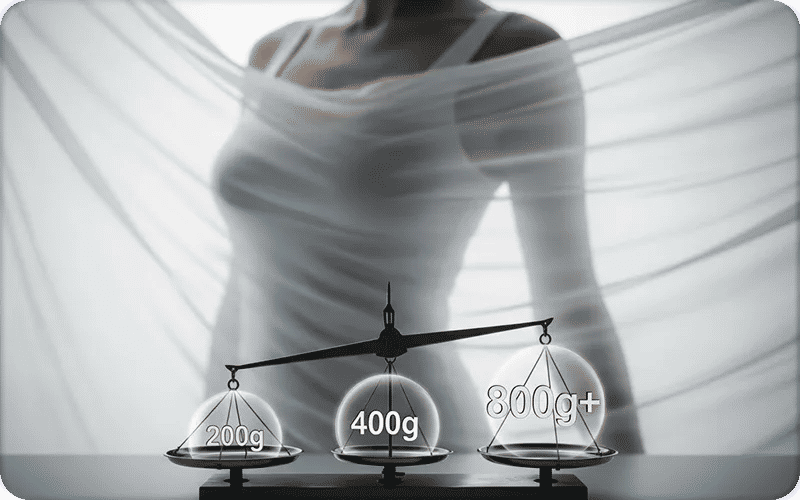
Most women go down about 1 to 3 cup sizes. Small reductions remove around 200–400 g per breast and large ones 800 g or more, always balanced against keeping a healthy blood supply to the nipple.
Remember, it’s all about your personal choice, proportions and your surgeon’s judgment that matters, because you are aiming for comfort after all, not just the number.
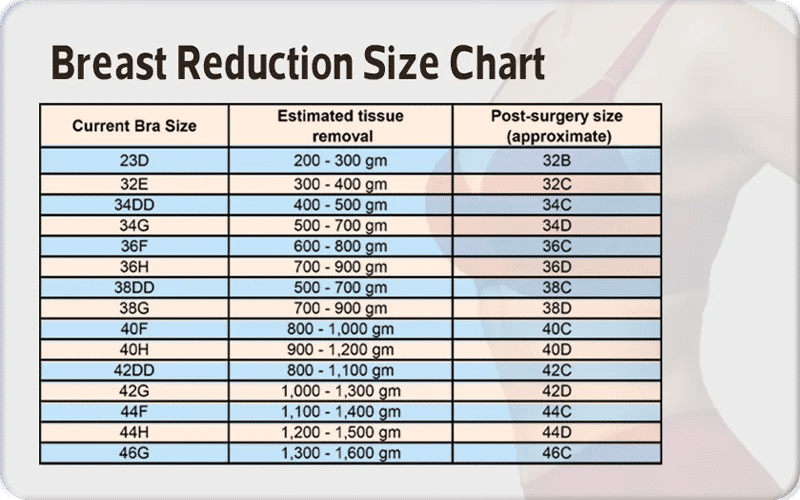
Breast Reduction Size Chart by Bra Size (US Sizes)
Use this chart as a guide only. Sizes are US bra sizes, weights are per breast, and your final cup letter depends on your band size and tissue density.
Current Bra Size | Estimated Tissue Removal (per Breast) | Approximate Post-Surgery Bra Size | Cup Sizes Down |
32D | 200–300 g | 32B | 2 |
32E | 300–400 g | 32C | 2 |
34DD | 400–500 g | 34C | 2 |
34G | 500–700 g | 34D | 3 |
36F | 600–800 g | 36C | 3 |
36H | 700–900 g | 36D | 4 |
38DD | 500–700 g | 38C | 2 |
38G | 700–900 g | 38D | 3 |
40F | 800–1,000 g | 40C | 3 |
40H | 900–1,200 g | 40D | 4 |
42DD | 800–1,100 g | 42C | 2 |
42G | 1,000–1,300 g | 42D | 3 |
44F | 1,100–1,400 g | 44C | 3 |
44H | 1,200–1,500 g | 44D | 4 |
46G | 1,300–1,600 g | 46C | 4 |
How Many Cup Sizes Can You Go Down With a Breast Reduction?
Most women go down 1 to 3 cup sizes after a breast reduction, for example from a D to a C or from a DDD to a C, which usually means removing about 150–700 g per breast. Going down 1 or 2 cup sizes is often enough to relieve neck, back and shoulder pain. Women who start from very large breasts, such as H or J cups, can go down 4 to 6 cup sizes with 1,000 g or more removed, often ending up in a C or small D cup.
How far you can go depends on how much tissue there is to begin with, how much can be removed while keeping a healthy blood supply to the nipple, and what size looks in proportion to your shoulders, chest and hips.
Tissue Removed (per Breast) | Approximate Cup Sizes Down |
150–300 g | About 1 |
300–500 g | 1–2 |
500–700 g | 2–3 |
700–1,000 g | 3–4 |
1,000 g or more | 4 or more |
No surgeon can promise an exact letter: bra sizes are not standard between brands, and your band size may also change after surgery, for example from a 38F to a 36D.
The Schnur Sliding Scale
It’s the scale that insurance uses to evaluate if your breast reduction is therapeutic and is a medical necessity, not just a cosmetic procedure.
- The main purpose is to objectively measure if large breasts are causing medical issues like back pain and neck pain, and therefore qualify you for coverage.
- This scale works by calculating Body Surface Area or (BSA) and matches it to the minimum weight of tissue the doctor is supposed to remove in grams. Here’s a table that explains the general measures.
Body Surface Area | Average grams of tissue per breast to be removed/ gm |
1.35 | 199 |
1.40 | 218 |
1.45 | 238 |
1.50 | 260 |
1.55 | 284 |
1.60 | 310 |
1.65 | 338 |
1.70 | 370 |
1.75 | 404 |
1.80 | 441 |
1.85 | 482 |
1.90 | 527 |
1.95 | 575 |
2.00 | 628 |
2.05 | 687 |
2.10 | 750 |
2.15 | 819 |
2.20 | 895 |
2.25 | 978 |
2.30 | 1068 |
2.35 | 1167 |
2.40 | 1275 |
2.45 | 1393 |
2.50 | 1522 |
2.55 | 1662 |
2.60 | 1806 |
2.65 | 1972 |
2.70 | 2154 |
2.75 | 2352 |
2.80 | 2568 |
2.85 | 2804 |
2.90 | 3061 |
2.95 | 3343 |
3.00 | 3650 |
3.05 | 3985 |
3.10 | 4351 |
3.15 | 4750 |
3.20 | 5186 |
3.25 | 5663 |
3.30 | 6182 |
3.35 | 6750 |
3.40 | 7369 |
3.45 | 8045 |
3.50 | 8783 |
3.55 | 9589 |
3.60 | 10468 |
3.65 | 11428 |
3.70 | 12476 |
3.75 | 13619 |
3.80 | 14867 |
3.85 | 16230 |
3.90 | 17717 |
3.95 | 19340 |
4.00 | 21112 |
4.05 | 23045 |
4.10 | 25156 |
4.15 | 27459 |
4.20 | 29972 |
4.25 | 32716 |
4.30 | 35710 |
4.35 | 38977 |
4.40 | 42543 |
4.45 | 46435 |
4.50 | 50682 |
4.55 | 55316 |
4.60 | 60374 |
4.65 | 65893 |
4.70 | 71915 |
4.75 | 78487 |
4.80 | 85658 |
Values above a BSA of 2.55 are not from the original study: BlueCross BlueShield of Tennessee extrapolated them with a mathematical formula.
Example: a BSA of 1.80 m² requires removing at least 441 g from each breast for the surgery to be considered a medical necessity.
Pay attention: if the removeSmall, moderate and large breast reduction by grams of tissue removed per breastd weight is below the 22nd percentile, it is considered cosmetic in the medical breast reduction size chart.
What are the Approximate General Size & Weight Guidelines?
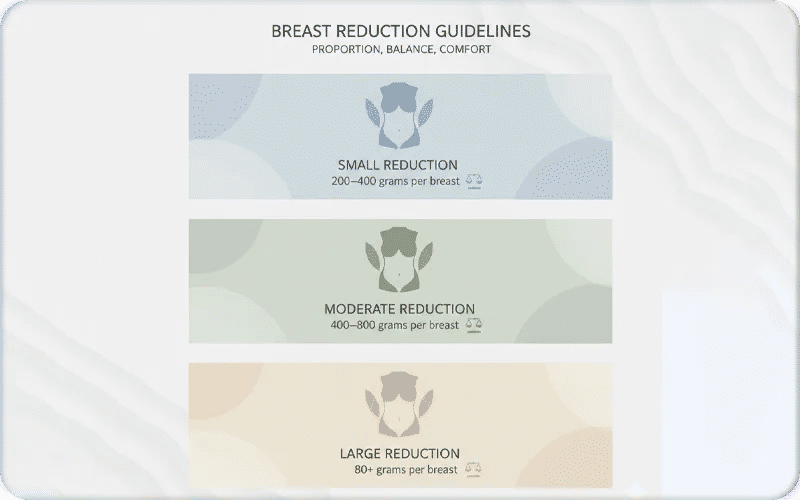
- For Small Reduction: 200 - 400 gm per breast.
- For Moderate Reduction: 400 - 800 gm per breast.
- For Large Reduction: 800 gm or more per breast.
How Many Grams of Breast Tissue Is a Cup Size?
Breast weight varies widely, but as a rough guide each cup size holds about 150–300 g of tissue per breast (published estimates range from about 100 to 300 g). For example, a D cup might be around 400–650 g per breast, while a G cup can be 950–1,100 g or more.
And for a better understanding, you can check out this table:
Cup Size | Approximate Weight (gm) |
Cup A | 200 - 250gm |
Cup B | 250 - 300gm |
Cup C | 300 - 400gm |
Cup D | 400 - 650gm |
Cup DD/E | 600 - 800gm |
Cup G | 950 - 1100+g |
Why a Cup Size Isn't a Fixed Weight: Band and Sister Sizes
A cup letter only describes the difference between your band (ribcage) measurement and your bust, so the same letter holds very different amounts of tissue on different frames. A D cup on a 32 band is much smaller and lighter than a D cup on a 40 band.
Bras that hold the same cup volume on different bands are called sister sizes: 32D, 34C and 36B hold roughly the same volume. That is why surgeons plan a breast reduction in grams, not letters, and why two women who have the same amount removed can end up in different cup sizes.
Tissue density matters too: glandular breasts are denser and heavier than fatty breasts of the same size (see the table in the next section).
Sizing Breast Reduction Size Chart During Consultation
To be honest, there isn’t a single “size Chart” for cup breast reduction size chart, and the Schnur Sliding Scale is only used by insurance companies to determine medical necessity.
So what actually matters during the consultation is to focus on creating the size that really fits your body, improve your posture and match your activity level.
It’s also about symptom relief, the doctor aims to alleviate discomfort from heavy breasts and make your life easier. And most importantly, most women go down about 1 to 3 cup sizes and you should know that before the operation.
Instead of asking for a cup letter, bring reference photos and tell your surgeon how you want to feel and look, and how active you are.
What Size Breasts Qualify for a Reduction?
There is no single cup size that qualifies you for a breast reduction. Many women seeking the procedure wear a DD cup or larger, but women with C or D cups may also experience significant physical discomfort, particularly if they have a smaller frame.
Qualification for breast reduction is not determined by breast size or proportions alone. What matters is how your breasts affect your health and daily activities. Common medical reasons for considering breast reduction include neck, back or shoulder pain, deep bra-strap grooves, recurrent rashes beneath the breasts, and difficulty exercising or performing everyday activities.
A D cup is not necessarily too small for breast reduction. Women with smaller cup sizes may also be candidates when they experience significant symptoms or have breasts that are disproportionately large for their body frame.
When you pay for surgery privately, there is generally no universal minimum cup size or tissue weight requirement. Your surgeon assesses your breast proportions, skin quality, symptoms, overall health and goals during the consultation.
You May Be a Good Candidate for Breast Reduction If:
- Your breasts cause physical discomfort: You experience persistent neck, back or shoulder pain, deep bra-strap grooves, recurrent rashes beneath the breasts, or difficulty exercising.
- Your breasts are disproportionately large for your frame: Many women seeking reduction wear DD to H cups (US sizes), but cup size alone does not determine suitability.
- Your weight is healthy and stable: You are close to your desired long-term weight, as significant weight changes can affect your surgical results.
- You do not smoke: Or you can stop smoking for the period recommended by your surgeon before and after surgery, as smoking increases the risk of wound-healing complications.
- You are in good general health: You can undergo anesthesia and surgery safely and have realistic expectations about your results and scars.
- You are not planning a pregnancy soon: Pregnancy and breastfeeding can change breast size and shape and may affect your surgical results.
If you are considering having the procedure abroad, read our guide to breast reduction surgery in Turkey to learn about the procedure, costs, recovery, and what to expect from treatment.
Factors Influencing Surgery Breast Reduction Size Chart
So how much exactly should your doctor remove? In fact, it’s not just about Schnur Scale, but there are always other factors your doctor take into consideration and these factors involve:
- The amount that should be removed. Generally, doctors remove 1 - 2 cup sizes down for smaller reductions, and up to 3 - 6 for larger ones. Anyways, this amount depends on your original breast size, tissue density, and your body’s anatomy.
- Grams per cup as about 150–300 grams per breast of tissue removal equals roughly one cup size reduction, but overall this is an average estimate and varies based on whether your breast tissue is more fatty or glandular in nature.
What’s fatty or glandular breast tissue? Read this table:
Factor | Fatty Breasts | Glandular Breasts |
Tissue Composition | Mostly fatty or adipose tissue | Mostly glandular or fibrous tissue |
Weight and density | Lighter- less dense | Heavier - denser |
Cup size Predictability | More predictable | Less predictable |
Response to Weight Changes | Size changes after weight gain or loss | Less changes |
Firmness and feel | Softer - more compressible | Firmer - more compact |
- Surgeon’s goal which is to achieve balanced, natural-looking proportions, not just a specific number. Surgeons prioritize harmony between breasts’ shape - chest width -shoulders and overall silhouette rather than focusing only on your cup size.
- Body proportions as your overall frame defines what looks balanced on you, and we mean your height - weight - shoulder width and waist-to-hip ratio. These measurements all influence what breast size will appear proportional and comfortable.
How Small Can You Go With a Breast Reduction?
The limit is set by blood supply. Your surgeon must leave enough tissue to keep blood flowing to the nipple and areola, and enough volume for a natural shape rather than a flat one. In very large reductions, the surgeon may suggest a slightly larger target to protect the nipple.
Important Considerations: keep this in mind!
- Up to this day, there’s no exact science to predict the right cup size, it’s about the aesthetic outcome. Swelling, healing, and how the tissue settles over time can affect the final appearance for several months after surgery.
- Consult a surgeon and don’t worry, he will use these charts for planning and tailor the surgery to your body and goals. A detailed consultation helps discuss expectations - comfort - symmetry and long-term results.
When Will You Know Your Final Size?
Most swelling goes down in the first 4 to 8 weeks, which is usually the earliest time to be measured for a new bra, however, your breasts keep settling for 3 to 6 months, and the final shape can take up to a year.
Large Breast Reduction Size Chart

A large breast reduction usually means removing 800 g or more of tissue from each breast, which typically takes off 3 or more cup sizes. But keep in mind that there’s no universal chart for large reductions, as bra sizes change by brand.
General Guidelines Of Breast Size Chart for Reduction
- From an F to a C involves removing almost 600 - 800 gm or more of tissue from each breast.
- From a G to a C is about 3 to 4 cup sizes and usually means removing roughly 600 to 1,000 g or more from each breast.
- From a DD to a C is about 2 cup sizes, roughly 400 to 500 g per breast.
- From a DD to a B is about 3 cup sizes, usually around 450 to 600 g per breast.
- From an E\F to a D involves a moderate breast reduction for proportional balance.
- From a DDD to a C involves a significant reduction mainly for pain relief and other symptoms.
What Do 300, 400 and 500 Grams of Breast Tissue Look Like?
As a rough guide, removing 300 g per breast is about one to two cup sizes, 400 g about two, and 500 g two to three, depending on your band size and tissue density. On a petite frame, 300 g can be a full cup or more; on a wider frame, the same amount looks smaller. See more real results in our breast reduction before and after gallery.
A size chart helps you plan, but our goal is to keep you comfortable and happy with your results!
Breast reduction at Turkey Luxury Clinics is the surgery that enhances your overall health, your posture and figure and everything you desire! Get the ideal medical help you dream of and let’s connect now!
Breast reduction in Turkey with us costs on average $2,600 to $3,200, and your final price is confirmed after your clinical examination. See the breast reduction package.
You can enjoy comprehensive packages that won’t cost more than half of what you might pay in your country and for the same operation! All the while getting the premium medical care you deserve including:
- Internationally certified top surgeons
- Luxury hotel accommodation and comfortable transportation
- Medical care that exceeds the required standards in Europe and the Gulf
Pay less and enjoy MORE here in Turkey!
Copyrights © Turkey Luxury Clinics