

- How Much Do Dental Implants Cost in Turkey in 2026?
- Dental Implant Packages in Turkey
- Dental Implant Types In Turkey
- Dental Implant Journey in Turkey: Step by Step
- Dental Implant Treatment Timeline in Turkey
- Who Is a Good Candidate for Dental Implants?
- Who Is Not a Good Candidate for Dental Implants?
- How Long Do Dental Implants Last?
- Dental Implant Recovery and Aftercare
- Dental Implant Risks and Possible Complications
- Are Dental Implants in Turkey Safe?
- Dental Implant Success Rate in Turkey
- Dental Implants in Turkey Before and After
- How Turkey Luxury Clinics Can Help With Dental Implants in Turkey
Dental Implants in Turkey cost between $350 and $1,000 for a single implant, and $3,000 to $7,000 per jaw for full-arch systems like All-on-4. Many factors affect the price range; here’s the article on Dental Implants in Turkey that’ll help you find out more.
How Much Do Dental Implants Cost in Turkey in 2026?
Dental Implants cost in Turkey range between $400 and $1,500 per tooth in 2026. This typically includes a complete dental implant in Turkey, covering the fixture, abutment, and crown.
And if you seek full-mouth restoration of both jaws, the cost generally falls between $3,000 and $16,000.
Compared with private-sector fees in the United States and the United Kingdom, this saves you approximately 60% to 80%. The difference stems mainly from lower operating overheads and laboratory costs in Turkey, not from any compromise in the quality of care.
Dental Implants in Turkey: Turkey Vs UK Vs US
Treatment | Country | Cost |
Single implant (full unit) | Turkey | 400$ - 1,500$ |
Single implant (full unit) | UK | 2,550$ - 4,450$ |
Single implant (full unit) | US | 3,000$ - 6,000$ |
All-on-4 (per arch) | Turkey | 2,500$ - 7,600$ |
All-on-4 (per arch) | UK | 12,700$ - 18,000$ |
All-on-4 (per arch) | US | 20,000$ - 26,000$ |
Full mouth (both jaws) | Turkey | 6,000$ - 16,000$ |
Full mouth (both jaws) | UK | 32,000$ - 45,000$ |
Full mouth (both jaws) | US | 40,000$ - 80,000$ |
Dental Implant Prices by Treatment Type
Procedure | Cost |
Single Tooth Implant | $400 - $1,500 per tooth |
All-on-4 System | $2,500 - $7,600 per arch |
All-on-6 System | $3,900 - $9,700 per arch |
Full-mouth reconstruction | $6,000 - $16,000 total |
Dental Implants Prices By Brand Tier
Premium | Examples | Cost |
Premium | Straumann, Nobel Biocare | $600 - $900 per implant fixture |
Budget/economy brands | Osstem, MegaGen | $400 - $600 per implant fixture |
Dental Implants Prices By Material Type
Material Type | Cost in Turkey 2026 |
Titanium | $400 - $1,500 per tooth |
Zirconia | $1,000 - $2,000 per tooth |
Turkey Dental Implants Prices By Procedure Type
Classification | Where is it placed | Cost in Turkey 2026 |
Endosteal | Inside the jawbone | $400 - $1,500 |
Subperiosteal | On top of the jawbone, beneath the gum | $1,100 - $1,900 |
Zygomatic | Anchored in the cheekbone | $1,700 - $5,000 |
Additional Costs of Dental Implants in Turkey
Bone Grafting: $140 - $600 per site.
Sinus Lifting: $361 - $1,500 depending on complexity.
What Affects the Cost of Dental Implants in Turkey?
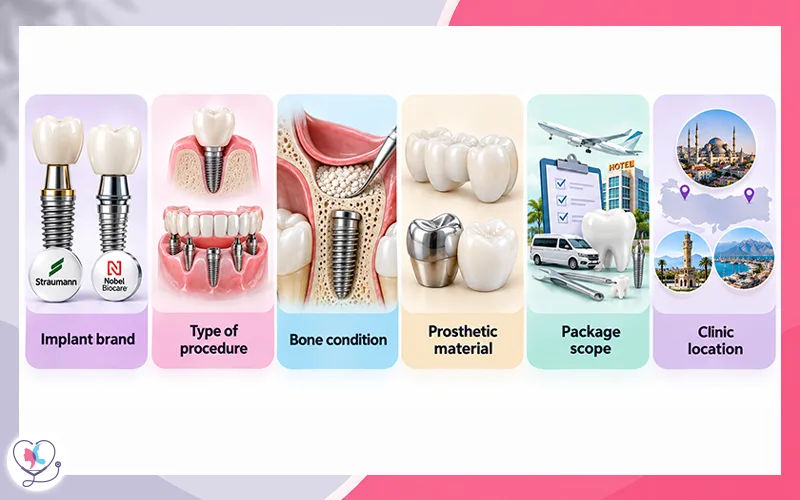
- Implant brand. Premium Turkey dental ımplants systems such as Straumann and Nobel Biocare cost $600 to $900 per fixture, while economy brands run $400 to $600.
- Type of procedure. A single implant costs less than All-on-4, All-on-6, or full-mouth reconstruction, which need more implants and prosthetics.
- Bone condition. Weak or thin bone may require grafting ($140 to $600 per site) or a sinus lift, adding cost.
- Prosthetic material. Zirconia crowns and bridges cost more than acrylic or metal-based options.
- Package scope. Extractions, temporary teeth, hotel, and transfers may or may not be included.
- Clinic location. Prices differ across Istanbul, Izmir, and Antalya clinics+
Dental Implant Packages in Turkey
Dental implant packages in Turkey range from $400 to $800 for a single implant and $3,000 to $12,000 for full-mouth options like All-on-4 or All-on-6.
What Is Usually Included in Dental Implant Packages?
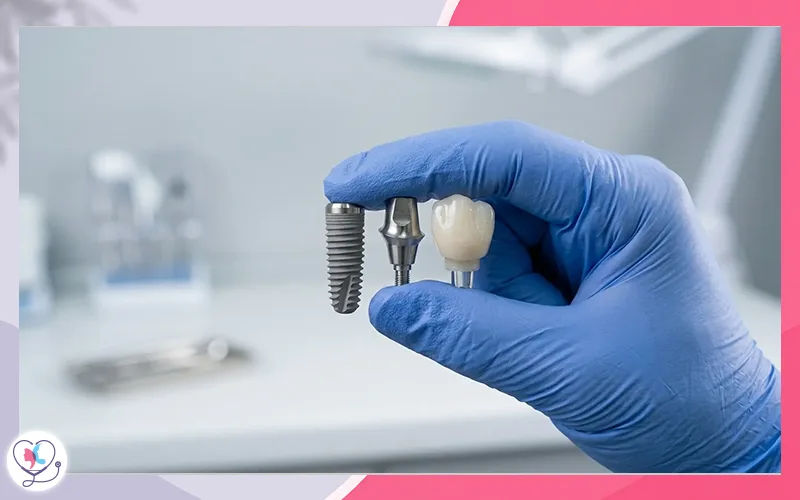
A standard dental implant Turkey package generally includes the core hardware, surgical placement, and final restoration needed to replace a single missing tooth:
- Implant post, which is a screw placed in the jawbone.
- Abutment, or the connector fixed to the post that holds the replacement tooth in place.
- Dental crown, the visible artificial tooth.
- Surgical placement.
- Consultation and planning.
What May Not Be Included in the Package?
- Diagnostic imaging like advanced 3D CBCT.
- Preparatory surgery, including extractions, bone grafting, and sinus lifts.
- Sedation fees like Nitrous oxide, oral sedation, and IV sedation.
- Temporary prosthetics. Temporary crowns or healing caps worn during the several-month healing phase are often billed on top of the base price.
Dental Implant Types In Turkey
dental implants turkey options range from single-tooth replacements to full-arch restorations, with solutions customized based on how many teeth are missing and your jawbone health.
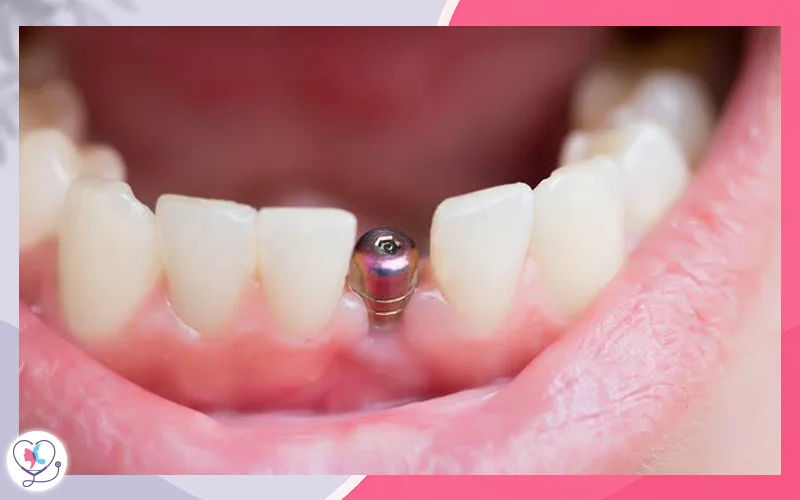
Single-Tooth Dental Implant
A single-tooth dental implant replaces one missing tooth and its root. A titanium post is placed in the jawbone and topped with a custom-made crown.
Because the neighboring teeth are left untouched, this option preserves natural tooth structure and restores chewing function and natural appearance.
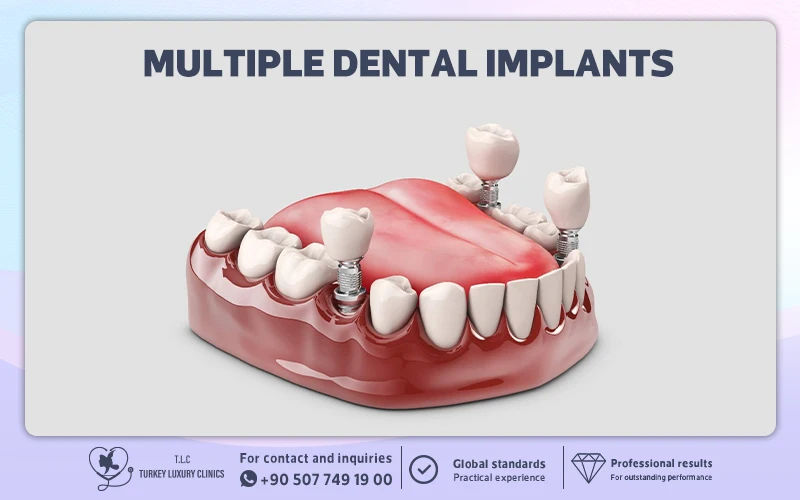
Multiple Dental Implants
Multiple dental implants replace several missing teeth that are scattered across your mouth, with each tooth supported by its own individual titanium implant.
This approach suits you if you have sufficient bone density and available space, and it avoids relying on adjacent natural teeth for long-term support.
Implant-Supported Bridges
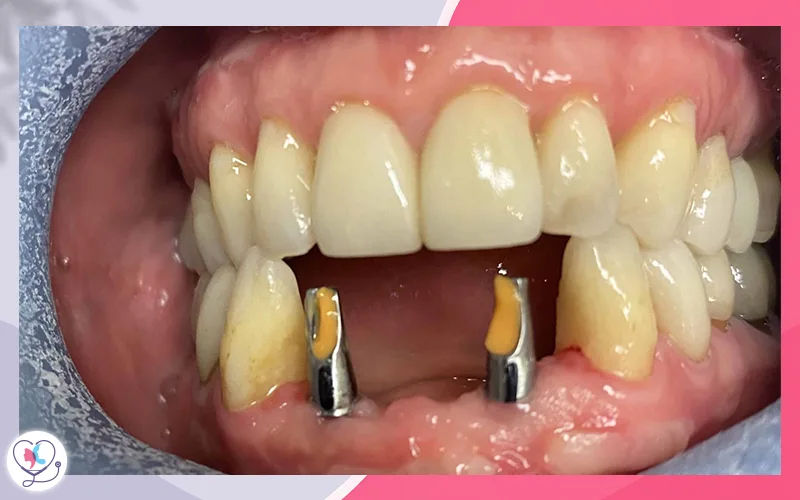
An implant-supported bridge uses two or more strategically placed implants to anchor a continuous bridge that replaces three or more consecutive missing teeth.
This reduces the number of surgical posts required compared with placing one implant per missing tooth, and leaves neighboring natural teeth intact.
All-on-4 Dental Implants
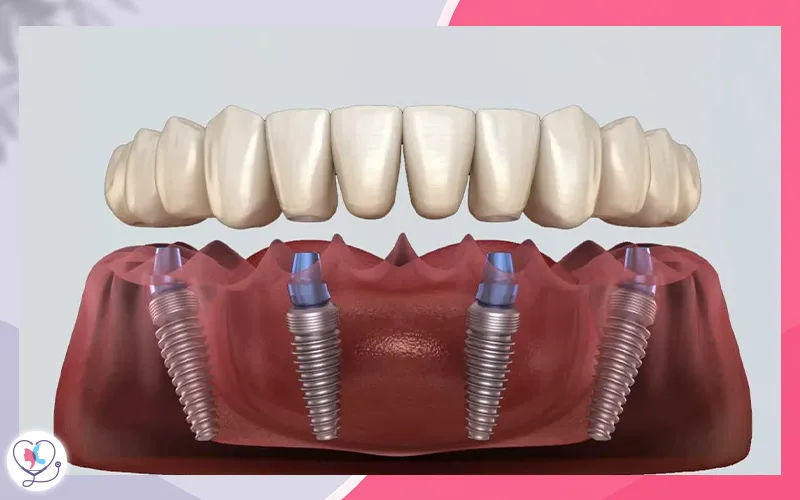
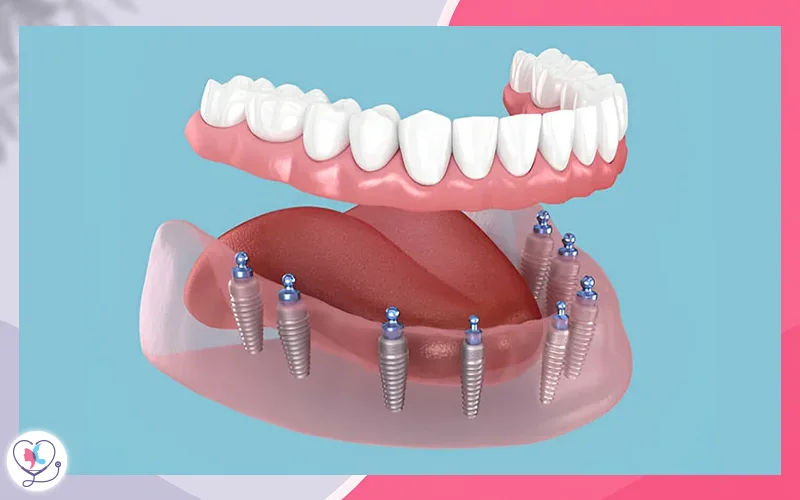
All-on-4 secures a complete fixed arch of teeth on four implants. The two back implants are angled to make maximum contact with the existing jawbone, which often helps you to avoid bone grafting. It offers a fixed alternative to dentures for the upper or lower jaw.
All-on-6 Dental Implants
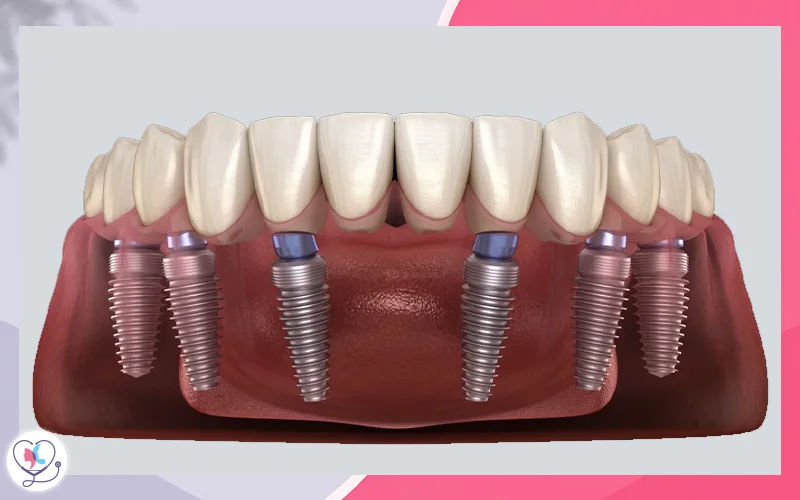
All-on-6 uses six strategically placed implants per arch to support a fixed set of teeth. The additional implants provide extra structural stability and spread chewing forces evenly across the jaw, making this option suitable if you have moderate bone quality and want added long-term durability.
All-on-8 Dental Implants
All-on-8 places eight implants in each jaw to give a fixed bridge the greatest possible load-sharing capacity, since more anchor points share biting force. It suits you if you have good bone volume and need a strong bite foundation or want extra long-term structural security.
Full-Mouth Dental Implants
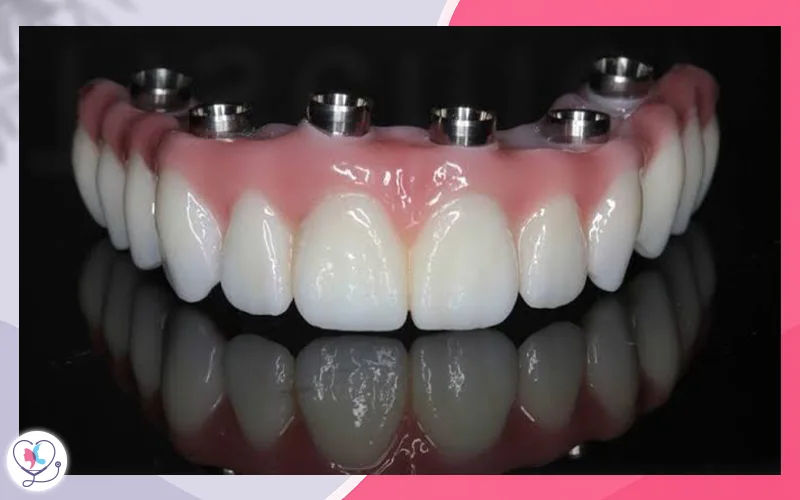
Full-mouth dental implants rebuild the upper and lower arches. Using a tailored combination of implants and fixed bridges or hybrid restorations, this treatment replaces all missing teeth, restoring chewing, speech, and appearance for people who have lost most of their teeth or face extensive damage.
Zygomatic Implants for Severe Bone Loss
Zygomatic implants are long, specialized fixtures anchored in the cheekbone (zygoma) instead of the jawbone. They are specially designed for severe upper-jaw bone loss, allowing a fixed set of teeth to be supported without the major preparatory bone grafting that standard implants would require.
Dental Implant Journey in Turkey: Step by Step
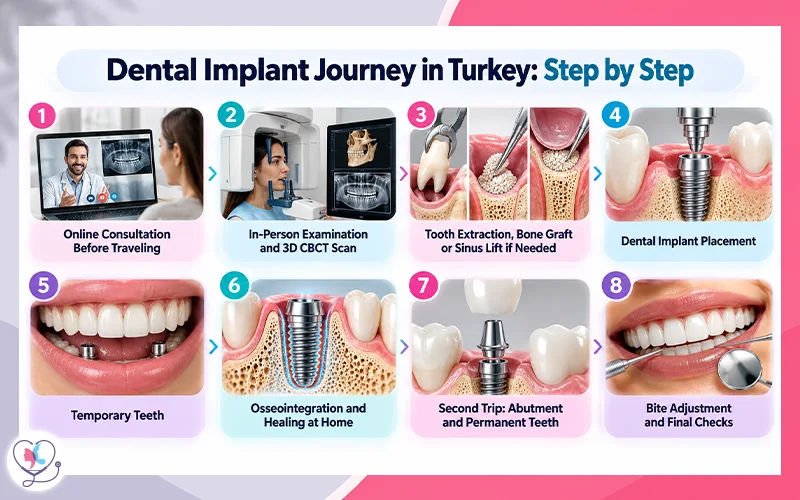
Getting dental implants in Turkey typically requires two separate trips spanning 3 to 6 months.
1. Online Consultation Before Traveling
Treatment begins remotely. You send photos or X-rays of your teeth, and the team reviews them. You receive a preliminary treatment plan with an estimated timeline and cost, so you can decide before booking travel.
2. In-Person Examination and 3D CBCT Scan
On your first trip, which usually lasts five to seven days, the oral surgeon carefully examines you face to face. A 3D CBCT scan and panoramic X-rays show your bone condition, which allows the surgeon to finalize the treatment plan.
3. Tooth Extraction, Bone Graft or Sinus Lift if Needed
If your scan shows damaged teeth or insufficient bone, preparatory procedures come first. The surgeon may remove problem teeth, rebuild the jawbone with a graft, or perform a sinus lift, so the implant has enough healthy, stable bone for support.
4. Dental Implant Placement
During surgery, the surgeon places the titanium implant into your jawbone under local anesthesia or sedation. The procedure is planned using your scans, and depending on your case, extractions or bone grafting may also be completed during the same visit.
5. Temporary Teeth
If required for appearance and function, the doctor fits temporary teeth or a temporary denture right after surgery, while the implants heal. This lets you return home with a natural-looking smile while your permanent restoration is being custom-made for you.
6. Osseointegration and Healing at Home
After surgery, you return home for three to six months of healing. During this osseointegration period, the jawbone fuses around the titanium implant, forming a firm foundation for the permanent teeth. Follow the aftercare instructions carefully throughout this period.
7. Second Trip: Abutment and Permanent Teeth
Once healing is complete, you return to Turkey for another five to seven days. The dentist confirms the implant has fused, attaches the abutment (the connector piece), then fits and permanently secures your final custom-made crowns, bridge, or full-arch prosthesis.
8. Bite Adjustment and Final Checks
Before you leave, the dentist checks that your new teeth fit comfortably and align with your bite, making small adjustments where needed. Final checks confirm the restoration looks natural and works well, and you receive aftercare guidance for long-term maintenance
Dental Implant Treatment Timeline in Turkey
Dental implant treatment timeline in Turkey typically requires two separate visits spread over a 3 to 6 month period.
How Many Trips to Turkey Are Needed for Dental Implants?
Most cases need two separate trips to Turkey for standard dental implant treatment.
How Long Should You Stay in Turkey for Dental Implants?
Generally, you need to plan for two separate trips to Turkey, staying 5 to 7 days for each visit.
How Long Does Dental Implant Treatment Take?
From start to finish, the complete dental implant process takes 3 to 9 months, although placing a single implant during surgery takes only about 30 to 60 minutes.
How to Choose a Dental Implant Clinic in Turkey
This process requires verifying official credentials, checking surgeon experience, and understanding the technology used.
Choose a clinic holding a health-tourism authorization from the Turkish Ministry of Health, with dentists registered in the Turkish Dental Association. During your examination, the doctor should use CBCT and 3D scans, certified implant brands like Straumann or Nobel Biocare, and experienced specialist surgeons.
Standard implants usually require two trips to Turkey, with a three- to six-month healing period between them, although placement can take a day or two. Beware of unusually cheap quotes that omit bone grafts, sinus lifts, abutments, or crowns.
Who Is a Good Candidate for Dental Implants?
A good candidate for dental implants is someone missing one or more teeth who has healthy gums, a fully grown jawbone, and good general health.
- Your gums should be healthy because active gum disease or infection can make an implant fail.
- Your jawbone should be thick and strong enough to hold the implant securely.
- You should be in good general health. Your body needs to handle minor oral surgery and heal well.
- Smoking is a risk, so you should be a non-smoker or willing to quit. Smoking reduces blood flow to your gums.
- Your jaw should be fully grown, usually by the late teens or later.
- You should be ready to care for your new teeth every day. Brush and floss daily and keep up regular dental visits to protect your implants from infection.
Who Is Not a Good Candidate for Dental Implants?
If you have uncontrolled medical conditions, active gum disease, or insufficient jawbone density, then you should not go for dental implants. Here’s a list of the dental implant contraindications:
- Uncontrolled diabetes.
- Active cancer treatment.
- Weakened immune system.
- Bleeding disorders.
- Certain medications.
- Active gum disease.
- Insufficient bone density.
- Heavy smoking.
- Severe teeth grinding.
- Incomplete jaw growth.
How Long Do Dental Implants Last?
With proper care and regular follow-ups, dental implants last for 25 years to a lifetime. The implant post, a titanium screw, is designed to fuse permanently with your jawbone and often lasts a lifetime.
A dental crown or visible tooth typically lasts 10 to 15 years before it needs replacement due to normal wear and tear from chewing.
Dental Implant Recovery and Aftercare
Dental implant recovery requires a soft diet, no smoking or straws for the first few days, and gentle cleaning to protect the healing site.
First 24 - 48 Hours
Some bleeding and swelling are normal, so bite gently on gauze and apply an ice pack to your cheek in short intervals. Rest, avoid strenuous activity, and stick to soft, cool foods.
Don't rinse hard, spit, or use a straw, since this can disturb the blood clot. And remember to take your prescribed medication exactly as directed, and avoid smoking and alcohol.
First Week
Swelling usually peaks around the second or third day, then gradually settles. Meanwhile, eat soft foods and avoid anything hot, hard, or crunchy.
You should also brush gently and keep the surgical area clean, using a salt-water rinse if your dentist recommends it. Finish any antibiotics you were prescribed.
Following Weeks
Return to your normal diet gradually, and avoid chewing hard on the implant side. Keep up your daily brushing and flossing to prevent infection around the implant. Also, you should stay away from smoking, which slows healing.
Osseointegration Period
Avoid putting pressure on the implant, and take good care of any temporary teeth. Keep your oral hygiene routine consistent and attend any recommended check-ups.
Once healing is confirmed, you return to Turkey for the abutment and permanent teeth.
Dental Implant Risks and Possible Complications
Although the dental implant procedure is highly safe and common, it carries specific risks and potential complications.
- Infection and peri-implantitis, a chronic inflammatory gum disease that can destroy supporting bone.
- Nerve damage if the implant is placed too close to the lower jaw nerve.
- Sinus complications
- Implantation failure or osseointegration issues
- Mechanical wear and tear. Connective components like abutment screws can loosen or crowns can fracture over time.
Are Dental Implants in Turkey Safe?
Yes, getting dental implants in Turkey can be safe. But to make it a safer trip for you, confirm your surgeon is a certified specialist in oral surgery or periodontology, and that the clinic holds Turkish Ministry of Health certification plus international accreditation.
Also, choose FDA- or CE-approved brands with traceable serial numbers and warranties, and avoid clinics that promise permanent results in one trip.
Dental Implant Success Rate in Turkey
Are dental implants successful in Turkey? With success rates between 95% and 98%, Turkey Luxury Clinics in Istanbul should be your next destination for dental implants.
- Clinical studies report an overall implant success rate of 98.38% over mid-term follow-ups
- As for lifespan, Endosteal (standard bone-rooted) implants achieve over a 95% success rate and can last 10 to 25 years, or a lifetime with good care.
- On the other hand, full-arch procedures like All-on-4 and All-on-6 maintain high success benchmarks between 95% and 98% when proper aftercare is observed.
Dental Implants in Turkey Before and After
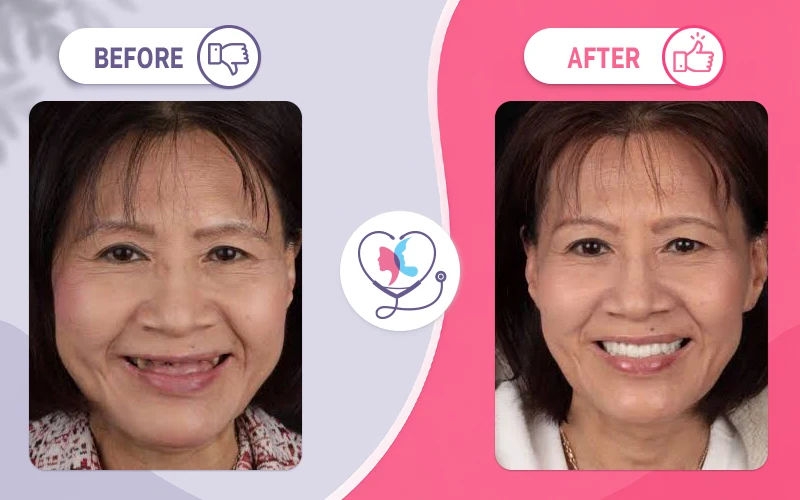
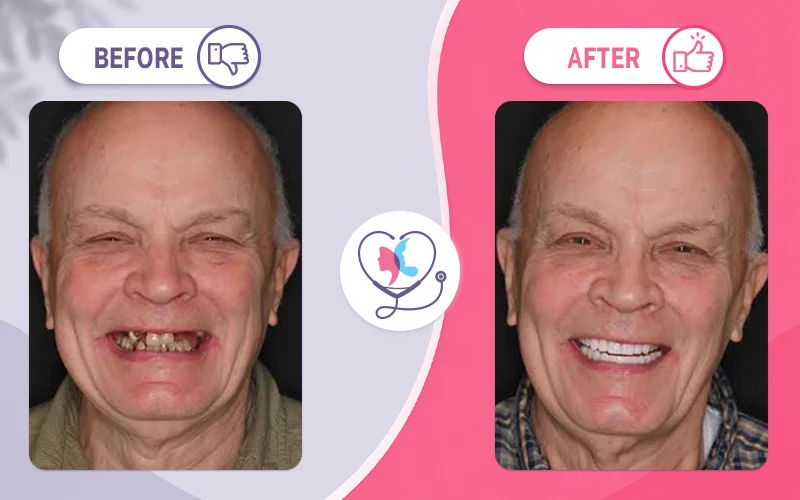
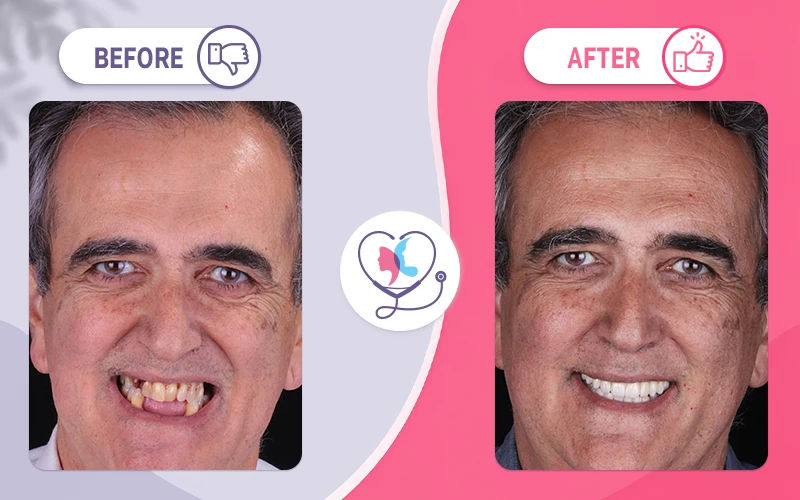
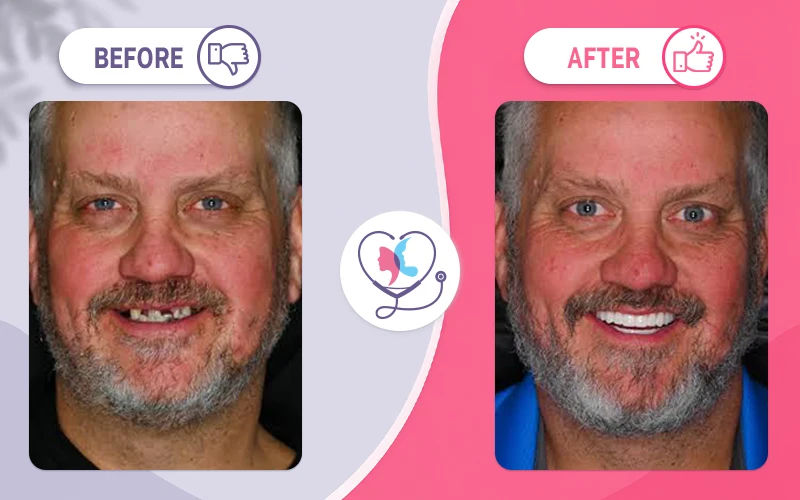
Dental implants in Turkey deliver significant clinical and aesthetic transformations, commonly restoring severe tooth loss, decay, and bone deterioration into fully functional, symmetrical smiles. Thousands of international patients choose Turkish clinics annually due to advanced digital smile design, premium global implant brands, and costs that are up to 70% lower than in the UK, US, or Eurozon
How Turkey Luxury Clinics Can Help With Dental Implants in Turkey
Turkey Luxury Clinics' doctors guide you through every stage of your dental implant treatment in Istanbul. Our team arranges your online consultation, matches you with an implant specialist, provides a clear quote, and coordinates your travel, accommodation, and both visits, so you can focus on recovery.
Contact our team of dentists at Turkey Luxury Clinics and schedule a FREE aponitment right away.
Copyright © Turkey Luxury Clinics