
- What is Incisionless Otoplasty?
- Who Is Incisionless Otoplasty For?
- Incisionless Otoplasty Before and After
- Incisionless Otoplasty Cost
- How Does Incisionless Otoplasty Work
- Incisionless Otoplasty Recovery
- Incisionless Otoplasty US
- Incisionless Otoplasty in the UK
- Incisionless Otoplasty Turkey
- Incisionless Fritsch Otoplasty
- Pros and Cons of Incisionless Otoplasty
- Incisionless Otoplasty vs Otoplasty
- Transform Your Ears Confidently with Turkey Luxury Clinics
- FAQs About Incisionless Otoplasty
Incisionless otoplasty, also known as scarless or suture otoplasty, is a non-surgical and minimally invasive procedure to correct prominent ears.
Unlike traditional ear pinning, which requires cutting the skin or cartilage, this technique reshapes the ear using permanent sutures placed through tiny punctures.
This non-surgical otoplasty is ideal for patients with mild to moderate ear protrusion caused by an underdeveloped antihelical fold. It’s especially suitable for those seeking cheaper otoplasty, faster recovery, minimal downtime, no visible scars, and avoidance of general anesthesia, making it a preferred option for children around age 6 and older, as well as adults seeking a subtle, permanent correction.
The method works by enhancing the ear’s natural folds, bringing the ears closer to the head. The results are natural-looking, long-lasting corrections with minimal downtime and a smoother recovery.
Discover with Turkey Luxury Clinics the incisionless otoplasty procedure, including candidates, costs, results, and recovery, with before and after photos to see the subtle, natural changes, and to compare it with traditional otoplasty surgery.
What is Incisionless Otoplasty?
Incisionless otoplasty, also known as scarless ear pinning, is a minimally invasive procedure that corrects prominent or mildly misshapen ears. The surgeon reshapes the ear by placing permanent sutures through tiny needle punctures, without making large incisions or leaving visible scars. This technique folds and repositions the ear cartilage to create a natural, pinned-back appearance with less discomfort and shorter downtime than traditional otoplasty surgery.
The surgeon performs incisionless otoplasty under local anesthesia and uses precise suturing, sometimes combined with gentle cartilage scoring, instead of open surgical cuts. Patients typically recover faster, experience minimal pain, and achieve subtle, long-lasting results.
While the most common use of incisionless otoplasty is the correction of prominent ears, especially in children, it can also improve minor ear asymmetry, poorly defined folds, or mild shape irregularities. For these cases, it offers natural-looking results with minimal downtime and no visible scarring.
Who Is Incisionless Otoplasty For?
- Patients with mild to moderate ear protrusion, especially caused by an underdeveloped antihelical fold.
- Individuals who want to avoid visible scarring behind the ears.
- Those seeking minimal downtime and a faster recovery compared to traditional otoplasty.
- Patients who prefer to avoid general anesthesia and undergo the procedure under local anesthesia.
Incisionless Otoplasty Before and After
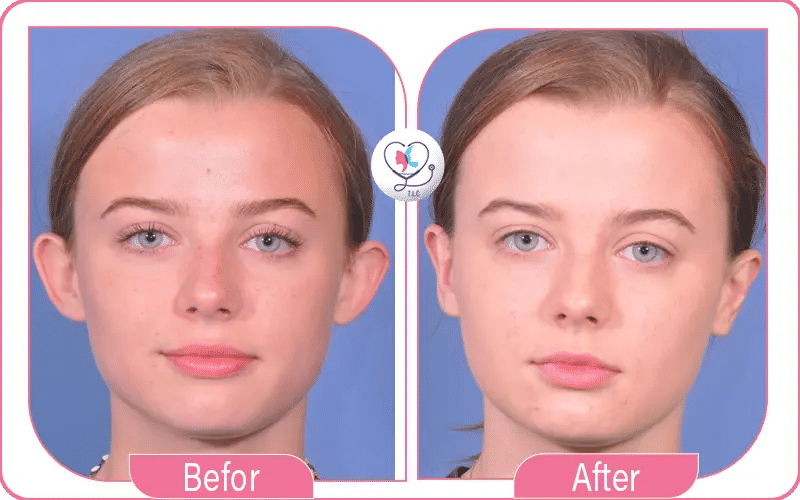
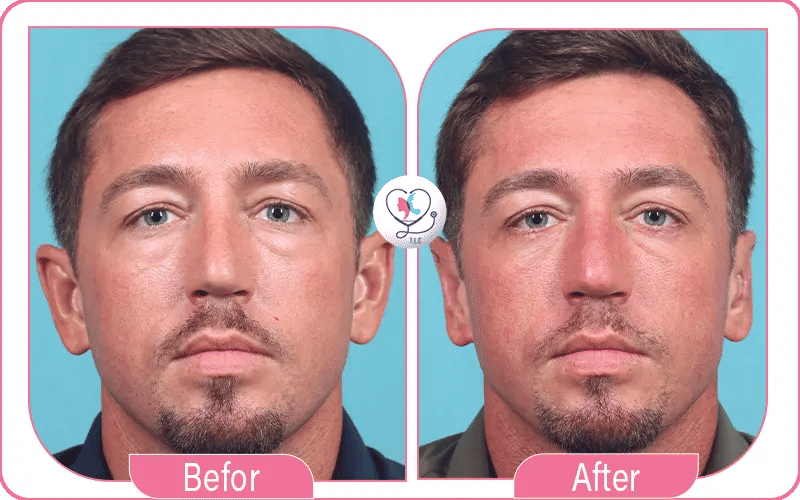
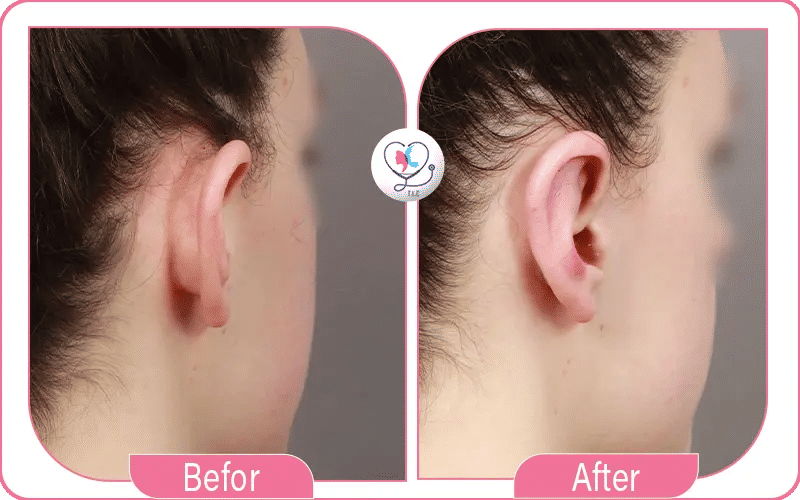
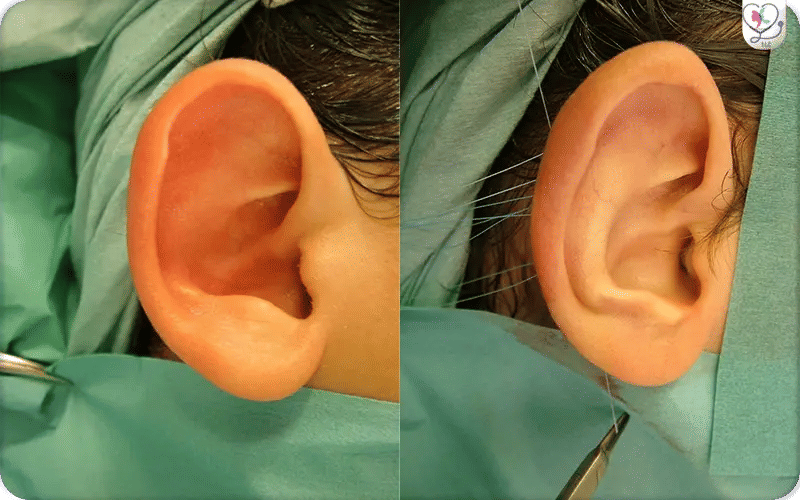
Incisionless otoplasty before and after results show ears that are pinned closer to the head, appearing less prominent and more balanced.
Before the procedure, ears often stick out noticeably due to a poorly formed antihelix or an oversized concha. After incisionless otoplasty, the ears sit closer to the head with a well-defined, natural-looking fold, creating a harmonious appearance without visible scars behind the ear. The final result is a subtle, balanced look that preserves the ear’s natural shape, giving a refined, aesthetically pleasing outcome.
While the results are visible immediately after incisionless otoplasty, swelling and bruising may temporarily hide the final appearance. The true outcome usually becomes apparent after around 2–4 weeks, as the swelling subsides, the ears settle into their natural, balanced appearance, revealing the natural look, long-lasting results of the incisionless otoplasty.
Incisionless Otoplasty Cost
The cost of incisionless otoplasty varies widely depending on location. The US is the most expensive, with prices typically ranging from $5,000 to $9,000+, followed by the UK ($6,200 to $10,200+) and Europe ($5,300 to $8,000+). Turkey offers the most affordable option, with prices usually between $1,300 and $3,000.
Location / City | Average Cost |
United States (US) | $5,000 – $9,000+ |
Florida | $5,000 – $8,500 |
California | $5,500 – $9,000 |
Chicago | $5,000 – $8,500 |
San Antonio | $4,800 – $7,500 |
New York | $5,500 – $9,000 |
United Kingdom (UK) | $6,200 – $10,200+ |
Turkey | $1,300 – $3,000 |
How Does Incisionless Otoplasty Work
Incisionless otoplasty is essentially a suture-based ear correction procedure. The skin is not cut, and the ear is not surgically opened. Instead, permanent sutures are placed beneath the skin through very fine needle punctures.
These sutures are used to reshape the ear cartilage and create or enhance the natural ear fold (the antihelical fold). By tightening the sutures, the ear is gently pulled closer to the head and stabilized in its new position.
This stitching technique is not superficial or cosmetic; it is a precise, technical method that works directly on the cartilage. For this reason, incisionless otoplasty is best suited for mild to moderate ear corrections and may not be appropriate for all ear shapes or more severe cases.
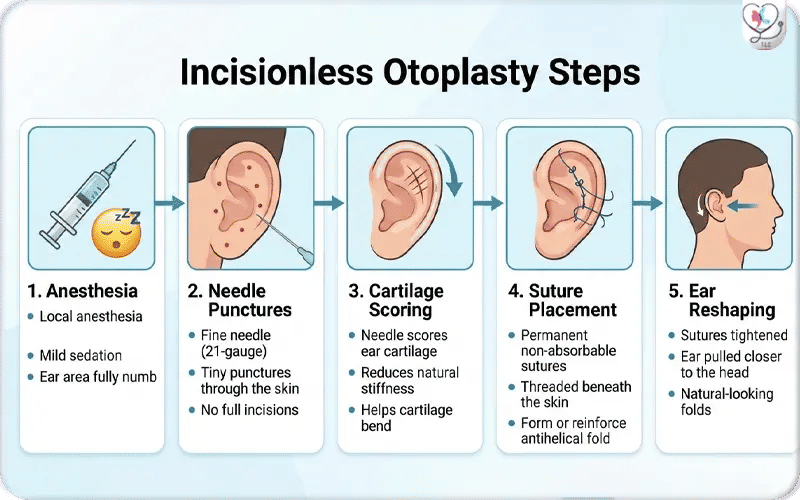
Incisionless otoplasty steps include
1. Anesthesia
The procedure is performed under local anesthesia, sometimes with mild sedation, to fully numb the ear area and ensure patient comfort.
2. Needle Punctures
A fine needle, commonly around a 21-gauge needle, is used to create tiny punctures through the skin without making full incisions.
3. Cartilage Scoring
Through these punctures, the needle gently scores the ear cartilage. This reduces the cartilage’s natural stiffness and helps it bend into the desired shape.
4. Suture Placement
Permanent, non-absorbable sutures are threaded beneath the skin through the puncture sites to form or reinforce the antihelical fold (the natural inner fold of the ear).
5. Ear Reshaping
The sutures are carefully tightened to pull the ear closer to the head and create a natural-looking fold, holding the ear securely in its corrected position.
Incisionless Otoplasty Recovery
Incisionless otoplasty recovery is generally quick, with most patients able to return to daily activities within 1–2 days. During the recovery period, patients typically experience minimal swelling, bruising, and discomfort, all of which are usually manageable with prescribed or over-the-counter medication. Heavy bandaging is rarely required.
Patients are often advised to wear a light compression headband at night during the early healing phase and to avoid applying direct pressure to the ears for several weeks to ensure optimal results. The tiny puncture marks heal rapidly, and the cartilage gradually adapts to its new shape, allowing the final outcome to become more apparent as healing progresses.
Incisionless Otoplasty Recovery Timeline
Immediate Recovery (Days 1–7)
Immediately after the incisionless otoplasty, until a week, expect temporary, mild throbbing, soreness, and itching., with minimal bruising and swelling peaks around 24-48 hours.
During this period:
- The mild soreness or pressure is usually managed with prescribed or over-the-counter pain relievers.
- Sleeping with the head elevated is recommended during the first few nights.
- Keep the area clean as instructed by your surgeon, using an antiseptic solution if recommended, to reduce the risk of infection.
- Wear a light compression headband (similar to a sweatband) continuously for the first few days, then at night for several weeks to help maintain ear shape and prevent folding.
- Most patients can return to light work or school within 1–2 days. Exercise, heavy lifting, swimming, helmets, and contact sports should be avoided for about one week.
Weeks 1–4 and Beyond
Most swelling subsides within the first week, however, remaining swelling gradually resolving over the following weeks, continuing wearing the headband at night for several weeks to protect the ears during sleep.
ًWhile the normal daily activities can be resumed gradually, strenuous exercise and heavy physical activity should be avoided for 3–4 weeks.
The final results develop progressively as the tissues settle, with the full outcome becoming more apparent over several weeks to a few months.
After the First Month and Beyond
Ear cartilage gradually remodels and stabilizes into its new shape over the following months, creating lasting improvement. The final results are long-term and often permanent, similar to those achieved with traditional otoplasty methods.
Incisionless Otoplasty US
Incisionless otoplasty is widely available across the United States, including Florida, California, New York, Chicago, and San Antonio. The procedure is typically performed by board-certified plastic surgeons, with costs varying by city, surgeon experience, and clinic setting.
Incisionless Otoplasty in the UK
In the UK, incisionless otoplasty is offered mainly in private cosmetic clinics. Costs are generally higher than in Turkey, reflecting clinic overheads and surgeon fees, while the technique remains similar to that used internationally.
Incisionless Otoplasty Turkey
Incisionless otoplasty offers significant cost savings (up to 60-80%) and access to experienced surgeons in Turkey compared to the US and UK, where costs are much higher, though both the US and UK offer high-quality care.
Turkey excels in medical tourism with package deals, high standards (JCI accredited clinics), and combines treatment with a vacation, while the US/UK provide care within local healthcare systems but at a premium, with Turkey providing similar quality but lower prices due to economic factors.
Incisionless Fritsch Otoplasty
While incisionless otoplasty is a scarless ear reshaping via suture techniques, "Incisionless Fritsch" specifies the exact suture placement and scoring method. Incisionless Fritsch otoplasty is a minimally invasive technique used to correct prominent (“lop”) ears. It involves placing hidden, permanent sutures through tiny skin punctures to reshape the ear cartilage, avoiding large incisions and the scarring associated with traditional methods.
This approach offers quicker recovery and natural-looking results and is often preferred for children and teens who need minor adjustments, such as forming or enhancing the antihelical fold.
Pros and Cons of Incisionless Otoplasty
Pros of Incisionless Otoplasty
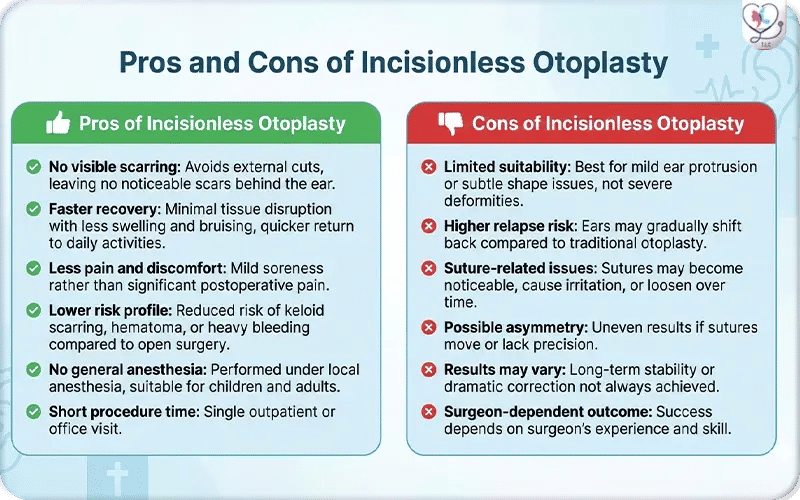
- No visible scarring: The technique avoids external cuts, leaving no noticeable scars behind the ear.
- Faster recovery: Minimal tissue disruption results in less swelling and bruising, allowing a quicker return to daily activities.
- Less pain and discomfort: Patients usually experience mild soreness rather than significant postoperative pain.
- Lower risk profile: The procedure reduces the risk of complications such as keloid scarring, hematoma, or heavy bleeding seen with open surgery.
- No general anesthesia: Surgeons typically perform the procedure under local anesthesia, making it suitable for both children and adults.
- Short procedure time: The treatment often takes place in a single outpatient or office visit.
Cons of Incisionless Otoplasty
- Limited suitability: The technique works best for mild ear protrusion or subtle shape issues and does not correct complex or severe deformities.
- Higher relapse risk: Compared to traditional otoplasty, the ears may gradually shift back in some cases.
- Suture-related issues: Internal sutures can sometimes become noticeable, cause irritation, or loosen over time.
- Possible asymmetry: Uneven results may occur if sutures move or are not placed with precision.
- Results may vary: Some patients may not achieve the same long-term stability or dramatic correction as with surgical otoplasty.
- Surgeon-dependent outcome: Success strongly depends on the surgeon’s experience and skill with suture-based techniques.
Incisionless Otoplasty vs Otoplasty
Incisionless otoplasty uses sutures through tiny needle punctures to reshape prominent ears, offering faster recovery, no visible scars, and minimal downtime , ideal for milder cases.
Traditional otoplasty surgery involves incisions, cartilage reshaping or removal, and sutures, allowing for more significant corrections but with longer recovery and potential scarring. The choice depends on anatomy and desired correction: incisionless for less severe issues and quicker return, traditional for major changes needing precise cartilage work.
The table breakdown all differences between Incisionless otoplasty and Traditional otoplasty:
Feature | Incisionless Otoplasty | Traditional Otoplasty |
Technique | Sutures through tiny punctures | Incisions, cartilage cut or scored |
Scarring | No visible scars | Small scar behind ear |
Anesthesia | Local only | Local or general |
Recovery | Few days | 1–2 weeks |
Pain | Mild | Moderate |
Best For | Mild–moderate protrusion | Mild–severe protrusion |
Results | Permanent, slight relapse possible | Permanent, stable |
Duration | 30–60 min | 1–2 hours |
Cost | Lower | Higher |
Transform Your Ears Confidently with Turkey Luxury Clinics
Transform your ears confidently at Turkey Luxury Clinics. Experience incisionless otoplasty with expert surgeons, transparent cost estimates, and genuine before-and-after results. Book your consultation today at JCI-accredited, state-of-the-art hospitals in Istanbul for natural, balanced ears with full support and premium care.
FAQs About Incisionless Otoplasty