

- What Is the Difference Between LASIK and LASEK?
- LASIK vs. LASEK: Which One is Better? Expert Opinion
- LASIK vs. LASEK: Which is Safer?
- LASIK vs LASEK for High Myopia
- LASIK vs LASEK for Astigmatism
- How to Choose Between LASIK and LASEK
- LASIK vs. LASEK Recovery Time
- Why LASIK and LASEK Heal Differently
- LASIK vs. LASEK: Pros and Cons
- LASIK vs. LASEK Cost: 2026 Prices
- LASIK vs LASEK Results and Success Rate
- LASIK vs LASEK: Long-Term Corneal Stability
- LASIK vs LASEK Procedure: What Happens During Surgery?
- How Do LASIK and LASEK Compare With PRK?
- LASIK vs LASEK vs SMILE
- Why Choose Turkey for LASIK or LASEK Eye Surgery
- Which Procedure Is Right for Your Eyes: LASIK or LASEK?
- FAQs About LASIK vs LASEK Surgery
Both LASIK and LASEK are highly effective laser eye surgeries that reshape the cornea (the clear front surface of the eye) to correct refractive errors such as myopia, hyperopia, and astigmatism. While both procedures use the same advanced excimer laser to improve vision, they differ significantly in how the surgeon accesses the corneal tissue.
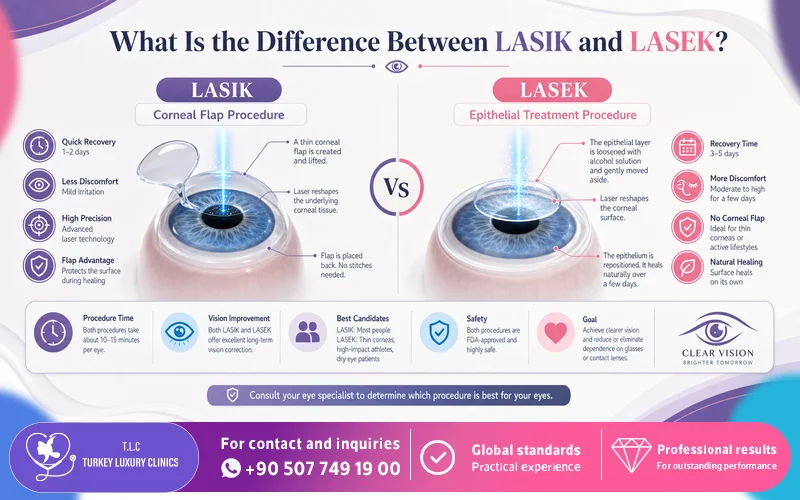
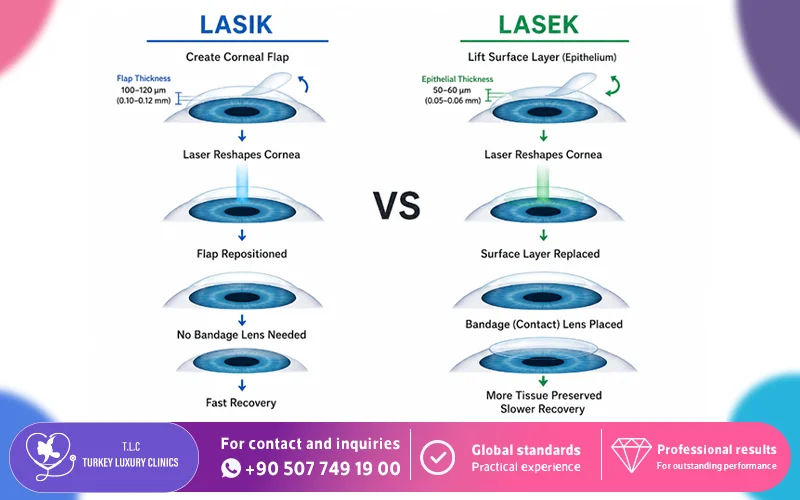
The key difference lies in the treatment approach. LASIK involves creating a thin corneal flap to access the underlying tissue, whereas LASEK gently loosens and lifts only the ultra-thin epithelial surface layer. This distinction affects recovery time, post-operative comfort, corneal biomechanics, and long-term structural stability.
Because both procedures use the same laser technology, the decision is not about which one delivers better vision correction. Instead, the choice depends on factors such as corneal thickness, lifestyle, recovery preferences, and overall eye anatomy.
What Is the Difference Between LASIK and LASEK?
Feature | LASIK | LASEK |
Flap Creation | A corneal flap is created involving epithelium and part of the stroma | No flap; only the superficial epithelial layer is loosened or removed |
Flap Depth | Deep flap, approx. 100+ μm | Surface layer only approx. ~50 μm |
Pain Discomfort | Minimal, for 2 to 4 hours. | Moderate to high, for 3 to 5 days |
Visual Recovery | Rapid, functional vision within 24 hours | Gradual; functional vision in 4–7 days |
Ideal Candidate | Patients with adequate corneal thickness and average prescriptions | Patients with thinner corneas, dry eyes, or a higher risk of eye trauma |
Corneal Requirements | Requires normal to thick corneas for safe flap creation | Suitable for thinner or structurally weaker corneas |
Flap Complications | Low risk, but possible complications | No flap-related complications |
Dry Eye Risk | Higher | Lower |
Cost (per eye) | Approximately $1,500 – $3,500 | Approximately $1,500 – $3,000 |
LASIK vs. LASEK: Which One is Better? Expert Opinion
There is no absolute “better” procedure in laser eye surgery; there is only the procedure that is clinically more suitable for your specific eye anatomy. Both surgeries use the same advanced excimer laser to reshape the cornea, meaning their final visual outcomes are highly comparable. In properly selected candidates, both procedures can achieve 20/20 vision or better, regardless of the chosen method.
LASIK is often “better” for lifestyle convenience: if you cannot afford downtime, want rapid visual recovery, and have normal corneal thickness, LASIK is usually the preferred option.
LASEK is often “better” for anatomical safety: if your corneas are naturally thin or your lifestyle carries a higher risk of eye trauma, LASEK may be the more suitable structural option.
LASIK vs. LASEK: Which is Safer?
Both procedures have excellent safety profiles, with patient satisfaction rates typically exceeding 95%. However, they differ in the type of risks associated with their surgical approach.
LASEK is generally safer for long-term structural integrity: because it does not involve creating a deep corneal flap, it eliminates flap-related complications such as dislocation, wrinkles, or debris beneath the flap. It also preserves more corneal tissue, which may reduce the risk of long-term structural weakening (ectasia).
LASIK is generally safer in the early healing phase: because the corneal flap acts as a natural protective layer, the eye surface is covered immediately after surgery, which may reduce early surface exposure risks during recovery.
LASIK vs LASEK for High Myopia
High myopia (severe short-sightedness) requires the laser to remove a larger amount of corneal tissue to achieve the desired vision correction. As the prescription strength increases, preserving enough corneal tissue becomes an increasingly important factor when choosing between LASIK and LASEK.
With LASIK, a thin corneal flap must be created before the laser reshapes the underlying tissue. Because flap creation consumes part of the cornea, some patients with high myopia and borderline corneal thickness may not have enough tissue remaining to safely undergo LASIK.
In these situations, LASEK may offer an advantage because it does not require a corneal flap, allowing more tissue to be preserved. This tissue-sparing approach can help maintain better long-term corneal stability while still providing excellent visual outcomes.
However, the decision is not based on prescription alone. Surgeons also evaluate corneal thickness, corneal topography, pupil size, and overall eye health before determining the most suitable procedure. In cases of extremely high myopia, some patients may be better candidates for an Implantable Collamer Lens (ICL), which corrects vision without removing corneal tissue.
LASIK vs LASEK for Astigmatism
Astigmatism occurs when the cornea has an irregular shape, causing light to focus unevenly on the retina and resulting in blurred or distorted vision. Both LASIK and LASEK are highly effective at correcting mild, moderate, and many cases of high astigmatism.
Modern LASIK systems use advanced eye-tracking and iris-registration technology to ensure precise alignment throughout treatment, allowing highly accurate correction of complex astigmatic errors. LASEK can achieve similarly excellent results and may be preferred in patients with thin corneas or those who are not ideal candidates for flap-based surgery.
For most patients, the choice between LASIK and LASEK is determined more by corneal anatomy and tissue availability than by the degree of astigmatism itself. When patients are appropriately selected, both procedures provide excellent long-term visual outcomes and high satisfaction rates.
LASIK vs LASEK for Dry Eyes
Dry eye is one of the most important factors when choosing between LASIK and LASEK. Because LASIK requires creating a corneal flap, more corneal nerves are temporarily disrupted during surgery, which can increase dryness during the healing period. LASEK preserves more of the cornea's natural nerve structure and is often preferred for patients with mild to moderate pre-existing dry eye symptoms. However, both procedures can cause temporary dryness, and the most suitable option depends on the severity of dry eye and the results of a comprehensive tear film assessment.
How to Choose Between LASIK and LASEK
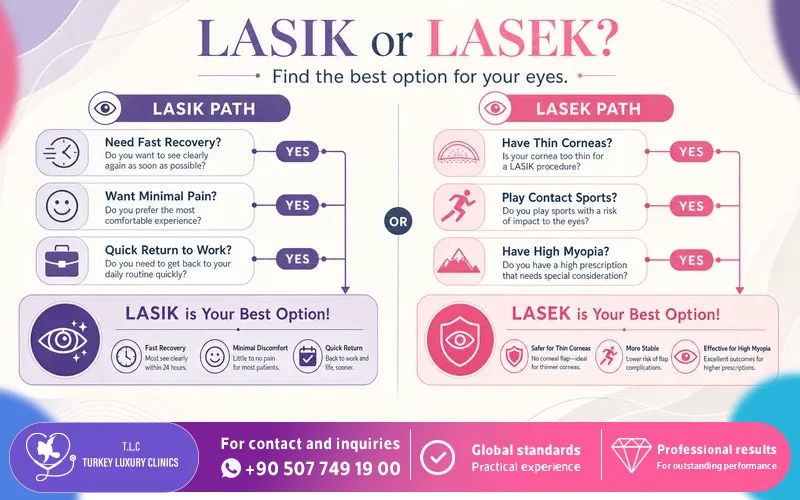
The best procedure depends on your corneal anatomy, prescription strength, lifestyle, and recovery preferences. A comprehensive eye examination is required to determine which option is most suitable.
LASEK may be a better choice if you:
- Have thin corneas
- Have high myopia requiring maximum tissue preservation
- Participate in contact sports such as boxing, martial arts, or rugby
- Work in the military, law enforcement, or other high-impact professions
- Have mild to moderate dry eye concerns
- Prefer to avoid flap-related risks
LASIK may be a better choice if you:
- Have adequate corneal thickness and healthy eye anatomy
- Want the fastest possible visual recovery
- Cannot take a week or more away from work or daily activities
- Prefer minimal post-operative discomfort
- Want clear functional vision within 24 to 48 hours
- Have a lifestyle with a low risk of eye trauma
LASIK vs. LASEK Recovery Time
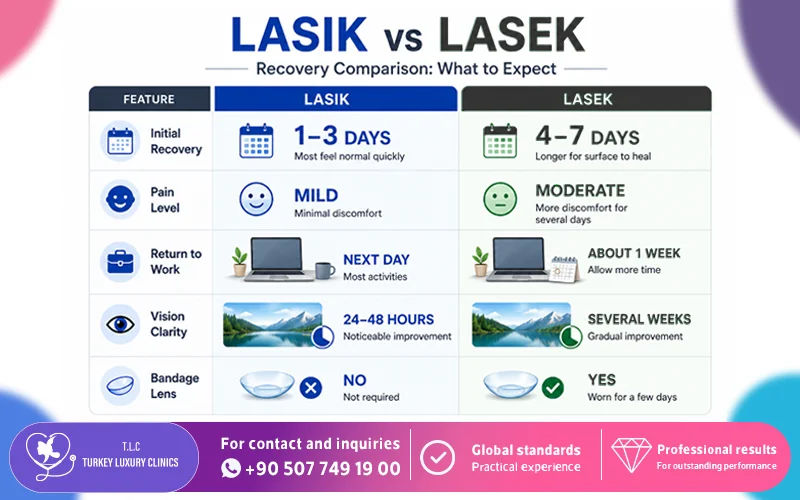
LASIK offers a significantly faster recovery than LASEK. Most LASIK patients achieve functional vision and return to work within hours with minimal discomfort. LASEK requires a longer, more uncomfortable healing period, taking 4 to 7 days for the initial surface healing and up to a few weeks for vision to fully stabilize.
Initial Recovery
Most LASIK patients experience clear functional vision within 24 to 48 hours and can often return to work the next day. In contrast, LASEK requires the corneal surface layer to heal and regenerate, resulting in a recovery period of approximately 4 to 7 days. While both procedures ultimately achieve similar visual outcomes, LASIK offers a significantly faster and more comfortable early recovery experience.
Pain and Comfort Differences
LASIK is generally associated with minimal discomfort. Most patients experience mild irritation, burning, or a gritty sensation for a few hours after surgery, with significant improvement by the next day.
LASEK involves surface healing of the cornea, making the first few days noticeably less comfortable. Patients commonly experience light sensitivity, watering, irritation, and moderate discomfort for three to five days while the epithelial layer regenerates.
Visual Recovery Differences
After LASIK, many patients achieve functional vision within 24 hours and can return to work or daily activities within one to two days.
After LASEK, vision typically remains blurry during the initial healing phase and gradually improves over the following days. Most patients regain functional vision within four to seven days, although complete visual stabilization may take several weeks.
LASIK vs. LASEK Recovery Timeline
Day 1
- LASIK: Vision is often noticeably clearer within hours, with minimal discomfort. Many patients can resume light activities such as reading or screen use the same day.
- LASEK: A protective bandage contact lens is placed. The eye may feel irritated, and vision is typically blurry as surface healing begins.
Days 3–5
- LASIK: Most patients return to normal routines, including driving and work, while continuing lubricating drops.
- LASEK: The most sensitive healing phase. Discomfort gradually improves, and the bandage lens is usually removed once the epithelial surface has sufficiently healed.
Weeks 1–2
- LASIK: Vision is generally stable, with night glare or halos gradually diminishing.
- LASEK: Visual clarity improves significantly as surface haze resolves and functional vision returns for daily activities.
Months 3–6
- LASIK: Corneal nerves continue to regenerate, and dry eye symptoms typically improve over time.
- LASEK: The corneal surface fully stabilizes, with long-term structural integrity maintained and no flap-related risks.
Why LASIK and LASEK Heal Differently
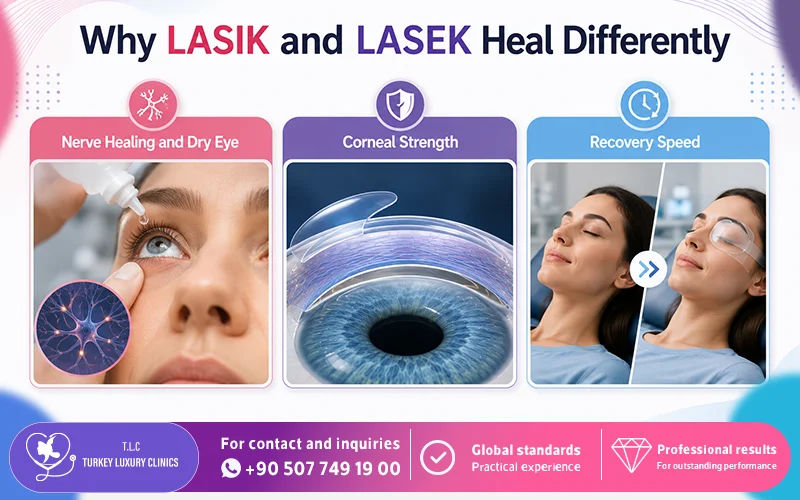
Although LASIK and LASEK use the same excimer laser to correct vision, they heal differently because they access the cornea in different ways.
Nerve Healing and Dry Eye: LASIK requires creating a corneal flap, which temporarily disrupts more corneal nerves and may increase dry eye symptoms during recovery. LASEK preserves more of the cornea's natural nerve structure and is often preferred for patients with mild dry eye concerns.
Corneal Strength: Because LASIK uses part of the cornea to create a flap, it removes more tissue overall. LASEK preserves more corneal tissue, making it a suitable option for patients with thinner corneas or higher prescriptions.
Recovery Speed: LASIK typically provides clear functional vision within 24 to 48 hours because the flap is repositioned immediately after treatment. In contrast, LASEK requires the surface epithelial layer to heal and regenerate, resulting in a slower recovery and several days of post-operative discomfort.
These differences explain why LASIK is generally chosen for faster recovery, while LASEK is often preferred when preserving corneal tissue is the priority.
LASIK vs. LASEK: Pros and Cons
To understand the differences clearly, it is important to focus on the trade-off between faster visual recovery and long-term structural preservation.
Pros of LASIK Eye Surgery
- Rapid visual recovery: many patients see clearly within 12 to 24 hours
- Minimal discomfort: typically only mild irritation or a gritty sensation for a short period
- Fewer early post-operative follow-ups in many cases
Cons of LASIK Eye Surgery
- Flap-related considerations: Although stable, the flap does not fully regain the original biomechanical strength of untouched corneal tissue
- Temporary dry eye symptoms due to corneal nerve disruption
- Requires sufficient corneal thickness for safe treatment
Pros of LASEK Eye Surgery
- No flap-related complications
- Greater preservation of corneal tissue
- Often preferred for thinner corneas and high-risk physical activities
- Potentially lower long-term dry eye risk in some patients
Cons of LASEK Eye Surgery
- More discomfort during early healing (3 to 5 days)
- Slower visual recovery, with blurred or hazy vision for 1 to 2 weeks
- Requires longer use of medicated eye drops to support healing and reduce haze risk
LASIK vs. LASEK Cost: 2026 Prices
Country | LASIK Average Cost (Both Eyes) | LASEK Average Cost (Both Eyes) |
Turkey | $1,400–$2,500 | $1,500–$2,700 |
United Kingdom | $4,000–$6,000 | $4,000–$6,000 |
United States | $4,000–$7,000 | $4,000–$6,500 |
In most clinics, the cost difference between LASIK and LASEK is relatively small. Pricing is influenced more by surgeon experience, clinic reputation, laser technology, and post-operative care than by the procedure itself. While LASIK may be slightly more expensive in some clinics because of the technology required to create the corneal flap, many providers charge similar fees for both procedures.
LASIK vs LASEK Results and Success Rate
Both LASIK and LASEK have among the highest success and patient satisfaction rates in modern elective surgery. When performed on appropriately selected candidates, the visual outcomes of both procedures are remarkably similar.
Once healing is complete, the majority of patients achieve 20/20 vision or better, with long-term satisfaction rates consistently exceeding 95%.
While LASIK provides faster visual recovery, long-term visual performance is generally comparable between the two procedures.
Once healing is complete, both LASEK and LASIK deliver permanent results. The laser-induced corneal reshaping is permanent, whether it is used to correct myopia, hyperopia, or astigmatism. However, age-related vision changes such as presbyopia may still develop later in life.
Visual Acuity Outcomes
Large clinical studies have shown that more than 95% of patients achieve 20/20 vision or better after either LASIK or LASEK, with many achieving even sharper unaided vision depending on their preoperative prescription and eye health.
Once healing is complete, long-term visual outcomes are highly comparable between the two procedures. Both LASIK and LASEK deliver permanent vision correction, and the corneal reshaping performed by the excimer laser does not wear off over time. However, natural age-related vision changes such as presbyopia may still occur later in life.
Patient Satisfaction
Patient satisfaction rates consistently exceed 95% for both procedures. Most patients report significant improvements in quality of life, freedom from glasses or contact lenses, and overall visual comfort.
Enhancement (Touch-Up) Rate
A small percentage of patients may experience under-correction or over-correction following treatment. In these cases, an enhancement procedure (second LASEK or LASIK) can often be performed once vision has stabilized, provided sufficient corneal tissue remains available.
LASIK vs LASEK: Long-Term Corneal Stability
Both LASIK and LASEK provide excellent long-term vision correction and are considered safe when performed on suitable candidates. The main difference is that LASIK requires creating a corneal flap, while LASEK preserves more of the cornea's natural structure. As a result, LASEK may be preferred for patients with thin corneas, high prescriptions, or those involved in contact sports. For patients with healthy, adequately thick corneas, both procedures offer excellent long-term visual stability with a low risk of serious complications.
LASIK vs LASEK Procedure: What Happens During Surgery?
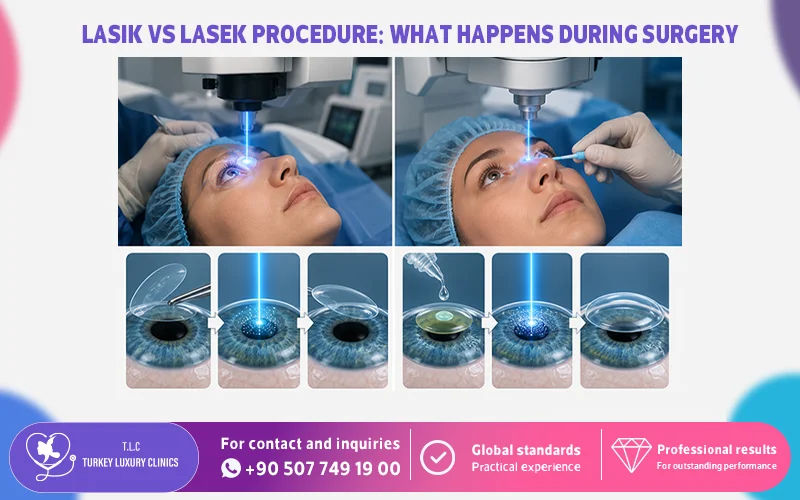
Although LASIK and LASEK use the same excimer laser to correct refractive errors, the way the surgeon accesses the treatment area is fundamentally different.
During LASIK, a thin corneal flap is created using either a femtosecond laser or a microkeratome. The flap is gently lifted, allowing the laser to reshape the underlying corneal tissue. Once the correction is complete, the flap is repositioned, where it naturally adheres without stitches.
During LASEK, no corneal flap is created. Instead, the surgeon loosens the thin epithelial surface layer using a specialized alcohol solution. After the laser reshapes the cornea, the epithelial layer is repositioned and protected with a temporary bandage contact lens while healing occurs.
Because LASIK treats the cornea beneath a flap, visual recovery is typically faster and discomfort is minimal. LASEK preserves more corneal tissue and eliminates flap-related concerns, but it requires a longer healing period while the surface layer regenerates.
How Do LASIK and LASEK Compare With PRK?
PRK is the closest procedure to LASEK. The key difference is that LASEK preserves and repositions the epithelial layer, whereas PRK removes it completely and allows it to regenerate naturally during healing.
Because of this, visual recovery and post-operative discomfort are generally similar, although some surgeons believe preserving the epithelial layer may offer a slightly more comfortable early healing experience.
In terms of long-term vision outcomes, PRK and LASEK are considered largely equivalent and are often chosen for patients who may not be ideal candidates for flap-based surgery.
LASIK vs LASEK vs SMILE
The main difference is that SMILE does not require either a corneal flap or surface epithelial healing. Instead, a small lenticule of tissue is removed through a tiny incision inside the cornea.
As a result, SMILE combines some of the tissue-preserving advantages associated with LASEK while offering a recovery experience closer to LASIK. It may also cause fewer dry eye symptoms in some patients because fewer corneal nerves are disrupted during the procedure.
However, SMILE is primarily used for myopia and myopic astigmatism and may not be suitable for all refractive errors.
Why Choose Turkey for LASIK or LASEK Eye Surgery
Turkey has become one of the world's leading destinations for laser eye surgery because it combines internationally accredited clinics, experienced refractive surgeons, and advanced laser technology at significantly lower prices than the UK or the United States.
The lower cost is primarily driven by economic factors, lower operating expenses, and high patient volumes rather than reduced quality of care. Many clinics also include accommodation, airport transfers, medications, and post-operative follow-up visits within the treatment package, providing additional value for international patients.
Which Procedure Is Right for Your Eyes: LASIK or LASEK?
While both LASIK and LASEK can provide excellent vision correction, the best option depends on factors such as corneal thickness, corneal shape, dry eye status, lifestyle, and long-term visual goals.
A comprehensive eye examination is the only way to determine which procedure is safest and most suitable for your eyes.
Schedule a personalized consultation with an experienced refractive surgeon to receive a tailored treatment recommendation and find out whether LASIK, LASEK, SMILE, or another vision correction procedure is the best fit for your unique eye anatomy.
FAQs About LASIK vs LASEK Surgery