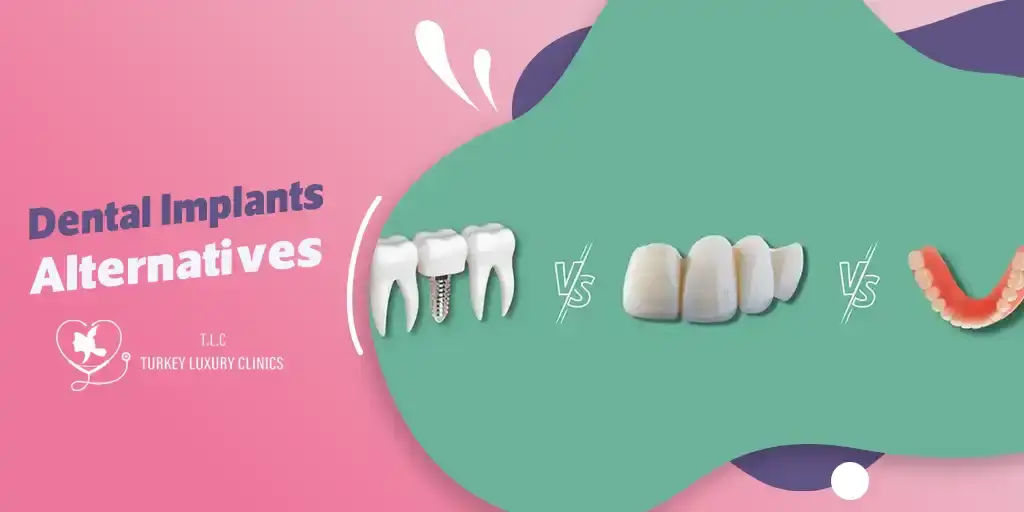


- What are the Alternatives to a Dental Implant?
- Dental Bridges vs Dentures as Alternatives to Implants
- Dental Implant Alternatives for Single, Multiple, and Full Mouth Tooth Replacement
- What Is a Cheap Alternative to Dental Implants?
- Why Choose an Alternative to Dental Implants?
- How to Choose the Right Dental Implant Alternatives?
- How Turkey Luxury Clinics Help
If you don't want a dental implants, , the main alternatives for missing teeth are fixed dental bridges, resin-bonded (Maryland) bridges, removable partial dentures, and full dentures. These tooth replacement options can restore one, several, or all missing teeth without requiring conventional dental implants.
Bridges are generally better suited for one or a few missing teeth when suitable supporting teeth are available, while partial or full dentures can replace multiple teeth and are usually less expensive and non-surgical.
Other options include flipper teeth for temporary tooth replacement and mini dental implants as a less invasive alternative to conventional implants.
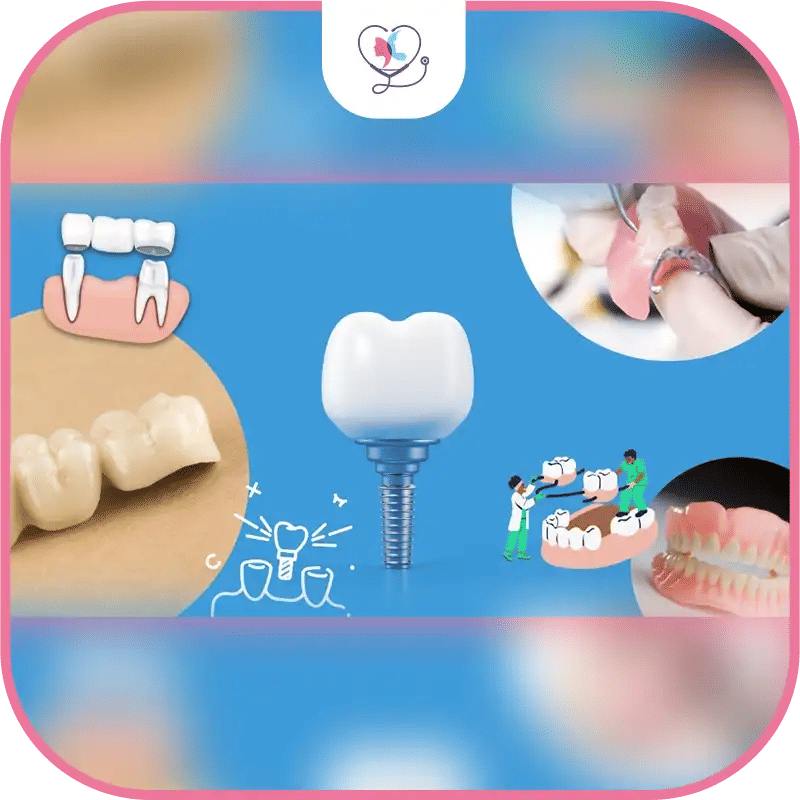
What are the Alternatives to a Dental Implant?
The primary non-surgical alternatives to dental implants are dental bridges and removable dentures
Traditional Dental Bridges
Classic dental bridges are one of the most common alternatives to dental implants, offering a strong and durable solution for replacing missing teeth.
They are often preferred when faster results, shorter recovery times, and a less invasive approach are desired, while also being more affordable than implants.
Classic bridges are particularly effective as dental implant alternatives for molars, using adjacent teeth as anchors to support the false tooth or teeth, restoring both function and appearance.
The main drawback of a traditional dental bridge is that the supporting teeth usually need to be reshaped to accommodate crowns, which means removing some healthy tooth structure. Unlike a dental implant, a bridge also does not replace the missing tooth root or stimulate the jawbone in the area of the missing tooth.
Resin-Retained Bridge (Maryland)
Maryland bridges are a conservative and less invasive alternative to traditional dental bridges. They look, feel, and function like natural teeth, but unlike classic bridges, they require minimal preparation of the supporting teeth. In most cases, no anesthesia or extensive crown shaping is needed.
The replacement tooth is held in place by thin metal or porcelain wings bonded to the back surfaces of the adjacent teeth, making it a non-surgical solution for missing teeth. Maryland bridges are especially suitable for front teeth due to their minimal invasiveness and natural appearance. However, they are generally less durable than other bridge types and may not withstand the heavy chewing forces typical of back teeth.
Cantilever Bridges
While traditional bridges require reshaping healthy teeth on both sides of the gap, cantilever bridges offer an alternative attachment method. They use one or more projecting structures, called cantilevers, anchored to a single adjacent tooth to support the replacement tooth.
This makes cantilever bridges a quicker, more affordable, and non-surgical dental implant alternative. They are especially suitable when only one tooth is missing and there is sufficient support from neighboring teeth, providing a conservative solution without extensive dental work.
The main limitation is that all biting forces are transferred to the supporting tooth, so cantilever bridges are generally reserved for carefully selected cases and may not be suitable for areas exposed to heavy chewing forces.
Removable Partial Dentures
A removable partial denture (RPD) is a set of replacement teeth that fits over the gums and attaches to your natural teeth. It restores chewing, speech, and appearance and can be easily removed for cleaning.
A removable partial denture is designed to replace a specific number of missing teeth for patients who want to restore function or aesthetics but may have financial, health, or personal limitations that prevent them from choosing implants or bridges.
Partial dentures are less invasive, more affordable, and simpler than dental implants or traditional bridges.
They are custom-made and can be easily removed for cleaning. Removable partial dentures are the simplest, fastest, and most affordable non-surgical alternative for replacing missing teeth.
They are especially suitable for patients with low bone density, no healthy teeth to support a bridge, or those seeking a non-surgical, less invasive tooth replacement option
However, partial dentures may not feel as natural in appearance or function as permanent options. They require regular cleaning and may need periodic adjustments or replacements to maintain comfort and proper fit.
Full Removable Dentures
Full dentures are a less complex and more affordable solution to restore a smile and the ability to chew and speak normally. They are especially popular among elderly patients with a limited number of healthy teeth, low bone density, gum problems, or those who cannot undergo invasive procedures.
Full dentures consist of a removable set of artificial teeth that replace all missing teeth in a dental arch. These custom-made dentures have artificial teeth on a pink gum-like base that fits over the gums and can be removed at night.
Drawbacks of removable dentures include a less natural feel and function compared to permanent options, the need for regular cleaning, possible periodic adjustments or replacements, and they may slip or shift while eating or speaking.
You may like: Dental Implants vs Dentures: Compare All Types for Missing Teeth
Flipper Teeth
Flippers are lightweight, temporary teeth replacements used as a short-term solution. They act as an interim option while a patient waits for a more permanent restoration. Simple and inexpensive, flippers are popular among patients who want a quick fix without a large investment. However, they are not intended for long-term use and are best suited as a temporary, budget-friendly solution.
Mini Dental Implants
Mini dental implants are smaller-diameter implants used to support dentures or replace individual teeth with minimal invasiveness. They are less expensive and require less bone than traditional implants, making them a practical solution for patients with limited bone density or those seeking a faster, less invasive procedure.
However, mini implants are still surgically placed implants and are not suitable for every type of tooth replacement or every patient.
Dental Bridges vs Dentures as Alternatives to Implants
Dental bridges are fixed tooth replacements that use neighboring teeth for support, while dentures are removable appliances that can replace several teeth or an entire arch. Bridges generally provide greater stability and a more fixed feel, while dentures are usually more affordable and can replace more missing teeth without surgery.
Factor | Dental Bridges | Removable Dentures |
Fixed or removable | Fixed | Removable |
Best suited for | One or a few missing teeth | Several or all missing teeth |
Surgery required | No | No |
Support | Adjacent teeth | Gums/remaining oral structures |
Adjacent tooth preparation | Usually required for traditional bridges | Usually not required |
Stability | Higher; fixed in place | Lower; may move during function |
Jawbone stimulation | No | No |
Cost | Generally higher | Generally lower |
Cleaning | Cleaned in place and underneath | Removed for cleaning |
Treatment time | Usually weeks | Usually weeks |
Read more about: Dental implant vs, bridges and discover which is best for you
Dental Implant Alternatives for Single, Multiple, and Full Mouth Tooth Replacement
The best dental implant alternative depends on how many teeth are missing, where they are located, whether you want a fixed or removable replacement, your bone and oral health, and your budget. Dental bridges are commonly used for one or a few missing teeth, removable dentures are suitable for multiple or full-arch tooth loss, and flipper teeth provide a temporary solution. Mini dental implants may also be considered in selected cases, although they still involve placing an implant in the jaw.
Situation | Best Dental Implant Alternatives |
Single Missing Tooth | Traditional Dental Bridge, Maryland Bridge, Cantilever Bridge, Mini Dental Implant |
Missing Front Tooth | Maryland Bridge, Traditional Dental Bridge, Flipper Tooth (temporary) |
Missing Molar | Traditional Dental Bridge, Mini Dental Implant, selected Cantilever Bridge cases |
Multiple Missing Teeth | Traditional Dental Bridge, Removable Partial Denture, Mini Dental Implants |
Most Teeth Missing | Removable Partial Denture or Full Denture, depending on remaining natural teeth |
Full Mouth | Full Removable Dentures |
Temporary Tooth Replacement | Flipper Tooth / Flipper Denture |
Non-Surgical Alternative | Dental Bridge or Removable Denture |
What Is a Cheap Alternative to Dental Implants?
Removable partial dentures and flipper teeth are among the cheapest alternatives to dental implants. Flipper teeth are typically the lowest-cost option for temporary tooth replacement, while removable partial dentures provide a more practical long-term, non-surgical option for replacing missing teeth.
Other affordable alternatives include Maryland bridges and traditional dental bridges. Bridges generally cost more than removable dentures but provide a fixed, non-removable replacement. Mini dental implants may also cost less than conventional implants, although they still require implant placement in the jaw.
Cheap Dental Implant Alternative | Typical USA Cost |
Flipper Tooth | $300–$500 |
Removable Partial Denture | $600–$2,000 |
Maryland Bridge | $700–$2,000 |
Traditional Dental Bridge | $2,000–$5,000 |
Why Choose an Alternative to Dental Implants?
To find an affordable, budget-friendly option: Implants are expensive and not affordable for everyone.
If you have health issues that prevent implants: Certain medical conditions, medications, or healing problems may affect implant candidacy and require an alternative treatment plan.
If you have poor jawbone health or low bone density: Implants need enough bone to attach; low bone may require extra procedures or alternative solutions.
To get faster results and shorter recovery: Implant treatment takes several months; some people prefer quicker solutions.
If you prefer a non-surgical or less invasive tooth replacement: Some patients prefer to avoid implant surgery and choose bridges or removable dentures instead.
If you have poor oral health or gum issues: Gum disease or other oral health problems can make implants risky or impossible. Explore if dental implants are right for you? 
How to Choose the Right Dental Implant Alternatives?
- Number of Missing Teeth: If you have only one or a few missing teeth, dental bridges are usually the best solution.
- Location of Missing Teeth: Bridges work well when the gaps are scattered, while dentures may be better for larger areas.
- Condition of Adjacent Teeth: Healthy neighboring teeth are necessary for certain bridges, so their condition affects your choice.
- Bone Density: Low bone density can limit implant options, making dentures or mini implants more suitable.
- Chewing and Speech Ability: Bridges can improve chewing and speech for some patients, while dentures can be effective for others.
- Comfort: Bridges are generally more comfortable, but some patients prefer the feel of well-fitted dentures.
- Appearance: Bridges tend to look more natural compared to dentures.
- Budget and Cost: Dentures are often more affordable, while bridges and implant-supported solutions can be a higher investment.
How Turkey Luxury Clinics Help
Choosing the right dental solution depends on your budget, oral health, and aesthetic goals. Get a personalized consultation and professional guidance to find the most suitable option for your smile. Contact our experienced dental team today—we can help you restore your teeth with comfort, safety, and confidence.