

- Is Parkinson's Fatal?
- Does Parkinson’s Kill You?
- What Do Parkinson's Patients Usually Die From?
- How Does Parkinson’s Kill Patients?
- Causes of Death in Parkinson Patients
- Why Does Parkinson’s Kill You?
- Does Parkinson’s Kill You Early?
- How Long Does it Take for Parkinson’s to Kill You?
- Symptoms of the End Stages of Parkinson’s?
- How to Improve Parkinson's Patients’ Life?
- FAQS About Does Parkinson's Kill You
Parkinson's disease is not directly fatal. It does not kill people on its own, and many older adults with Parkinson's die from age-related or other medical conditions rather than from Parkinson's disease itself. However, as the disease progresses, it can lead to life-threatening complications that may ultimately be fatal.
Parkinson's disease is a progressive neurological disorder that primarily affects movement. While many people with Parkinson's have a normal or near-normal life expectancy, advanced stages of the disease can impair swallowing, breathing, and mobility, increasing the risk of serious complications such as aspiration pneumonia, falls, and infections.
In this article, you'll learn whether Parkinson's disease is fatal, how Parkinson's can lead to death, the most common causes of death in people with Parkinson's, life expectancy after diagnosis, and the warning signs of advanced Parkinson's disease.
Is Parkinson's Fatal?
Parkinson's disease itself is not considered directly fatal, and many people with PD have a normal or near-normal life expectancy. Most people live for many years after diagnosis, especially with appropriate treatment and supportive care that protect from secondary complications. Unlike a heart attack or stroke, Parkinson's disease does not directly affect vital organs or cause sudden death. With early diagnosis, proactive medical management, and therapies, many individuals successfully maintain a high quality of life for decades. With early diagnosis, proactive medical management, and therapies, many individuals successfully maintain a high quality of life for decades.
Does Parkinson’s Kill You?

No, Parkinson's disease does not directly kill you, but secondary complications from the disease can be fatal, making it a condition that may reduce life expectancy. While many people with Parkinson's live 10, 15, or even 20 years after diagnosis, their life expectancy may be around 5% to 10% lower than that of people without Parkinson's disease. Life-threatening complications can occur unexpectedly, including choking, falls and fractures, and aspiration pneumonia, particularly in older patients.
Parkinson's disease is a neurodegenerative and in the early and mid stages, Parkinson’s affects external body movement, coordination, and muscle control, but these changes are rarely dangerous. However, in late stages, the disease can interfere with essential functions such as swallowing, breathing, and mobility. These changes can lead to conditions that may become life-threatening if not managed properly.
What Do Parkinson's Patients Usually Die From?
People with Parkinson's disease usually die from complications of advanced disease rather than from Parkinson's disease itself. The most common causes of death include:
- Aspiration pneumonia (the leading cause)
- Choking caused by swallowing difficulties (dysphagia)
- Severe falls, head injuries, and hip fractures
- Urinary tract infections (UTIs)
- Pressure ulcer infections in bed-bound patients
- Blood clots caused by prolonged immobility
- Complications of advanced Parkinson's disease dementia
- Respiratory infections and, in some cases, respiratory failure
How Does Parkinson’s Kill Patients?
Parkinson's disease itself is not directly fatal. However, as the disease progresses, it can lead to secondary complications that may eventually cause death. People with Parkinson's disease are at a much higher risk of developing these complications because the disease affects swallowing, balance, mobility, and muscle control. In the advanced stages, patients may develop difficulty swallowing (dysphagia), severe mobility impairment, recurrent choking episodes, and weakened respiratory muscles. These problems increase the risk of aspiration pneumonia, serious infections, falls, fractures, and airway obstruction, which are the leading causes of death in Parkinson's disease.
Causes of Death in Parkinson Patients
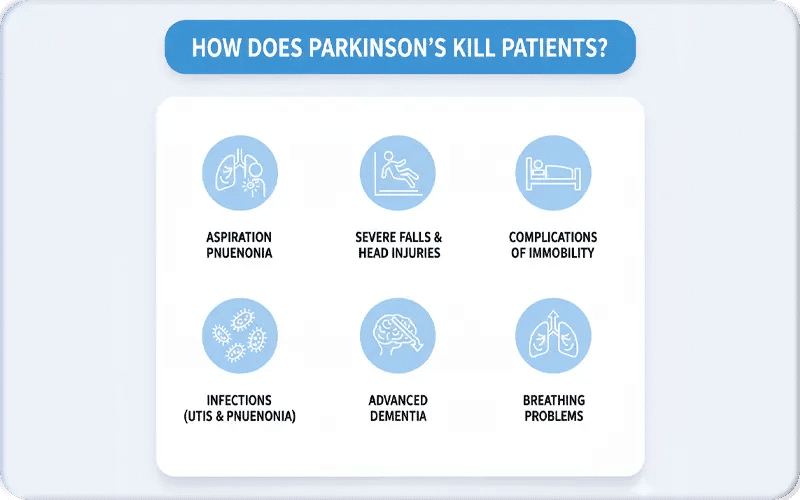
Aspiration pneumonia is the most common cause of death in Parkinson's disease. Other common causes include severe falls and head injuries, urinary tract infections, pressure ulcer infections, blood clots caused by immobility, and complications related to advanced dementia.
1. Aspiration Pneumonia
Aspiration pneumonia is the most common cause of death in Parkinson’s patients, accounting for approximately 70% of cases. It develops when food or liquids accidentally enter the lungs due to swallowing difficulties (dysphagia), which often occur in the late stages of Parkinson’s disease.
As the muscles used for swallowing weaken, patients become more vulnerable to inhaling food or fluids, leading to severe lung infections.
Early recognition of warning signs, such as choking while drinking, coughing after meals, difficulty swallowing pills, and repeated respiratory tract infections, can allow timely intervention and significantly reduce the risk of life-threatening complications. Proper management, including swallowing assessments and medical care, is essential to protect patients’ health in advanced Parkinson’s stages.
2. Severe Falls and Head Injuries
The risk of falls increases as Parkinson’s progresses to moderate stages and patients begin to lose gait and balance. This is a serious problem, as falls can lead to significant injuries such as fractures, head trauma, or internal injuries.
In some cases, complications from these injuries, like brain hemorrhage or hip fractures, can be life-threatening. Severe falls are therefore one of the ways Parkinson’s indirectly contributes to death, emphasizing the need for balance training, home safety measures, and careful monitoring for patients with advancing disease.
3. Complications of Severe Immobility
As Parkinson’s progresses, some patients may become almost fully dependent or bed-bound. This severe immobility increases the risk of blood clots, pressure ulcers that can become infected, muscle wasting, and weakened respiratory function. Over time, these complications can seriously affect overall health and contribute indirectly to life-threatening outcomes.
4. Infections (UTIs and Pneumonia)
Limited mobility, weakened immunity, and difficulty emptying the bladder make patients more prone to infections such as urinary tract infections and bacterial pneumonia. If not detected and treated early, these infections can become severe and further compromise the patient’s health.
5. Advanced Dementia
Some individuals with Parkinson’s develop dementia in the later stages. This can cause difficulty eating, increase the risk of malnutrition, and lead to confusion that hinders proper care. While dementia itself is not directly fatal, it often contributes to complications that can become life-threatening. Life expectancy is shorter for those with Parkinson's disease and dementia compared to those with Parkinson's alone
6. Breathing Problems
In advanced Parkinson’s, stiffness of the chest muscles can make breathing shallow and weak. This increases the risk of chronic respiratory infections, low oxygen levels, and, in rare cases, respiratory failure. These breathing difficulties can significantly affect overall survival if not managed properly.
Why Does Parkinson’s Kill You?
Parkinson’s can become fatal due to the progressive degeneration of neurons in the brain, especially dopamine-producing cells. The mitochondria in these cells lose efficiency and fail to generate enough energy, toxic byproducts accumulate, and the protein alpha-synuclein misfolds and clumps, disrupting cell function. This gradual neural breakdown affects movement, swallowing, breathing, and other vital bodily functions, leaving the body vulnerable to serious complications that can eventually lead to death.

In the end Parkinson’s gradually affects muscles all over the body, not just those involved in movement. In advanced phases, this includes:
- muscles needed to swallow
- muscles needed to breathe
- muscles that help maintain posture
- muscles that support walking and balance
Once these muscles weaken severely, the body becomes vulnerable to complications such as pneumonia, falls, blood clots, and infections. These complications—not the condition itself—are what typically cause death.
Does Parkinson’s Kill You Early?
Parkinson’s rarely causes early death. However, certain factors can shorten life expectancy, including diagnosis at an older age, a rapidly progressing disease type, severe balance problems early in the disease, Parkinson’s disease dementia, frequent aspiration episodes, unmanaged infections, and major falls. Patients with these risk factors require close monitoring and proactive care to manage complications and maintain quality of life.
How Long Does it Take for Parkinson’s to Kill You?
On average, people with Parkinson's live about 10 to 20 years after diagnosis, but this varies significantly.The life expectancy for people with Parkinson’s disease is typically around 15 years after diagnosis, although some patients live for more than 20 years. Older patients diagnosed after age 70 often experience faster progression.
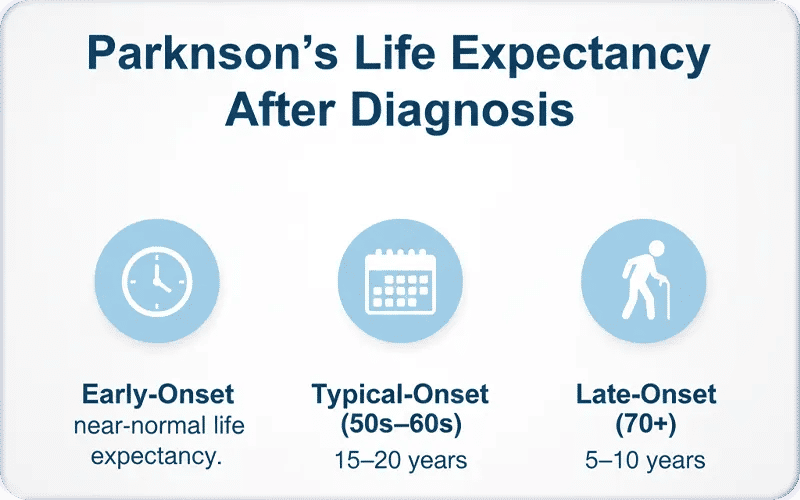
Average life expectancy after diagnosis:
- Early-onset Parkinson’s: near-normal life expectancy
- Typical-onset (50s–60s): 15–20 years on average
- Late-onset (70+): 5–10 years on average
These figures are approximate because Parkinson’s disease itself does not directly cause death. Instead, life expectancy is influenced by age at diagnosis, disease progression, and the management of complications such as aspiration pneumonia, falls, and infections. With proper care and monitoring, many patients can live for years and ultimately die from causes unrelated to Parkinson’s.
Parkinson’s disease usually progresses slowly. Symptoms worsen gradually over several years, often in predictable stages:
- Early stage: mild symptoms, full independence
- Mid-stage: more noticeable motor symptoms, medication dependence
- Advanced stage: mobility problems, swallowing difficulties, cognitive changes
- End stage: full dependence and risk of life-threatening complications
Factors that Influence Parkinson’s Patients' Life Expectancy
- Age of onset: Younger-onset Parkinson’s can sometimes lead to a longer course, but may also affect quality of life differently compared to late-onset disease.
- Disease progression rate: Some patients experience slow, relatively mild progression, while others have more aggressive symptoms.
- Overall health: General health at diagnosis, including heart, lung, and metabolic conditions, impacts survival.
- Quality of care: Access to medical care, rehabilitation, and proactive management of symptoms can significantly improve long-term outcomes.
Symptoms of the End Stages of Parkinson’s?
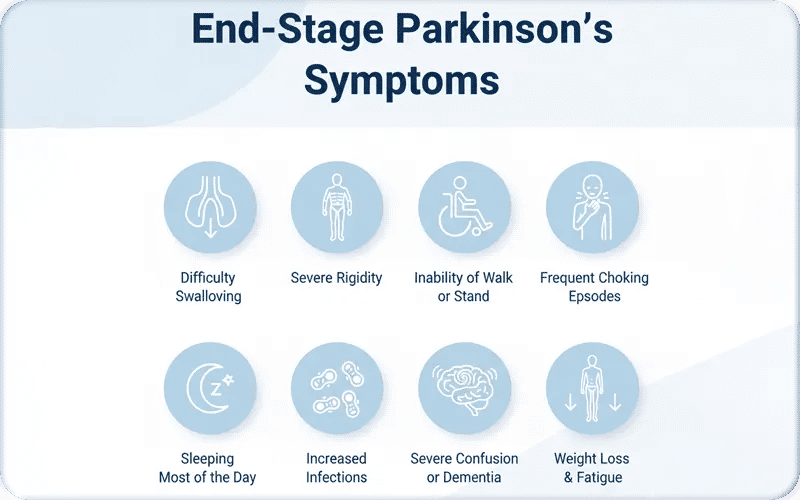
End-stage Parkinson’s marks the most advanced phase of the disease, where symptoms become severe and daily functioning is heavily impacted. Recognizing these signs early helps families and caregivers provide proper support and reduce the risk of life-threatening complications. Common signs include:
- difficulty swallowing (dysphagia)
- severe rigidity
- inability to walk or stand
- frequent choking episodes
- sleeping most of the day
- increased infections
- severe confusion or dementia
- weight loss and fatigue
During this phase, families often work with palliative care teams to keep the patient comfortable and reduce the risk of dangerous complications.
How to Improve Parkinson's Patients’ Life?
Although Parkinson's disease cannot be prevented, certain lifestyle habits may help reduce the risk. Advances in medical treatments have made it possible to manage Parkinson’s symptoms more effectively and improve daily functioning.
While these interventions can not prevent the progression of Parkinson’s disease, they provide significant improvements in daily functioning, independence, and overall quality of life during the later stages.
These therapies focus on reducing tremors, enhancing mobility, and maintaining independence even in advanced stages.
Deep Brain Stimulation (DBS):
DBS involves implanting electrodes in specific brain areas to regulate abnormal signals. It can significantly reduce tremors, stiffness, and motor fluctuations. While it doesn’t stop disease progression, it improves movement, balance, and daily functioning.
Magnetic Resonance-guided Focused Ultrasound (MRgFUS):
MRgFUS is a non-invasive procedure that uses focused ultrasound waves to target brain regions causing tremors. It can reduce severe tremors and improve hand coordination. This treatment enhances quality of life without the need for surgical implants.
Read more about life after DBS surgery
FAQS About Does Parkinson's Kill You