

- Breast Fat Transfer in Turkey Before and After
- Cost of Fat Transfer Breast Augmentation in Turkey (2026 Prices)
- Best Fat Transfer Breast Augmentation Surgeons in Turkey 2026
- Is Fat Transfer Breast Augmentation Safe in Turkey? Safety Standards & Regulations
- Patient Reviews & Experiences at Turkey Luxury Clinics
- Step-by-Step Breast Fat Transfer in Turkey for International Patients
- Breast Fat Transfer in Turkey Recovery Timeline
- How Much Volume Can Increase with Breast Fat Transfer?
- Fat Survival Rate & How to Improve Results
- Fat Transfer Breast Augmentation Risks and Side Effects
- Who is the Ideal Candidate for Fat Transfer Breast Augmentation?
- Fat Transfer Breast Augmentation vs Implant Breast Augmentation
- Get 100% Natural Breast and Body Contouring with TLC
- FAQs About Fat Transfer Breast Augmentation
Fat transfer breast augmentation in Turkey has become a highly popular option for natural breast enhancement with100% natural feeling and appearance showing subtle, not very large, and harmonious, aligning with 2026 modern aesthetic trends that favor natural, proportional curves rather than exaggerated enlargement.
What makes fat transfer really brilliant is its dual benefit of the autologous grafting: it removes unwanted fat from areas such as the abdomen or thighs and repurposes it to enhance the breasts, effectively sculpting two areas with one procedure.

With no implants, no foreign bodies, and minimal downtime, it represents a safe aesthetic and body contouring procedure and offers the ultimate solution for refining your silhouette while reclaiming natural confidence.
Turkey Luxury Clinics surgeons, including Prof. Dr. Ayşe Öztürk, and other elite plastic surgeons are board-certified plastic surgeons with European affiliations and over 10 years of experience. These experts provide a natural lift while simultaneously contouring donor areas like the abdomen or thighs.
Take the first step toward a beautifully balanced silhouette. Book a free consultation.
Breast Fat Transfer in Turkey Before and After
Cost of Fat Transfer Breast Augmentation in Turkey (2026 Prices)
The cost of fat transfer breast augmentation in Turkey ranges between $3,000 and $6,000, depending on technique, surgeon expertise, and clinic reputation. The price includes your consultation, liposuction and fat transfer procedure, anesthesia, hospital or clinic fees, operating room use, and post-operative care.
Fat Transfer Breast Augmentation Cost in Turkey vs the US and the UK
Country | Average Cost | What’s Included |
Turkey | $3,000 – $6,000 | Surgery + liposuction + anesthesia + hospital + hotel + VIP transfers + aftercare |
UK | $8,500 – $17,000 | Surgery + hospital + anesthesia |
USA | $10,000 – $20,000+ | Surgery + hospital + anesthesia |
Patients traveling to Turkey can save 50% to 70% compared to the UK and US, while still receiving high-quality care and a fully managed medical travel experience.
Turkey’s competitive pricing is driven by lower operational costs, high surgical volume, and a well-developed medical tourism sector, without compromising on safety standards. Procedures are typically performed in accredited hospitals by experienced, board-certified plastic surgeons using advanced fat grafting techniques.
Book a free consultation to get a personalized treatment plan, exact pricing, and a detailed breakdown of your all-inclusive fat transfer breast augmentation package in Turkey.
How Much Do You Save with Breast Fat Transfer in Turkey?
Country | Fat Transfer Breast Aug. (2026) | Turkey Savings |
Turkey | $3,500 – $5,500 | Reference |
USA | $9,000 – $18,000 | ~65% |
UK | $8,500 – $14,000 | ~60% |
Germany | $7,500 – $11,000 | ~55% |
Thailand | $4,500 – $7,000 | ~25% |
This means you can often combine surgery, travel, and recovery in Turkey for less than the surgery alone in many Western countries while receiving comparable quality of care in internationally accredited hospitals and qualified surgeons.
Factors Affecting Fat Transfer Breast Augmentation Cost in Turkey
- Fat Volume & Donor Sites: Larger transfers or “360-degree” liposuction (abdomen, flanks, back) increase surgical time and cost.
- Harvesting Technique: Advanced methods like VASER (ultrasound) or PAL (power-assisted) liposuction cost more but improve fat survival rates.
- Fat Processing Technology: Using Stem Cell Enrichment (SVF) or closed-system centrifugation adds a premium to increase fat survival.
- Surgical Complexity: Correcting asymmetry or combining with implants (Hybrid Breast Augmentation) requires advanced planning and higher fees.
- Combined Procedures: Adding a breast lift (mastopexy) raises the price due to longer operating room time.
- Surgeon Expertise & Clinic Tier: Board-certified surgeons with international fellowships (e.g., EBOPRAS) and clinics in Istanbul or luxury Antalya facilities charge higher fees. Accreditation, like JCI, also affects cost.
All-Inclusive Fat Transfer Breast Augmentation Packages in Turkey (2026)
Fat transfer breast augmentation in Turkey is often offered as an all-inclusive package costing between an $3,500 and $6,000an
What’s Included in a Fat Transfer Breast Package in Turkey?
- Surgical & Facility Fees: Surgeon fees, anesthesia, and 1–2 nights of hospital stay
- Advanced Liposuction: Typically includes VASER or PAL harvesting to maximize fat-cell viability
- Logistics: VIP airport–hotel–clinic transfers
- Accommodation: 5–7 nights in a 4- or 5-star hotel, essential for the initial recovery period
- Post-Op Essentials: Medical compression bras, liposuction garments, and all required medications/antibiotics
- Language Support: A dedicated English-speaking patient coordinator
You can request a personalized quote based on your body type, desired volume, and whether additional procedures are needed.
Best Fat Transfer Breast Augmentation Surgeons in Turkey 2026
Surgeon Name | Experience | Accreditation / Background |
20+ years | Breast surgery specialist, international training, ASBrS member | |
18+ years | Professor of Plastic Surgery, TPRECD member | |
13+ years | ISAPS member, body contouring & fat grafting expert | |
15+ years | Breast & body aesthetics specialist | |
20+ years | Advanced breast reshaping & fat transfer techniques |
The success of fat transfer breast augmentation depends heavily on the surgeon’s technique—especially fat handling and injection strategy.
How to Choose the Best Plastic Surgeon for Fat Transfer Breast Augmentation
- Choose a board-certified plastic surgeon with official credentials
- Look at real before & after results of similar body types
- Consider how often they perform fat transfer procedures (experience volume)
- Check that surgery is done in accredited hospitals (JCI / ISO)
- Ensure they use modern techniques like VASER and micro-injection
- Ask about realistic results and fat survival rate (no exaggerated promises)
- Review patient feedback from real, independent sources
- Confirm proper follow-up care after surgery
- Avoid clinics that guarantee unrealistic size changes
- Prefer surgeons who explain risks clearly and honestly
Is Fat Transfer Breast Augmentation Safe in Turkey? Safety Standards & Regulations
Fat transfer breast augmentation in Turkey is regarded as a safe procedure when performed by experienced, board-certified plastic surgeons in accredited medical facilities. Major cities such as Istanbul, Ankara, and Izmir host clinics and hospitals that operate under strict medical protocols aligned with international healthcare standards.
Many reputable hospitals hold international accreditations such as JCI (Joint Commission International) and ISO certifications, which ensure high levels of safety, hygiene, and clinical quality. These standards require structured surgical protocols, sterilization systems, and continuous patient monitoring before and after surgery.
Because the procedure uses the patient’s own fat (autologous transfer), it avoids risks associated with synthetic implants, such as rupture or long-term foreign body reactions. This contributes to its strong safety profile when performed correctly.
Overall, safety outcomes in Turkey are comparable to those in Europe and the United States when patients choose reputable clinics with experienced surgical teams.
Patient Reviews & Experiences at Turkey Luxury Clinics
Patients treated at Turkey Luxury Clinics frequently highlight the natural appearance of results and the overall organization of the treatment journey, from consultation to recovery.
“Everything was explained clearly from the beginning. The result looks very natural and fits my body shape perfectly.”
— Sarah, UK
“The entire process was smooth and professional. I felt safe throughout my stay and the recovery was easier than expected.”
— Emily, Germany
“Very good experience overall. The team was supportive and the final result looks soft and balanced.”
— Laura, USA
“I’m really happy with the outcome. The coordination, care, and result exceeded my expectations.”
— Amanda, Canada
Most feedback commonly emphasizes three key points: natural-looking results, organized medical coordination, and a smooth international patient experience.
Step-by-Step Breast Fat Transfer in Turkey for International Patients
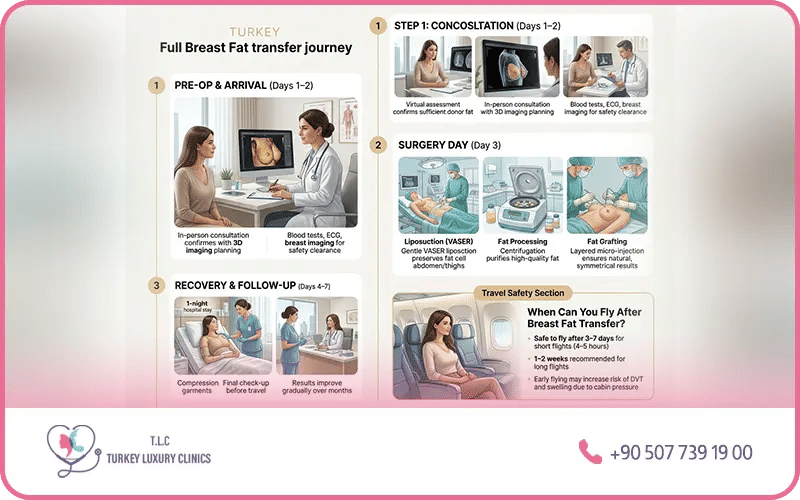
Step 1: Pre-Op & Arrival (Days 1–2)
Virtual assessment confirms enough donor fat, followed by an in-person consultation with 3D imaging to plan results.
Medical tests (blood work, ECG, breast imaging) ensure you’re fit and safe for surgery.
Step 2: Surgery Day (Day 3)
- Harvesting (Liposuction): The surgeon extracts fat from donor areas, such as the abdomen, thighs, or flanks—using gentle liposuction techniques like VASER. This ultrasound-assisted method preserves the viability of the fat cells, ensuring they remain healthy for grafting.
- Processing & Purification: The collected fat is placed in a centrifuge to separate pure, living fat cells from blood, oil, and damaged tissue. Only the highest-quality fat is selected to maximize survival rates and ensure safety.
- Grafting (Injection): Using fine cannulas, the purified fat is strategically injected in small amounts across multiple layers of the breast. This layered approach ensures the new fat cells connect to a blood supply (vascularization), leading to smooth, natural volume and symmetrical contour.
Step 3: Recovery & Follow-Up (Days 4–7)
You stay one night in the hospital, then begin recovery with compression garments and basic aftercare.
A final check-up is done before travel, with results gradually improving over the next few months.
When Can You Fly After Fat Transfer to the Breasts in Turkey?
It is generally safe to fly 3–7 days after a breast fat transfer for short flights (up to 4–5 hours). For longer flights (more than 5 hours), waiting 1–2 weeks is recommended.
Why wait? Flying too soon can increase the risk of blood clots (DVT) after general anesthesia and may worsen swelling or tenderness in the breasts due to cabin pressure changes.
Breast Fat Transfer in Turkey Recovery Timeline
Recovery from breast fat transfer begins immediately after the procedure. During the first week, patients typically experience the peak of post-operative side effects, including swelling, tenderness, and mild pain in the injection areas.
Timeline | What to Expect |
Week 1 | Peak swelling and bruising at donor and breast sites. Rest is mandatory. |
Week 2 | Return to desk work. Light walking is encouraged to prevent blood clots. |
Month 1 | The "Absorption Phase" begins. Slight decrease in volume may occur as the body processes non-viable fat. |
Month 3 | Result Stabilization. Remaining fat has established its own blood supply and is now permanent. |
Month 6 | The final contour is visible. Tissues have softened to a completely natural feel. |
Tips for a Smooth Recovery & Better Fat Survival
To ensure the best possible results and maximize the survival of your new fat grafts, follow these essential tips during your recovery:
- Avoid Pressure on Breasts: For at least 4–6 weeks, do not wear underwire bras or tight sports bras that compress the breast tissue. Constant pressure can cut off the blood supply to the new fat cells before they fully integrate.
- Don't Sleep on Your Stomach: Sleep strictly on your back for the first month. This prevents accidental compression and displacement of the fat grafts during the critical "taking" phase.
- Care for the Donor Sites: Don't forget the liposuction areas! Wear your compression garments as directed on your abdomen or thighs to reduce swelling and help the skin tighten smoothly.
- Stay Hydrated & Eat Well: Proper nutrition and hydration support the body’s healing process and help the new blood vessels (vascularization) form more efficiently.
- No Smoking: Nicotine is the biggest enemy of fat transfer. It constricts blood vessels and significantly lowers the fat survival rate. Avoid smoking for at least 4 weeks before and after surgery.
How Much Volume Can Increase with Breast Fat Transfer?
Target Goal | Fat Volume (Per Breast) | Bra Cup Increase | Notes |
Refinement | 100–150 cc | 0.5 Cup | Minor adjustment/ Subtle Increase |
Standard | 250–300 cc | 1 Cup | Noticeable natural enhancement |
Max Natural | 400–500 cc | 1.5 to 2 cups | Maximum safe volume |
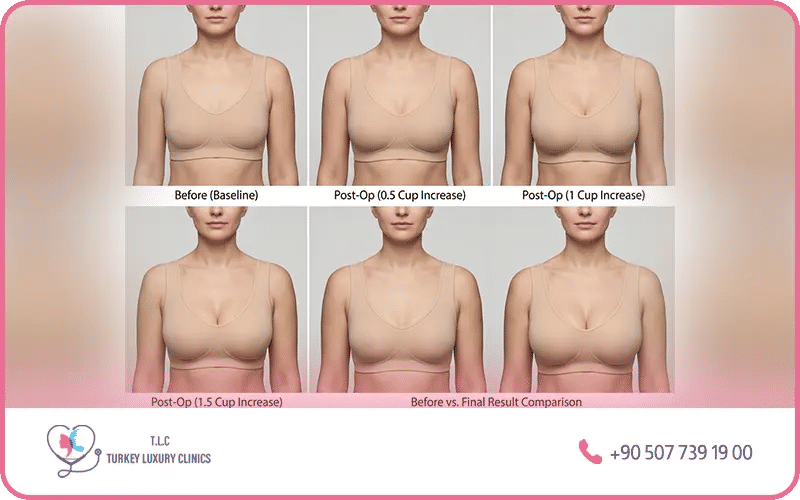
Fat transfer typically increases breast size by 0.5 to 1 cup per session, providing a subtle and natural enhancement. While some cases may achieve up to two cup sizes depending on fat availability and tissue capacity, roughly 30–50% of the injected fat is naturally reabsorbed, limiting the long-term increase
Factors Affecting Fat Transfer Breast Enlargement Volume & Results
The outcome of your surgery is governed by several biological variables that dictate how much fat truly "takes":
1. Amount of Fat Harvested and Transferred
The final size depends on having enough "harvestable" fat in donor areas like the abdomen or thighs. If you have a very low BMI, the volume of fat that can be purified and transferred may be limited.
2. Volume Limit and Breast Tissue Capacity
The breast’s ability to support new fat is limited by its existing tissue and blood supply. Injecting too much fat at once can overwhelm the tissue and lower survival rates, which is why surgeons prioritize quality of survival over sheer volume in a single session.
3. Amount of Fat Survival (50%–70%)
On average, only 50% to 70% of the injected fat survives permanently. Your surgeon may slightly "overfill" the area to compensate for this natural reabsorption. If greater volume or symmetry is desired, a second "touch-up" session may be recommended after 6 months once the tissue has stabilized.
4. Blood Supply and Vascularization
Fat transfer is a biological process, not an instant filler. It takes time (up to 90 days) for the cells to develop a new blood supply (vascularization). Only the fat that successfully integrates during this window becomes a permanent part of your anatomy.
5. Weight Fluctuation Sensitivity
Your new breast volume consists of living tissue that maintains its metabolic memory. Significant weight loss will cause the breasts to shrink, while weight gain will cause them to grow. Weight stability is key to maintaining permanent results.
6. Number of Sessions
Because of the natural volume limits, achieving your desired size may require multiple sessions. Each session builds on the previous one, allowing the tissue to heal and prepare for additional volume safely.
Fat Survival Rate & How to Improve Results
The success of fat transfer breast augmentation depends on how well the transferred fat survives. On average, 50% to 70% of the fat remains long-term, while the rest is naturally reabsorbed by the body within the first few months.
To maximize survival, surgeons use a micro-injection technique, placing small amounts of fat across multiple layers of the breast so each cell can develop a stable blood supply. This careful approach helps improve symmetry, smoothness, and long-term stability of results.
Because some fat is naturally absorbed, the final breast size is usually smaller than the initial post-surgery appearance. In some cases, patients may require a second “touch-up” session after 6 months to achieve their desired volume or improve symmetry. This can also affect the overall treatment cost, especially if additional fat grafting is needed.
Avoiding excessive overfilling during the first procedure is essential, as too much fat in one area can reduce survival rates and lead to uneven results. A balanced and controlled injection strategy delivers more predictable and natural results.
Fat Transfer Breast Augmentation Risks and Side Effects
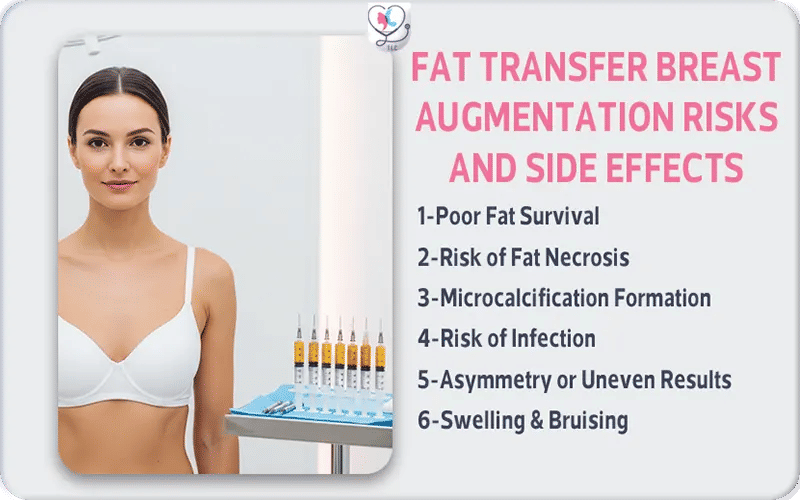
- Risk of Fat Necrosis: Some fat cells may die, forming hard, painless lumps or oil cysts. These usually resolve on their own and are typically only visible on mammograms.
- Microcalcification Formation: Tiny calcium deposits can sometimes form around necrotized fat. These appear as white spots on mammograms and may occasionally require additional imaging to rule out cancer.
- Risk of Infection: While uncommon when performed by skilled surgeons following high standards, infection is possible at the liposuction or injection sites. Infections can be superficial or deeper and may require antibiotics.
- Asymmetry or Uneven Results: Uneven fat distribution can lead to asymmetric breasts or cause lumps and irregularities in breast shape. Breast revision surgery can be performed to improve symmetry by adding more fat in targeted areas.
- Swelling & Bruising: These are common side effects after surgery and usually resolve within a few weeks
Who is the Ideal Candidate for Fat Transfer Breast Augmentation?
The best candidate for a fat transfer breast augmentation is a woman who:
- Has enough excess body fat to transfer to her breasts.
- Has realistic expectations about the results.
- Is not undergoing breast cancer treatments.
- Is over the age of 18.
- Is in good general health.
- Is not nursing or pregnant.
Fat Transfer Breast Augmentation vs Implant Breast Augmentation
While both procedures enhance breast shape, they offer different paths. Breast implants use artificial shells to provide a precise, predictable size increase in a single session. However, they are foreign objects that may require replacement every 10–15 years.
On the other hand, fat transfer is a natural way to increase size using your own living tissue. It offers a softer, more natural feel and bypasses risks like implant rupture or hardening. While the volume increase is more modest (typically half to one cup size), the results are lifelong once the fat integrates into your body.
Get 100% Natural Breast and Body Contouring with TLC
Ready to enhance your breasts naturally and safely? Book a consultation with our expert Turkish surgeons today and discover how fat transfer breast augmentation can give you a soft, natural look while contouring your body. Start your transformation now with a fully personalized plan tailored to your goals.
Schedule your consultation with our experienced team in Turkey and experience the ultimate combination of breast enhancement and body contouring in one safe, minimally invasive procedure.
You may like
Breast Revision Surgery Cost: 2026 Price, Coverage, Insurance, and Factors
How Much is a Boob Job in 2026: Implant, Fat Transfer & Lift Prices
Breast Lift Cost in Turkey: Cheapest 2026 Prices & All-Inclusive Packages
Breast Augmentation Cost Turkey 2026: All-Inclusive Price & Packages
FAQs About Fat Transfer Breast Augmentation