

- How Much Fat Can Be Removed with Lipo 360?
- How to Determine Fat Removal Amount in Lipo 360
- Factors That Affect How Much Fat Lipo 360 Can Remove
- Maximum Amount of Fat Removal with Lipo 360
- Candidate for More Than 5 Liters Fat Removal in Lipo 360
- Risks of Excess Fat Removal with Lipo 360
- How Fat Removal Amount Affects Lipo 360 Recovery
- FAQs About How Much Fat Can Be Removed With Lipo 360
Lipo 360 is a safe and precise body-contouring procedure designed to sculpt the midsection without the need for a tummy tuck or other invasive body-lifting surgeries.
During the preoperative consultation, the surgeon evaluates your body shape, fat distribution, and aesthetic goals to customize the procedure, determining the areas to treat, the techniques to use, and the appropriate amount of fat to remove.
So, how much fat can be removed with Lipo 360? While the exact volume varies based on your BMI and your desired results, most patients safely achieve a reduction of about 2 to 5 liters in a single session. This range is widely considered both safe and effective for full-circle body contouring.
The final amount is always personalized. In a properly planned Lipo 360, a qualified surgeon assesses key factors such as overall health, BMI, fat distribution, and skin elasticity to determine the safest and most effective fat-removal limit for each patient.
How Much Fat Can Be Removed with Lipo 360?
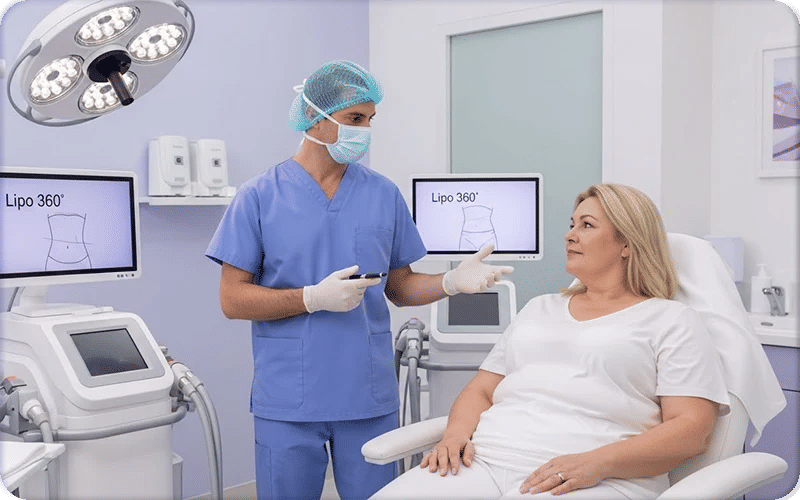
Most Lipo 360 procedures safely remove 2–5 liters (4–11 pounds) of fat in a single session. The exact amount depends on your BMI, overall health, skin elasticity, and aesthetic goals. Surgeons may split treatments into multiple sessions if more reduction is needed.
This total represents all areas treated together, including the abdomen, waist, flanks, and back. If a patient requires more reduction, surgeons usually divide the treatment into two separate sessions to maintain safety and avoid complications such as fluid imbalance or poor skin tightening.
The final amount always depends on the patient’s BMI, health status, and skin elasticity, as well as how much stubborn fat is present around the torso. Lipo 360 is ultimately designed to reshape the midsection, not to achieve dramatic weight loss.
How to Determine Fat Removal Amount in Lipo 360
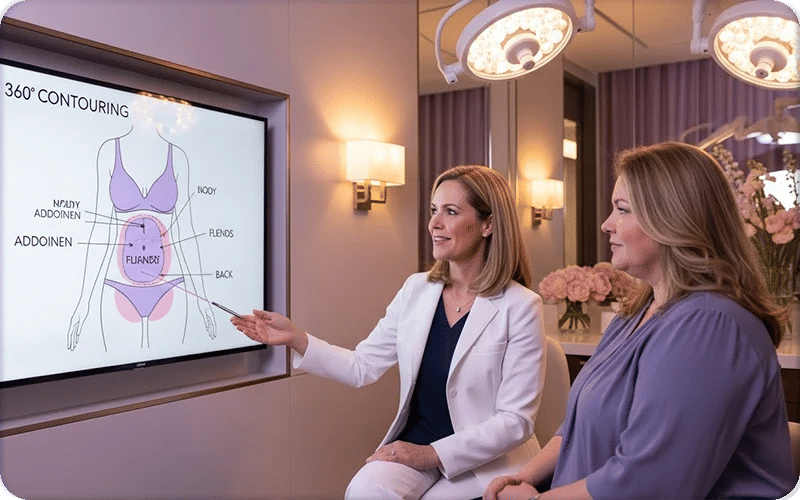
Lipo 360 is a highly customizable procedure because the surgeon chooses the areas of liposuction, and the amount of fat to remove per patient individually. Customization of Lipo 360 allows for adding other procedures, like a tummy tuck to tighten loose skin and muscles, or a BBL to transfer the removed fat to the buttocks, to help the patient reach a more sculpted appearance.
The surgeon builds a tailored plan by adjusting the fat removal volume to create different body shapes.
For example, they may remove more fat from the flanks and waist for a more dramatic hourglass contour in women, or enhance definition for a more athletic, sculpted look in men.
Customization also includes selecting the most appropriate technique. Surgeons can use traditional liposuction, advanced options such as tumescent or VASER (ultrasound-assisted liposuction), or a combination of methods depending on the patient’s anatomy and the areas being treated.
Factors That Affect How Much Fat Lipo 360 Can Remove
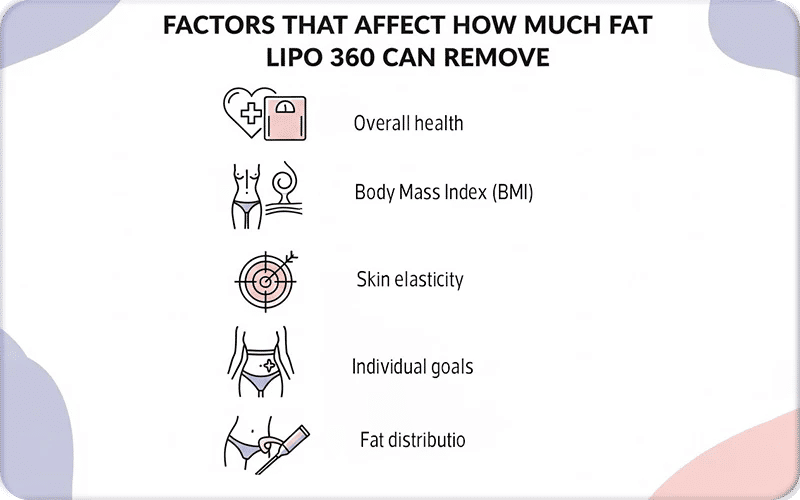
The safe limits for fat removal during liposuction do vary between patients. While a general guideline of no more than 5 liters (about 11 pounds) is often cited, the exact amount depends on individual factors such as the patient's overall health, Body Mass Index (BMI), and their aesthetic goals.
Key factors that determine how much fat can be removed: age, weight, skin type, overall health, and the surgical technique used.
- Overall health
Certain medical conditions, such as heart problems, bleeding disorders, or uncontrolled diabetes, can limit how much fat can be safely removed. Surgeons always prioritize patient safety when deciding the appropriate volume.
- Body Mass Index (BMI)
A higher BMI may mean there’s more fat available for removal, but it also increases the risks linked to the procedure. Your surgeon will balance both factors when determining the safe limit.
- Skin elasticity
The ability of the skin to retract after fat removal is crucial. Patients with good skin elasticity are better candidates for larger-volume liposuction, as their skin can conform smoothly to the new contours, reducing the risk of sagging or irregularities.
- Individual goals
What you want to achieve, whether it’s subtle shaping or a more dramatic contour, plays a role in how much fat is removed. Your goals help guide the surgical plan.
- Fat distribution:
The location and density of fat deposits influence both how much fat can be removed and how the body will look afterward. Even within the same person, some areas may tolerate more removal than others to achieve a balanced, natural appearance.
- Surgeon’s assessment and technique
The surgeon evaluates all factors, patient health, fat distribution, and skin quality, and selects the safest and most effective technique. This may include traditional liposuction, tumescent, ultrasound-assisted methods, or a combination, always following safety guidelines to minimize complications. Different techniques, like the tumescent or superwet methods, are designed to reduce blood loss and improve safety, allowing more fat to be removed safely compared to older techniques.
Maximum Amount of Fat Removal with Lipo 360
According to the American Society of Plastic Surgeons (ASPS) the maximum safe fat removal in a single Lipo 360 session is about 5 liters (10–11 pounds). Removing more increases risks like fluid imbalance, blood loss, and uneven contours. Surgeons always tailor removal to your health, BMI, and skin elasticity.
These guidelines are in place to protect the cardiovascular system and ensure a safe, smooth recovery. Pre-existing conditions such as heart problems, bleeding disorders, or uncontrolled diabetes can further limit the amount of fat that can be safely removed.
Ultimately, a surgeon will tailor the fat removal to achieve a balanced and aesthetically pleasing contour within safe limits, not just to remove the maximum amount of fat.
The limitation exists for a simple reason: patient safety. Removing too much fat — including the fluids that come out with it, can put the body under stress and increase the risks of fluid imbalance, significant blood loss, infection, or uneven body contours.
And more fat does not mean better results. If the skin does not have enough elasticity, excessive fat removal can lead to sagging, dimpling, lumps, or an irregular shape rather than a smooth, natural-looking silhouette.
Candidate for More Than 5 Liters Fat Removal in Lipo 360
Patients close to their ideal weight, with good skin elasticity and stubborn fat deposits, are the best candidates. Those with higher BMI or medical conditions may require multiple sessions to safely achieve their desired fat removal.
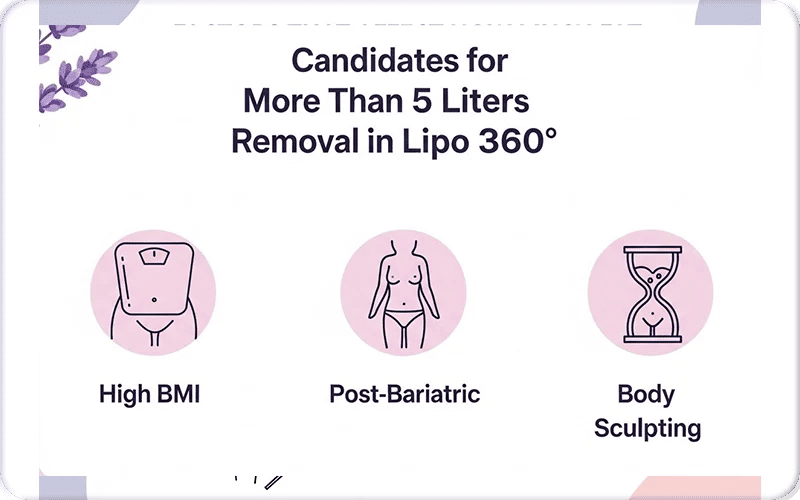
Patients who may require more than 5 liters of fat removal usually include:
- High BMI (≥ 30–35): Significant fat deposits around the abdomen, waist, and back.
- Post-bariatric patients: Those with localized stubborn fat after major weight loss.
- Body sculpting cases: Patients seeking extreme definition or specific contours, such as an hourglass shape.
How to remove more than 5 Liters of fat in Lipo 360?
To safely remove more than 5 liters of fat, you will need to have multiple staged procedures spaced several weeks or months apart to reduce health risks.
Usually, the time between sessions is typically 8–12 weeks, allowing the body to recover, swelling to subside, and results from the first session to be evaluated before the next. Careful planning considers overall health, skin elasticity, and cardiovascular condition, while close postoperative monitoring ensures a smooth recovery.
Risks of Excess Fat Removal with Lipo 360

Removing too much fat, or fat combined with fluid, in a single liposuction session significantly increases health risks.
During liposuction, fat, fluid, and blood are removed, so removing excessive amounts may lead to fluid and electrolyte imbalances, which can lead to dehydration and other complications, as well as excessive blood loss during and after surgery.
Larger procedures also raise the risk of infection, prolong recovery time due to increased bruising and swelling, and place additional stress on the heart and circulatory system because of fluid shifts and anesthesia exposure.
It is important to understand that an appealing body shape is not achieved solely by removing large amounts of fat during Lipo 360.
In fact, removing too much fat can produce the opposite effect.
Excessive fat removal from a single area can lead to sagging and loose skin.
The skin may also develop dimpling or uneven contours, resulting in an irregular surface instead of smooth curves. Over-removal in certain areas can create stomach lumps, asymmetry, or an unnatural body shape, all of which negatively impact the overall aesthetic result.
How Fat Removal Amount Affects Lipo 360 Recovery
The amount of fat removed during Lipo 360 directly affects swelling, recovery time, and risk level. The table below summarizes these effects for different fat removal volumes:
Fat Removed | Expected Swelling | Recovery Time | Risk Level |
2–3 liters | Mild | 1–2 weeks | Low |
4–5 liters | Moderate | 3–4 weeks | Medium |
5+ liters | High | 4–6 weeks | High |
During recovery after Lipo 360, symptoms are affected by the amount of fat removed. The more fat extracted, the longer it may take for the body to fully heal.
While mild activity can usually resume within a few days, full recovery, including seeing final contours, can take several weeks.
Larger volumes of fat removal usually cause more swelling and bruising. Patients who have 4–5 liters removed often experience more pronounced swelling than those with 2–3 liters.
Also, Higher volumes can lead to increased post-operative discomfort, requiring stronger pain management and a slightly longer period of limited activity.
Extracting a larger amount is associated with high health and aesthetic risks, such as risk of fluid imbalance, hematoma, seroma, or uneven skin retraction, which can prolong recovery or require additional corrective treatments.
Patients with higher-volume fat removal need to be especially diligent with compression garments, hydration, and gradual return to activity to support healing and maintain results.
FAQs About How Much Fat Can Be Removed With Lipo 360