
- What Is Afro Hair Transplant in Turkey?
- Afro Hair Transplant Cost in Turkey (2026 Prices)
- Afro Hair Transplant Cost in Best Cities
- Afro Hair Transplant Prices by Technique
- Afro Hair Transplant Costs Around the World
- Factors Affect Afro Hair Transplant Cost in Turkey
- Hair Transplant For Afro Hair Before & After Photos
- Best Afro Hair Transplant Clinic in Turkey
- Best Surgeon for Afro Hair Transplant in Turkey
- Best Afro Hair Transplant Techniques
- Afro Hair Transplant Success Rate & Patient Reviews in Turkey
- Types of Afro Hair
- Why Afro Hair Transplants Are More Complex
- Who Is a Good Candidate for Hair Transplant For Afro Hair?
- Common Hair Loss Patterns in Afro Hair Patients
- Afro Women Hair Transplant
- Hair Transplant for African American Men
- Afro Hair Transplant Surgery Steps
- Afro Hair Transplant Recovery
- Restore a Beautiful Dense Afro Hair With Turkey Luxury Clinics
- FAQs About Hair Transplant For Afro Hair
Afro hair transplant in Turkey has become one of the most popular solutions for individuals with curly or tightly coiled hair who want natural and permanent hair restoration. Thanks to specialized techniques such as FUE and DHI, Turkish clinics are able to safely transplant curved Afro hair follicles while preserving the natural curl pattern.
Getting an Afro hair transplant in Turkey delivers natural, dense results, with prices typically ranging from $2,500 to $5,000 (€2,000–€4,500) depending on the number of grafts, donor hair quality, and the surgical technique used.
FUE Afro hair transplant in Turkey typically ranges from $2,500 to $4,000, depending on the graft count and clinic quality. DHI Afro hair transplant in Turkey is more advanced and time-intensive, with prices usually ranging from $3,000 to $5,000.
Istanbul is home to some of the best clinics that combine expert care with affordable all-inclusive packages, including accommodation, transportation, and post-operative support. Choosing the best Afro hair transplant clinic in Turkey requires focusing on specialized expertise rather than general popularity.
In this article, you’ll discover the average cost of Afro hair transplant in Turkey, the best techniques used for curly hair follicles, how to choose the right clinic, and what results you can realistically expect.
If you’re considering the procedure, you can contact Turkey Luxury Clinics for a personalized consultation and a detailed treatment plan with pricing.
What Is Afro Hair Transplant in Turkey?
Afro hair transplant is a specialized hair restoration procedure for individuals with tightly coiled, kinky, or curly hair, typically seen in people of African, Afro-Caribbean, or African-American descent. This hair type is distinct because the follicles grow in a curved or spiral shape beneath the scalp, not straight like other hair types. Standard hair transplant techniques cannot always preserve these follicles effectively, which is why Afro hair transplant requires advanced surgical skills and special tools.
The primary goal is to restore hair density while preserving the natural curl pattern. Each follicle must be implanted at the correct angle and direction to ensure the transplanted hair grows naturally and blends seamlessly with existing hair.
Afro Hair Transplant Cost in Turkey (2026 Prices)
Number of Grafts | Estimated Cost (USD) | Common Use Case |
1,000 – 2,000 | $1,500 – $2,500 | Minor hairline restoration or temple edges |
2,500 – 3,500 | $2,500 – $4,000 | Moderate baldness in the front and mid-scalp |
4,000 – 5,000+ | $3,500 – $5,000+ | Large coverage from the hairline to the crown |
Afro hair transplants in Turkey typically cost between $2,500 and $5,000, offering 60–80% savings compared to Western countries, where similar procedures can exceed $10,000.
Hair transplant prices typically include the main transplant session along with basic medical follow-up and vary depending on the treatment plan, the number of grafts required, and the technique used.
Despite the relatively low cost, Turkey is considered one of the most competitive destinations globally due to the experience of its specialists and their expertise in handling the unique characteristics of Afro-textured hair.
Most Turkish clinics offer all-inclusive packages instead of charging per graft, making the procedure significantly more affordable for international patients.
Although most clinics in Turkey offer flat package pricing, the effective cost of an Afro hair transplant often depends on the number of grafts required. As the graft count increases, the average cost per graft usually decreases.
Afro Hair Transplant Cost in Best Cities
Prices can vary slightly depending on clinic reputation and location.
City | Starting Price | Average Price |
Istanbul | $2,905 | $3,080 |
Antalya | $2,905 | $3,080 |
Izmir | $2,901 | $3,076 |
Istanbul remains the most popular destination due to the large number of specialized hair transplant clinics and experienced surgeons.
Afro Hair Transplant Prices by Technique
Hair Transplant Technique | Average Price in Turkey |
FUE (Follicular Unit Extraction) | $2,500 – $4,000 |
Sapphire FUE | $2,500 – $4,500 |
DHI (Direct Hair Implantation) | $3,000 – $5,000 |
PRP or Stem Cell Add-Ons | $500 – $2,000 (additional) |
Afro Hair Transplant Costs Around the World
Location | Estimated Cost (USD) |
Afro hair transplant NYC cost | $6,000 – $12,000 |
Afro hair transplant Seattle cost | $6,000 – $12,000 |
Afro hair transplant London cost | $5,000 – $9,000 |
Afro Caribbean hair transplant in London cost | $5,000 – $9,000 |
Afro hair transplant Birmingham cost | $5,000 – $9,000 |
Afro hair transplant Manchester cost | $5,000 – $9,000 |
Best Afro hair transplant UK cost | $5,000 – $9,000 |
Hair transplant Afro hair UK cost | $5,000 – $9,000 |
Afro hair transplant Belgium cost | $3,800 – $7,600 |
Afro hair transplant Prague cost | $3,800 – $7,600 |
Afro hair transplant Mexico cost | $3,000 – $5,000 |
Read about average Cost of Hair Transplant in Different Countries
Factors Affect Afro Hair Transplant Cost in Turkey
The final cost of an Afro hair transplant in Turkey can vary depending on:
- The extent of hair loss and number of grafts required.
- The clinic’s reputation and surgeon’s expertise.
- The technique used (FUE or DHI).
FUE Afro hair transplant in Turkey typically ranges from $2,500 to $3,500, depending on the graft count and clinic quality.
DHI Afro hair transplant in Turkey is more advanced and time-intensive, with prices usually ranging from $3,000 to $4,000.
Hair Transplant For Afro Hair Before & After Photos
See the natural transformation after an Afro hair transplant in Turkey. Curly and tightly coiled hair restored with FUE or DHI techniques for dense, natural-looking results.
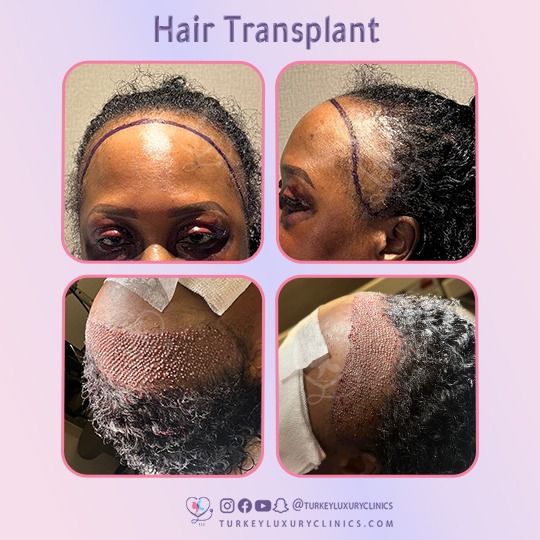
Afro hair transplant procedure showing hairline design and immediate graft placement for severe traction alopecia in an African-American woman.
Condition: Traction Alopecia
Patient: African-American Woman
Severity: Severe Frontal and Temporal Hairline Loss
Technique: FUE Hair Transplant
Estimated Grafts: 2,000–3,500
Stage: Immediate Post-Procedure
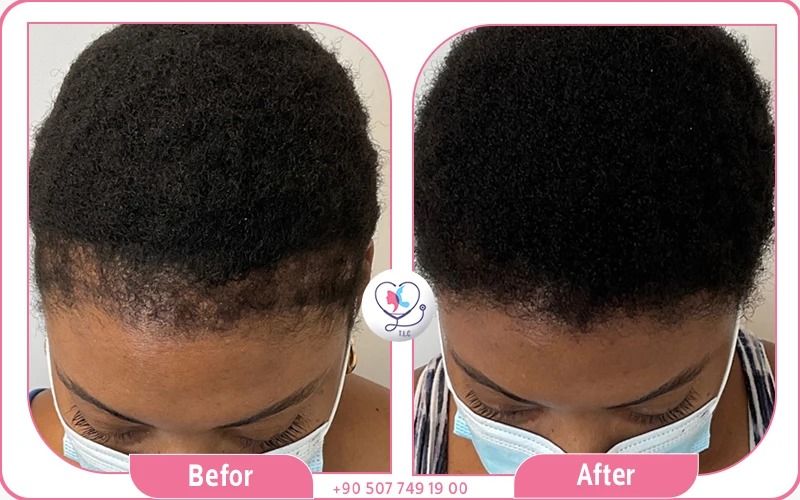
Condition: Traction Alopecia
Patient: African-American Woman
Severity: Moderate Frontal and Temporal Hairline Loss
Estimated Grafts: 1,500–2,500
Results Timeline: 12 Months
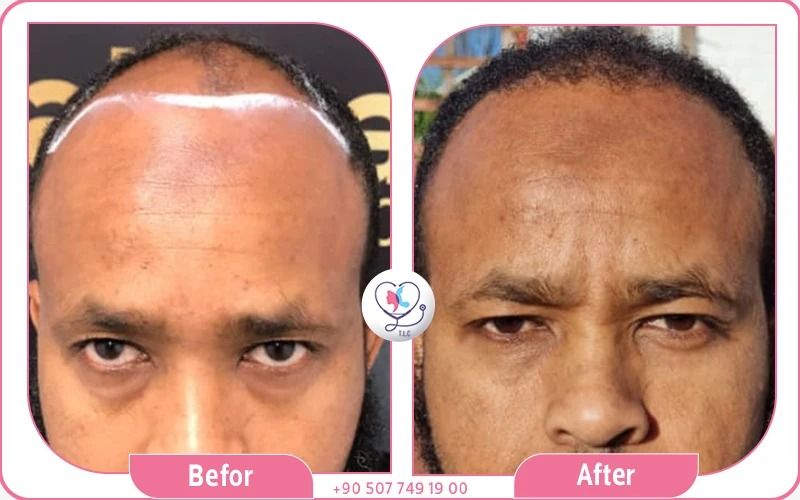
Condition: Male Pattern Baldness
Patient: African-American Man
Severity: Advanced Hairline Recession (Norwood V)
Estimated Grafts: 3,000–4,500
Results Timeline: 12 Months
Best Afro Hair Transplant Clinic in Turkey
Finding the best Afro hair transplant clinic in Turkey requires choosing surgeons who understand the unique structure of curly and tightly coiled hair follicles. Afro hair grows in a curved pattern beneath the scalp, which means the transplant procedure requires specialized skills and advanced techniques to protect the grafts and preserve the natural curl pattern.
Experienced surgeons performing Afro hair transplant procedures in Turkey use advanced methods such as FUE (Follicular Unit Extraction) and DHI (Direct Hair Implantation) to carefully extract and implant curved hair follicles while minimizing the risk of damage.
How to Choose the Best Afro Hair Transplant Clinic in Turkey
When selecting a clinic, consider the following factors:
- Surgeon experience in performing Afro hair transplant procedures
- Clinic accreditation and compliance with international medical standards
- Before-and-after results showing natural hairlines, good density, and minimal scarring
- Hair transplant techniques used during the procedure
Afro hair transplantation requires special expertise because the follicles are curved under the scalp. Surgeons must carefully follow the natural angle of the follicle during extraction to avoid graft damage and maintain a high survival rate. Working with an experienced clinic helps improve graft survival, ensures natural hairline design, and reduces the risk of visible scarring after surgery.
Best Surgeon for Afro Hair Transplant in Turkey
Dr. Osman Gün is among the leading specialists in hair restoration. He is a licensed Medical Doctor (MD), ECFMG-verified, and a member of FUE Europe, an international organization dedicated to advancing hair transplant techniques.
Best Afro Hair Transplant Techniques
1. Follicular Unit Extraction (FUE) & Sapphire FUE
FUE is the most commonly used technique for Afro hair transplants. It involves extracting individual follicles from the donor area, which avoids the long linear scar associated with older strip methods (FUT).
Key details for Afro hair:
- Surgeons use curved micro-punch tools (0.9–1.1 mm) to follow the natural curl of each follicle, reducing the risk of damage.
- Sapphire FUE is a variation that uses sapphire blades to make precise incisions in the recipient area, supporting faster healing and allowing dense graft placement.
- Enables careful selection and placement of follicles for natural hairlines and consistent density.
2. Direct Hair Implantation (DHI)
DHI is considered one of the best Afro hair transplant methods because it offers maximum control and precision by using a Choi implanter pen for direct and accurate placement of hair follicle into the recipient area without creating prior incisions.
Also it protects the delicate curved follicles of Afro hair which makes it particularly advantageous for Afro hair.
Benefits for Afro hair:
- Provides better control over depth, angle, and direction of each graft, matching the natural growth pattern of tightly coiled hair.
- Follicles spend less time outside the body, which improves graft survival rates.
- Protects the delicate, curved follicles of Afro hair, making it ideal for 3C–4C types.
Afro Hair Transplant Success Rate & Patient Reviews in Turkey
Patient experiences in Turkey are overwhelmingly positive, with high success rates thanks to specialized techniques such as FUE and Sapphire FUE, designed specifically for tight curls and dense follicle structures.
Many patients also praise Turkey—particularly Istanbul—for its affordable, all-inclusive packages, which include 5-star hotel stays, VIP transfers, and comprehensive aftercare. These packages ensure the delicate extraction process for curly hair is performed carefully, minimizing scarring and achieving a natural, dense hairline.
Types of Afro Hair
Hair Type | Curl Pattern / Follicle | Transplant Tip |
3A | Loose curls, elongated | Easy extraction, lower transection risk; standard FUE works, follow slight curl angle |
3B | Medium curls, tighter | Slightly curved follicles; use small punches, careful implantation angle |
3C | Tight corkscrew curls | High density, curved follicles; extraction must follow curve; DHI or Sapphire FUE preferred |
4A | S-shaped coils, soft | Moderate shrinkage; maintain curl direction, careful extraction and implantation |
4B | Z-shaped coils, less defined | Highly curved, fragile follicles; precise implantation, advanced FUE/DHI to minimize graft damage |
4C | Very tight coils, extreme shrinkage | Most challenging; only highly experienced surgeons; use DHI/small FUE; match curl pattern exactly |
Different types of Afro hair require specialized transplant techniques. 3C–4C types have tightly coiled follicles needing careful FUE or DHI extraction to preserve curl pattern and maximize graft survival.
Why Afro Hair Transplants Are More Complex
Afro hair transplantation is more complex than other hair types because the follicles grow in a curved or spiral shape beneath the scalp. While the tools and techniques used are similar to those used for Asian or Caucasian hair, the tightly coiled nature of Afro hair requires a more specialized surgical approach.
Curved Follicles: Afro hair follicles curve under the skin, which increases the risk of damaging the follicle during extraction if the angle is incorrect. Damaged follicles may not survive, reducing the overall success rate.
Follicle Transection Risk: If the surgeon cuts the follicle during extraction, the graft becomes damaged. This issue, known as follicle transection, occurs more frequently with Afro hair because of its curved structure.
Lower Visible Density: Afro hair may appear very dense due to its curl pattern, but the actual number of follicles per square centimeter is often lower than in straight hair types. This requires careful planning of graft placement to achieve natural density.
Direction of Hair Growth: The angle of implantation is critical. If grafts are implanted incorrectly, the hair may grow in an unnatural direction or lose its natural curl pattern.
Scarring and Keloids: Individuals with darker skin may have a higher tendency for keloid formation. For this reason, many surgeons prefer the FUE technique over FUT because it minimizes visible scarring.
Because of these challenges, an Afro American or Afro Caribbean hair transplant in Turkey should be performed by a surgeon experienced in handling tightly curled follicles. Techniques such as FUE or DHI are commonly used to carefully extract and implant grafts while preserving the natural curl pattern and achieving natural-looking density.
Who Is a Good Candidate for Hair Transplant For Afro Hair?
- Individuals with Afro-textured hair experiencing pattern baldness (male or female).
- Patients with hair loss caused by traction alopecia from tight hairstyles like braids, cornrows, or weaves.
- Patients with a sufficient donor area at the back or sides of the scalp.
- People in good general health with no active scalp conditions.
Common Hair Loss Patterns in Afro Hair Patients
- Receding hairline in men due to male pattern baldness.
- Thinning of the crown.
- Traction alopecia along the hairline in women caused by prolonged tension from certain hairstyles.
- Patchy hair loss in cases of scarring alopecia or other medical conditions.
Afro Women Hair Transplant
Hair loss in women with Afro-textured hair can occur due to various reasons, including traction alopecia, hormonal changes, or genetic factors.
Afro female hair transplant is absolutely possible and highly successful when performed using advanced techniques such as DHI and FUE by skilled surgeons specialized in Afro hair restoration.
When done correctly and followed by proper aftercare during the recovery period, Afro female hair transplant can provide long-lasting—often permanent—results, restoring natural density and confidence.
Hair Transplant for African American Men
African American men often face unique hair loss patterns, such as traction alopecia or male pattern baldness.
Afro American hair transplant for men requires a specialized approach due to the tightly curled nature of the hair follicles. Techniques like FUE and DHI, performed by experienced surgeons, ensure natural density and a seamless hairline that respects the natural curl pattern.
Afro Hair Transplant Surgery Steps
Afro hair transplant surgery steps resemble other hair types. Read in detail Hair Transplant Surgery Step by Step Guide
These steps include:
1.Consultation & Planning: Assess hair loss, determine graft count, and design the hairline while setting realistic expectations.
2. Graft Extraction: Harvest follicles from the donor area using FUE or FUT, with special care for Afro hair’s curl pattern.
3. Graft Preservation: Store extracted grafts in a solution to keep them viable before implantation.
4. Implantation: Create recipient sites and implant grafts at the correct angle to match Afro hair’s natural curl and direction.
5. Post-Operative Care: Follow aftercare guidelines, including washing instructions, avoiding scalp trauma, and taking prescribed medications.
Afro Hair Transplant Recovery
Afro hair transplant recovery timeline generally follows a similar week-by-week timeline as other hair types. Read about Hair Transplant Week by Week: From Week 1 to Week 48
The recovery period typically consists of two distinct phases:
- First Phase (1–2 months):
This stage involves the healing process. During the first two weeks, scabbing and mild discomfort are common but gradually subside as the scalp heals.
Around the third or fourth week, the transplanted hair will likely shed. This is called shock loss and is a normal part of the hair growth cycle—not a sign of transplant failure. While usually lasts for 3 to 4 weeks, in some cases it may last longer for up to 3 months.
- Second Phase (Months 3–12 to 18):
Hair begins to grow as thin strands during the next 2 to 4 months and gradually thickens and strengthens over time.
Visible improvement appears within 6 months, but full results are usually achieved within 12 to 18 months.
Discover Post Hair Transplant Care to achieve best recovery and natural results.
Restore a Beautiful Dense Afro Hair With Turkey Luxury Clinics
Ready to restore your natural hairline with a trusted expert .. smoothly, safely and confidently? Book your free consultation today with Turkey Luxury Clinics and discover how our specialized Afro hair transplant solutions deliver natural, long-lasting results at affordable prices. Get your best afro hair transplant in Turkey now!
FAQs About Hair Transplant For Afro Hair