

- Did Matt Damon Have a Hair Transplant?
- Matt Damon Before and After Hair Transplant Photos
- Matt Damon Hair Transplant Estimate
- Matt Damon Hairline Analysis Over the Years
- Why Do People Think Matt Damon Had a Hair Transplant?
- Expert Hair Transplant Analysis of Matt Damon Hair Transplant
- Could Matt Damon's Hairline Have Improved Without a Hair Transplant?
- What Norwood Stage Is Matt Damon?
- How Many Grafts Did Matt Damon Need?
- Which Hair Transplant Technique Did Matt Damon Most Likely Have?
- How Much Would a Similar Hair Transplant Cost?
- Get Your Customized Hair Transplant Evaluation
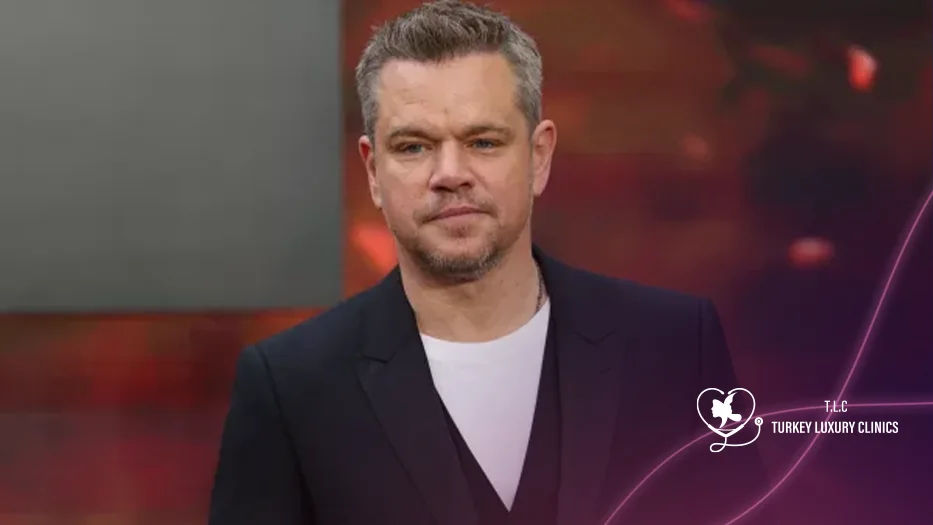
Matt Damon has never confirmed undergoing a hair transplant. However, comparisons of his before-and-after photos have led many hair restoration specialists to suggest that his recent hairline may be consistent with a conservative FUE hair transplant involving approximately 1,800 to 2,200 grafts. The speculation stems from his fuller frontal hairline, improved temple definition, and remarkably stable hair density over the years.
Because no official information is available, this assessment is based solely on photographic analysis and expert opinion rather than confirmed medical evidence. Matt Damon's hair transformation could also be explained by professional hairstyling, hair fibers, lighting, camera angles, or non-surgical hair loss treatments.
In this expert analysis, we'll examine Matt Damon's before-and-after photos, estimate his Norwood stage, graft count, and most likely transplant technique, and explain whether similar results could have been achieved without surgery.
Did Matt Damon Have a Hair Transplant?
Matt Damon has never publicly confirmed or denied undergoing a hair transplant. However, comparisons of photographs spanning nearly three decades have fueled ongoing speculation that he may have had a subtle hair restoration procedure.
Unlike many celebrity hair transformations that involve dramatic changes, Matt Damon's appearance has remained relatively consistent with subtle improvements in the frontal hairline and temple areas rather than a completely new hairline.
This has led some hair restoration surgeons and online observers to suggest that, if a procedure was performed, it was likely conservative and designed to preserve a natural, age-appropriate appearance.
Matt Damon Before and After Hair Transplant Photos
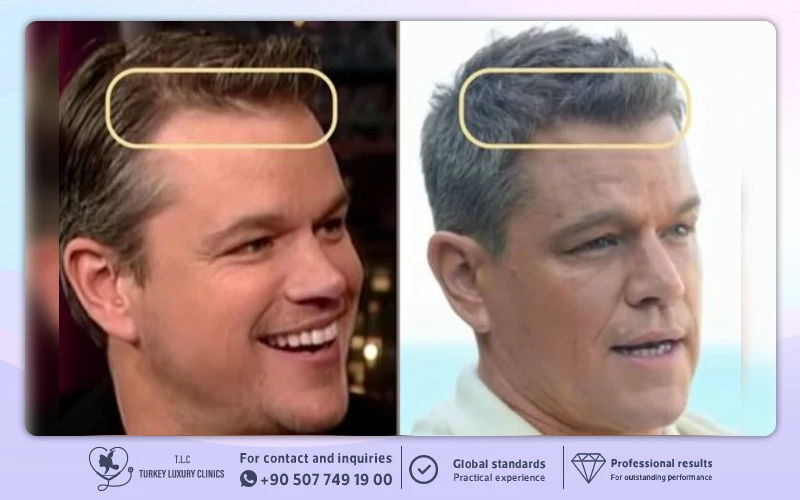
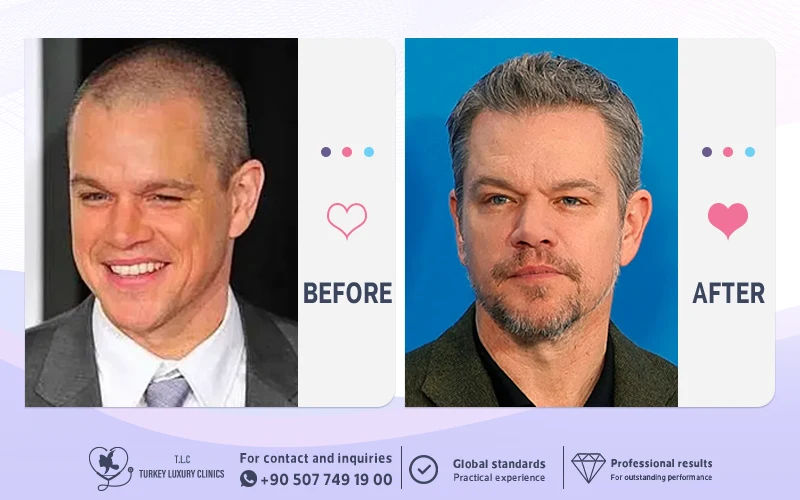
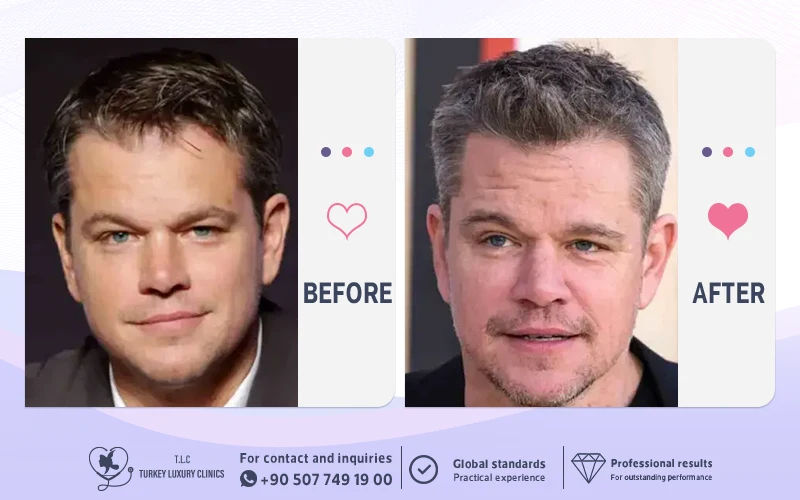
Before-and-after photographs are the primary reason speculation about Matt Damon's hair has continued over the years. Although the overall changes are subtle, comparing images from different stages of his career reveals several differences that attract the attention of hair restoration specialists.
The most noticeable observation is that his frontal hairline appears slightly fuller in recent years than in some photographs taken during his middle career. His temples also appear more defined in certain images, creating a smoother and more continuous hairline. Unlike many celebrities who undergo aggressive hairline lowering, Matt Damon's appearance has remained conservative, making any possible change difficult to identify without side-by-side comparisons.
Matt Damon Hair Transplant Estimate
Feature | Expert Estimate |
Likely Norwood Stage | Norwood 2 |
Estimated Grafts | 1,500–2,500 grafts |
Most Likely Technique | FUE |
Visible Crown Loss | None apparent |
Likely Treatment Area | Hairline and temples |
While these estimates are consistent with what many experienced hair transplant surgeons might expect from the visible changes, they are based exclusively on photographic analysis. Since Matt Damon has never confirmed undergoing a procedure, none of these estimates should be interpreted as verified medical facts.
Matt Damon Hairline Analysis Over the Years
One of the strongest arguments in the debate over whether Matt Damon had a hair transplant is the remarkable stability of his hairline over nearly three decades. Rather than experiencing progressive recession, his hair has maintained a mature yet relatively consistent appearance throughout most of his career. Examining each stage separately provides a clearer understanding of why specialists continue to debate whether the changes represent natural aging, medical treatment, or subtle surgical restoration.
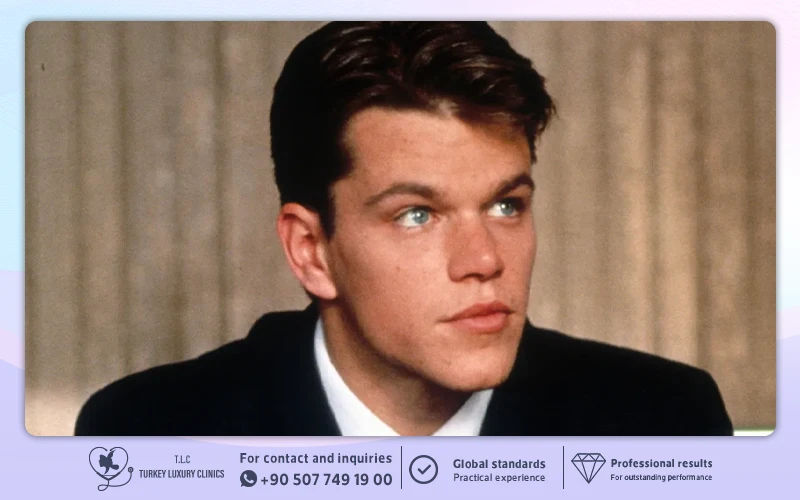
Early Career (1997–2001)
During the late 1990s, Matt Damon displayed a youthful hairline with excellent density and minimal recession. His temples remained full, and the frontal hairline followed a naturally rounded contour commonly seen in men with little or no androgenetic hair loss. At this stage, his appearance was consistent with a Norwood 1 pattern.
Bourne Era (2002–2007)
Throughout the Bourne franchise, slight recession became visible at the temples while overall density remained strong. The changes were subtle and consistent with the development of a mature adult hairline rather than significant male pattern baldness. No obvious thinning was visible at the crown.

Mid-Career (2008–2016)
Photographs from this period show mild fluctuations in frontal density depending on hairstyle and lighting. In some appearances, the hairline appeared slightly softer and the temples more recessed, leading some observers to speculate that early hair loss had begun. However, the progression remained slow and relatively stable compared with the pattern typically seen in untreated male pattern baldness.
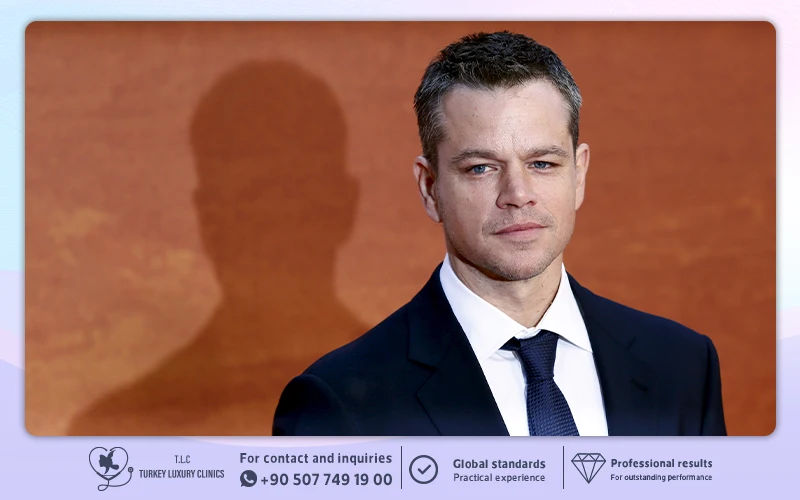
Recent Years (2017–Present)
In more recent public appearances, Matt Damon's frontal hairline often appears fuller and more uniform than it did during parts of his middle career. The temples also appear slightly better defined in certain photographs, prompting speculation that he may have undergone a conservative hair restoration procedure. Nevertheless, these visual changes could also be explained by non-surgical factors, including hairstyling, hair fibers, medications, or differences in photographic conditions. Without confirmation from Matt Damon himself, no definitive conclusion can be drawn.

Why Do People Think Matt Damon Had a Hair Transplant?
Speculation about Matt Damon's hair did not arise from a dramatic transformation but from a series of subtle changes observed over many years. Unlike celebrities who undergo obvious hairline reconstruction, Matt Damon's appearance has evolved gradually, making the discussion more complex and largely dependent on photographic comparisons.
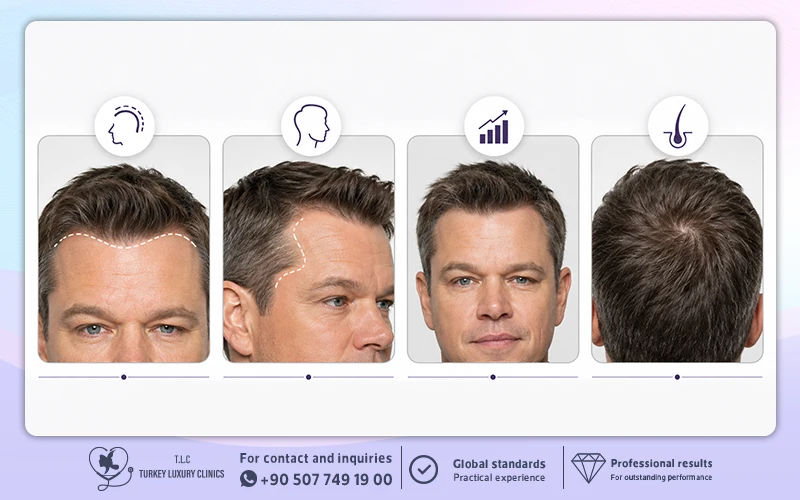
Hair transplant surgeons typically evaluate more than whether the hair looks "thicker." They examine the shape of the hairline, temple recession, density distribution, and whether these features remain stable over time. Several characteristics seen in Matt Damon's more recent appearances have led some specialists to suggest that hair restoration could be one possible explanation.
A Fuller Frontal Hairline
One of the most noticeable differences is the appearance of a denser frontal hairline. In several recent photographs, the front of the scalp appears more evenly filled than it did during parts of his middle career. Although the improvement is subtle, it is consistent with the type of conservative enhancement commonly achieved through modern hair transplantation.
Better Temple Definition
The temples also appear more complete in certain side-by-side comparisons. Rather than creating an unnaturally low hairline, the frontal corners appear smoother and more balanced, which is often the primary goal of a small FUE procedure.
Stable Hair Density Over Time
Male pattern baldness usually progresses gradually throughout adulthood. However, Matt Damon's hairline has remained remarkably consistent for many years, with no obvious acceleration of recession or significant crown thinning. This long-term stability is one reason some observers question whether medical or surgical intervention may have contributed to maintaining his appearance.
No Visible Crown Hair Loss
Another point frequently mentioned is the apparent absence of significant thinning at the crown. While frontal recession can occur without crown involvement, maintaining good density across both areas into later adulthood naturally raises questions about whether preventive treatments or hair restoration played a role.
Expert Hair Transplant Analysis of Matt Damon Hair Transplant
Feature | Why Experts Consider It Relevant |
Frontal Hairline | Appears slightly fuller and more uniform in recent years. |
Temple Definition | Temples look more balanced with less visible recession. |
Hair Density | Frontal density has remained consistently strong over time. |
Hairline Stability | Minimal progression despite decades of public appearances. |
Crown Area | No obvious crown thinning or advanced hair loss is visible. |
Natural Appearance | The hairline remains age-appropriate rather than overly lowered. |
Possible Technique | These subtle changes are consistent with a conservative FUE procedure, if one was performed. |
From a surgical perspective, the visible changes suggest refinement rather than reconstruction. If Matt Damon underwent hair restoration, the objective was likely to preserve an existing mature hairline instead of dramatically altering his appearance.
The overall pattern does not resemble the outcome of a large hair transplant typically performed for advanced baldness. Instead, it reflects the type of subtle enhancement commonly achieved in patients with mild recession who want to maintain a natural, age-appropriate look without obvious signs of cosmetic surgery.
Equally important, there are no visual features that indicate an overcorrected hairline, excessive graft density, or an unnatural transition between transplanted and native hair. The result—if surgical—is balanced enough that it attracts attention only when photographs from different years are compared side by side.
Surgeon's Verdict: Based solely on publicly available photographs, the appearance is most consistent with a conservative FUE procedure using approximately 1,500 to 2,500 grafts. However, because Matt Damon has never confirmed undergoing hair restoration, this conclusion should be regarded as professional photographic assessment rather than verified medical evidence.
Could Matt Damon's Hairline Have Improved Without a Hair Transplant?
Yes. A hair transplant is only one of several possible explanations for Matt Damon's consistently full hairline. Because he has never publicly discussed hair restoration, non-surgical factors should be considered before assuming cosmetic surgery.
Hairstyling Techniques
Professional hairstyling can significantly change how a hairline appears. Longer hair in the frontal region, strategic blow-drying, and styling products can create additional volume that partially conceals mild temple recession.
Hair Fibers and Thickening Products
Hair fibers are commonly used by actors, television personalities, and public figures. These products attach to existing hairs, making the scalp appear less visible and creating the impression of greater density without any surgical treatment.
Hair Loss Medications
Prescription medications such as finasteride and topical minoxidil can slow the progression of androgenetic alopecia and, in some individuals, improve hair density. Although there is no evidence that Matt Damon uses either treatment, both remain plausible explanations for a stable hairline over many years.
Lighting, Photography, and Hair Length
Lighting direction, camera angle, image resolution, and even hair moisture can dramatically alter the appearance of density in photographs. A slightly different hairstyle or lighting setup may make the same hairline appear noticeably fuller or thinner, which is why surgeons avoid drawing conclusions from a single image.
What Norwood Stage Is Matt Damon?
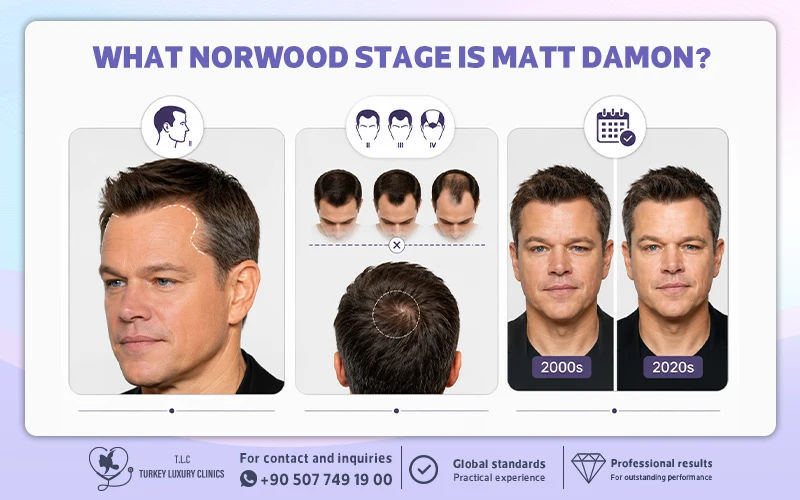
Matt Damon most closely resembles Norwood Stage 2, with mild temple recession while maintaining a strong frontal hairline, good overall density, and no obvious crown thinning.
Unlike men with Norwood Stage 3 or higher, he shows no convincing signs of advanced recession or significant hair loss at the crown. His hairline has also remained relatively stable over the years, suggesting a mature hairline rather than progressive male pattern baldness.
Because Matt Damon has never publicly discussed his hair loss, this assessment is based solely on publicly available photographs.
How Many Grafts Did Matt Damon Need?
If Matt Damon underwent a hair transplant, most hair restoration specialists would likely estimate 1,500 to 2,500 grafts based on the visible appearance of his hairline. This range would generally be appropriate for restoring mild temple recession, reinforcing the frontal hairline, and increasing density without creating an unnaturally low or aggressive hairline.
Unlike patients with advanced hair loss, Matt Damon has never appeared to require extensive coverage across the entire scalp. The visible changes are limited primarily to the frontal third of the scalp, suggesting that, if surgery was performed, the goal would have been refinement rather than reconstruction.
Treatment Area | Estimated Grafts |
Hairline Refinement | 700–1,000 |
Temple Restoration | 400–700 |
Density Enhancement | 300–800 |
Estimated Total | 1,500–2,500 |
Why Would 1,500–2,500 Grafts Be Enough?
The estimated range reflects the conservative nature of the visible changes. Modern hair transplantation is no longer focused on creating an entirely new hairline. Instead, surgeons often restore density where recession first becomes noticeable while preserving a natural transition between transplanted and existing hair.
For someone with a mature Norwood 2 hairline, approximately 1,500 to 2,500 grafts can usually provide noticeable improvement without making the result appear artificial. This conservative approach is commonly preferred by actors and public figures because it enhances the hairline while maintaining a look that is consistent with natural aging.
Which Hair Transplant Technique Did Matt Damon Most Likely Have?
If Matt Damon underwent a hair transplant, most hair restoration specialists would consider FUE the most likely technique. These expectations were based on his natural-looking appearance and the absence of visible donor scarring.
FUE (Most Likely)
FUE has become the preferred technique for many celebrities because it allows individual follicular units to be extracted without leaving a long linear scar on the back of the scalp. The tiny extraction sites usually heal as nearly invisible dots, making the procedure particularly suitable for people who frequently appear on camera or wear shorter hairstyles.
A conservative FUE procedure could explain the subtle improvement in Matt Damon's frontal hairline while preserving a mature, age-appropriate appearance.
DHI (Also Possible)
Direct Hair Implantation (DHI) is another technique sometimes suggested by online observers. Using a specialized implantation pen, surgeons can place grafts with precise control over angle and direction, making it useful for refining the frontal hairline.
FUT (Less Likely)
Follicular Unit Transplantation (FUT), also known as the strip method, is generally considered less likely in this case. While FUT remains an effective option for patients requiring a large number of grafts, it leaves a linear scar across the donor area that may become visible with shorter hairstyles.
Given the relatively subtle changes associated with Matt Damon's appearance and the limited number of grafts that would likely be required, many surgeons would consider FUE a more probable choice if surgery took place.
How Much Would a Similar Hair Transplant Cost?
If a patient wanted to achieve results similar to those attributed to Matt Damon, the overall cost would depend on the clinic, surgeon's experience, geographic location, and the total number of grafts required. For an estimated session of 1,500–2,500 grafts, prices typically fall within the following ranges.
Country | Estimated Cost |
Turkey | $2,000–4,500 |
United Kingdom | $7,000–12,000 |
United States | $8,000–18,000 |
Turkey continues to be one of the most popular destinations for international patients because experienced surgeons often perform high-volume FUE procedures at significantly lower prices than clinics in the UK or the United States. However, the quality of the surgeon and clinic should always take priority over cost alone.
Get Your Customized Hair Transplant Evaluation
Celebrity hair transformations can be inspiring, but the best hair transplant is one designed specifically for you. The ideal treatment depends on your pattern of hair loss, donor hair availability, facial proportions, and long-term hair restoration goals.
Book a consultation with an experienced hair transplant surgeon to receive a personalized evaluation, including your Norwood stage, estimated graft requirements, the most suitable technique, and a treatment plan tailored to achieve natural, long-lasting results.