


- Penile Prosthesis ICD-10 Codes 2026
- What is penile implant ICD-10 Codes
- Importance of ICD-10 Coding for Penile Prosthesis
- Penile Prosthesis ICD-10-CM Primary Diagnosis (ED)
- ICD10 for Penile Prosthesis Presence Status
- Penile Prosthesis ICD10 for Complication (T-Series)
- Penile Implant ICD10 for Bills and Insurance Coverage
- Penile Prosthesis Specific Coding System
- FAQs Penile Prosthesis ICD 10
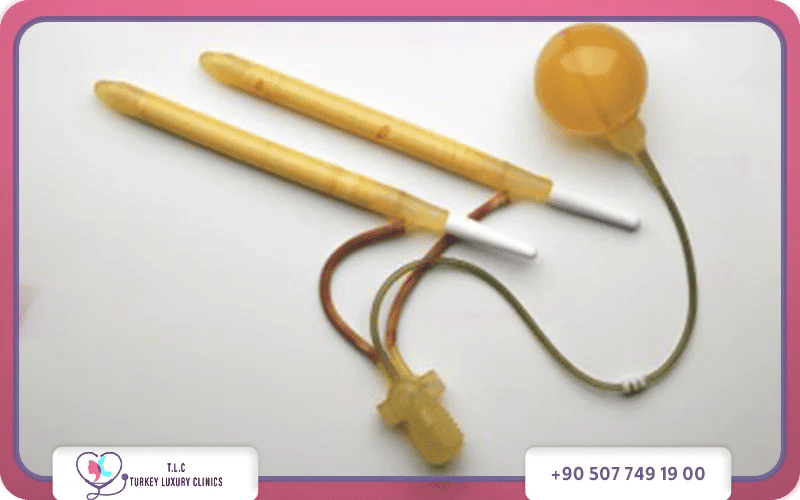
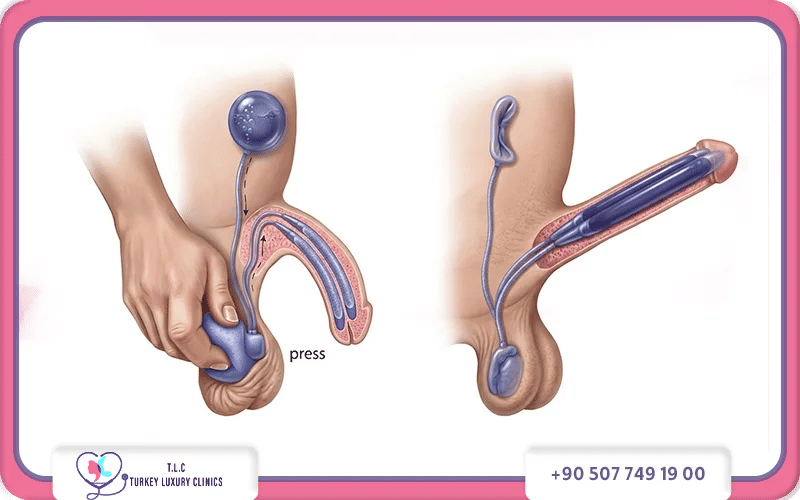
In ICD-10-CM coding, penile prostheses are classified based on their presence or any complications rather than the specific device type. The main clinical types include inflatable implants (2-piece or 3-piece) and non-inflatable implants (malleable or semi-rigid), which are reflected in diagnostic and procedural codes.
Complications of penile prostheses are primarily coded under T83.4, covering mechanical issues, displacement, and infections (e.g., T83.410 for mechanical breakdown, T83.420 for displacement, T83.61 for infection). These codes are essential for billing repairs or replacements and differentiate between initial and subsequent encounters.
A penile prosthesis is a surgically implanted device used to treat severe erectile dysfunction when other therapies have failed. Accurate documentation and ICD-10-CM coding are critical for maintaining precise medical records, supporting insurance claims, and guiding follow-up care.
This article details the presence, types, and common complications of penile prostheses, along with their corresponding ICD-10 codes.
Proper ICD-10 coding ensures accurate medical records, facilitates correct billing, and supports effective patient management.
By understanding both general codes for device presence/status and complication-specific codes (T83.x), healthcare providers can maintain comprehensive documentation and streamline clinical workflows.
Penile Prosthesis ICD-10 Codes 2026
Complication / Status | ICD-10 Code |
Presence of penile prosthesis | Z96.0 |
Presence of other specified functional implants | Z96.89 |
Erectile Dysfunction – Arterial | N52.01 |
Erectile Dysfunction – Diseases elsewhere | N52.1 |
Erectile Dysfunction – Unspecified | N52.9 |
Psychogenic ED | F52.21 |
Mechanical breakdown – Initial encounter | T83.410A |
Mechanical breakdown – Subsequent encounter | T83.410D |
Mechanical breakdown – Sequela | T83.410S |
Displacement / Malposition – Initial encounter | T83.420A |
Other mechanical complications | T83.490A |
Infection / Inflammatory reaction – Initial encounter | T83.61XA |
Erosion / Perforation – Initial encounter | T83.42XA |
Penile prosthesis removal – Procedure | 0VY44ZZ / 0VNL0ZZ |
What is penile implant ICD-10 Codes
The primary ICD-10-CM diagnosis code for the presence of a penile prosthesis (without complications) is Z96.0. For patients considered candidates for a penile implant, the primary code is N52.9 (Male erectile dysfunction, unspecified). ICD-10-CM codes for penile implants primarily focus on complications, including mechanical breakdown, displacement, infection, or other issues (T83.4‑ series). Professional coding also requires specific sub-codes to document the underlying medical necessity—the "why" and the "who"—behind the procedure.
Importance of ICD-10 Coding for Penile Prosthesis
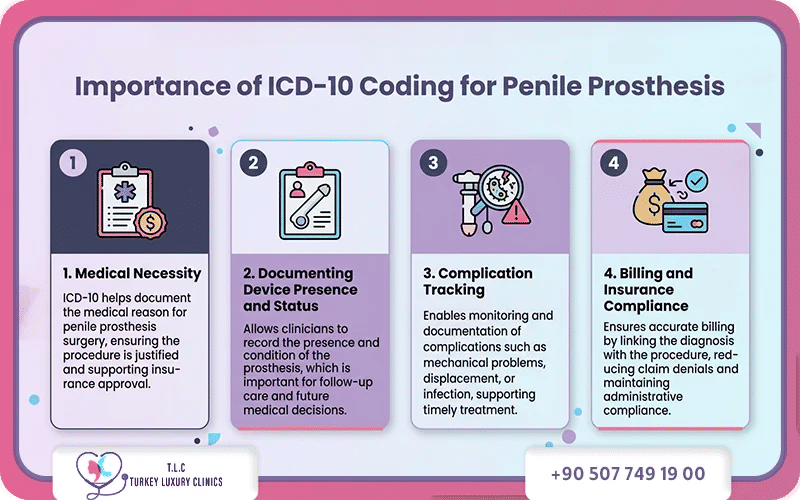
The ICD-10 (International Classification of Diseases, 10th Revision) provides a standardized system to classify medical conditions. For penile prostheses, it serves several important purposes:
1. Medical Necessity
Understanding ICD-10 helps healthcare providers document the medical reason for performing a penile prosthesis procedure. It clarifies why the surgery is necessary, ensuring that every intervention is medically justified. This also supports insurance processes and strengthens the credibility of the medical record.
2. Documenting Device Presence and Status
ICD-10 allows clinicians to accurately record whether a penile prosthesis is present and its current condition. This information is essential for patient follow-up, informing other medical teams, and ensuring proper decisions in future procedures or imaging studies.
3. Complication Tracking
ICD-10 plays a key role in monitoring complications after a penile prosthesis is implanted, including mechanical issues, displacement, or infection. Proper documentation enables timely medical intervention, improves patient outcomes, and provides a reliable clinical record for ongoing care.
4. Billing and Insurance Compliance
Knowing ICD-10 facilitates accurate billing and insurance documentation by linking the patient’s medical condition with the procedure. This reduces claim denials, ensures correct financial coverage for medical services, and maintains full compliance with both clinical and administrative standards.
Penile Prosthesis ICD-10-CM Primary Diagnosis (ED)
For 2026, coding for a penile prosthesis requires a clear distinction between the underlying condition (the “why”) and the mechanical status of the device. The following ICD-10-CM codes are used for documenting the primary diagnosis of erectile dysfunction in patients considered for a penile implant:
Code | Description | Clinical Context |
N52.01 | ED due to arterial insufficiency | Most common organic cause |
N52.1 | ED due to diseases classified elsewhere | Often used for diabetes-related ED |
N52.9 | Male erectile dysfunction, unspecified | Default if specific cause is not documented |
F 52.21 | Psychogenic erectile dysfunction | Psychological origin |
ICD10 for Penile Prosthesis Presence Status
The primary ICD-10-CM code for the presence of a penile prosthesis is Z96.0 (Presence of urogenital implants). This code is used when a penile implant is present and functioning normally without any complications. Another related code is Z96.89, which indicates the presence of other specified functional implants.
Z96.0 is a status code, meaning it serves as a label in the patient’s medical record to show that a prosthesis is present. It applies to all penile implant types, including inflatable 2-piece, 3-piece, or malleable devices. This code is typically used for routine follow-ups or when the presence of the implant may affect other medical care.
What Z96.0 indicates in medical records:
- No current problem: The device is present but is not broken, infected, or causing pain.
- Informational only: Alerts other healthcare providers or insurance that the patient has a foreign medical device, important for future procedures or imaging (e.g., MRI).
- Not the “reason for visit”: This code is not used for the surgery itself or device failure; it is applied when the implant is part of the patient’s medical history.
Penile Prosthesis ICD10 for Complication (T-Series)
ICD-10-CM Code | Description |
T83.410A | Mechanical breakdown of implanted penile prosthesis, initial encounter |
T83.410D | Mechanical breakdown of implanted penile prosthesis, subsequent encounter |
T83.410S | Mechanical breakdown of implanted penile prosthesis, sequela |
T83.420A | Displacement of implanted penile prosthesis, initial encounter |
T83.490A | Other mechanical complications (leakage, protrusion, obstruction, perforation), initial encounter |
T83.61XA / T83.61XD | Infection and inflammatory reaction due to implanted penile prosthesis |
Penile implant ICD-10-CM codes for complications include T83.410A (mechanical breakdown), T83.420A (displacement), and T83.490A (other complications). These codes are used for reporting specific, active issues with prosthetic devices.
Complications have precise ICD-10-CM codes under T83.4 (Complications of other prosthetic devices, implants, and grafts of the genital tract):
ICD-10-CM Codes for Penile Prosthesis Malfunction
Mechanical Complication Type | ICD-10-CM Code | Description |
Breakdown – Initial Encounter | T83.410A | Mechanical breakdown of implanted penile prosthesis |
Breakdown – Subsequent Encounter | T83.410D | Mechanical breakdown of implanted penile prosthesis |
Breakdown – Sequela | T83.410S | Mechanical breakdown of implanted penile prosthesis, sequela |
Displacement – Initial Encounter | T83.420A | Displacement (malposition) of implanted penile prosthesis |
Other Mechanical Complications | T83.490 | Other mechanical complications (leakage, obstruction, perforation) |
ICD10 for Erosion of Penile Prosthesis
The code is T83.491A, used to document cases where the penile prosthesis erodes into surrounding tissue, helping track mechanical complications, guide clinical decisions, and ensure accurate medical documentation.
ICD 10 Code for Infected Penile Prosthesis
The code is T83.61, applied when the implanted penile prosthesis develops an infection or inflammatory reaction, supporting proper treatment, medical record documentation, and insurance claims.
ICD 10 for Penile Prosthesis Removal
The code depends on the procedure—for example, ICD-10-PCS 0VY44ZZ for removal (external approach), with underlying diagnosis codes such as T83.61, T83.410A, or T83.420A to reflect infection, mechanical breakdown, or displacement, ensuring the procedure is fully documented and justified for clinical and insurance purposes.
Penile Implant ICD10 for Bills and Insurance Coverage
Purpose | Code Example |
Underlying Diagnosis (ED) | N52.01 – N52.9, F52.21 |
Device Status / Presence | Z96.0, Z96.89 |
Mechanical Complication | T83.410A, T83.420A, T83.490A |
Infection / Inflammation | T83.61XA |
Device Removal Procedure | 0VY44ZZ / 0VNL0ZZ |
Penile implants, primarily used for treating erectile dysfunction (ED), are generally covered by insurance when deemed medically necessary. Billing requires specific ICD-10 codes. Key codes include N52.x (Erectile Dysfunction) for the underlying diagnosis and complication-related codes such as T83.410 (mechanical breakdown) or T83.61X (infection).
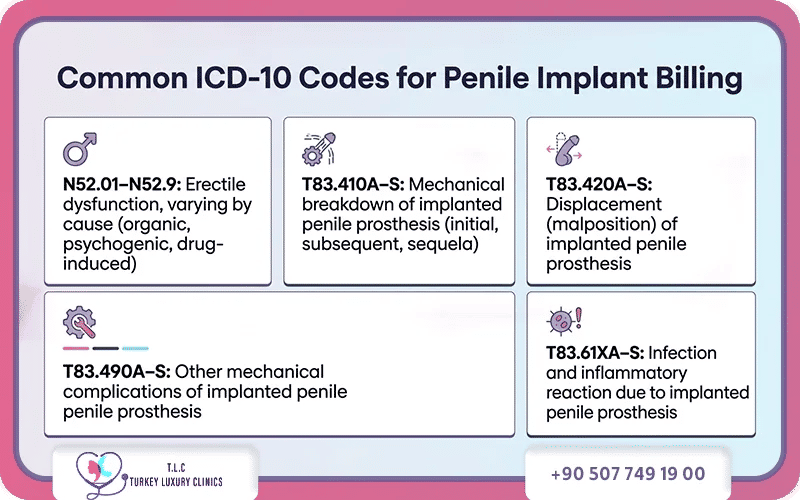
Common ICD-10 Codes for Penile Implant Billing:
- N52.01–N52.9: Erectile dysfunction, varying by cause (organic, psychogenic, drug-induced)
- T83.410A–S: Mechanical breakdown of implanted penile prosthesis (initial, subsequent, sequela)
- T83.420A–S: Displacement (malposition) of implanted penile prosthesis
- T83.490A–S: Other mechanical complications of implanted penile prosthesis
- T83.61XA–S: Infection and inflammatory reaction due to implanted penile prosthesis
Penile Prosthesis Specific Coding System
Category | Primary Code(s) | Usage Context |
Diagnosis | N48.4 | Organic impotence / Erectile dysfunction |
Status Code | Z96.0 | Presence of a functional penile prosthesis |
Complications | T83.61XA | Infection or inflammatory reaction due to device |
Procedure | 0VUS0JZ | ICD-10-PCS for implantation of synthetic substitute |
CPT codes are used alongside ICD-10 codes to document the surgical procedure for penile prostheses. Common codes include 54410 for insertion of a penile prosthesis and 54416 for revision or replacement. Including both ICD-10 and CPT codes ensures accurate billing, insurance approval, and complete medical documentation.
Related topics:
How Long After Penile Implant Surgery Can I Use It
Penile Implant Size Options: Find the Best Fit for You
How Much Does a Penile Implant Cost? 2026 Prices by Country and Type
FAQs Penile Prosthesis ICD 10
When does a penile prosthesis need removal?
Removal is usually required for severe infection, mechanical failure, or erosion. Code: penile prosthesis removal icd 10.
What is the difference between inflatable and fixed implants?
Inflatable implants allow controlled erections; fixed (malleable) implants stay semi-rigid.
How are malfunctions or infections documented?
Use T83.410A for mechanical breakdown, T83.420A for displacement, T83.61 for infection.