

- What Do PRK and ICL Have in Common?
- PRK vs ICL at a Glance
- How Do PRK and ICL Correct Vision?
- TransPRK vs ICL
- Which Is Better: PRK or ICL?
- Are You Eligible for Both PRK and ICL? How to Decide?
- Long-Term Complications of PRK vs ICL
- Who Is NOT a Candidate for PRK?
- Who Is NOT a Candidate for ICL?
- PRK and ICL Cost in Turkey
- Not Sure Whether PRK or ICL Is Right for You?
- FAQs About PRK vs ICL
PRK is usually the better choice for mild to moderate nearsightedness (up to about −6.00 D) with healthy corneas, while ICL is usually better for high myopia, thin corneas, or dry eyes. PRK reshapes the cornea with a laser and costs less, while ICL implants a removable lens inside the eye, offers faster recovery, and costs more.
PRK (Photorefractive Keratectomy) and ICL (Implantable Collamer Lens) are two effective vision correction procedures designed to reduce dependence on glasses and contact lenses for adults with myopia and astigmatism.
While they share the same goal, they work in fundamentally different ways. PRK uses an excimer laser to permanently reshape the cornea, whereas ICL corrects vision by implanting a biocompatible lens inside the eye without removing corneal tissue.
This fundamental difference extends far beyond the surgical technique itself.
It influences recovery time, visual quality, dry eye risk, reversibility, long-term considerations, and the types of patients who are most suitable for each procedure.
Both procedures can deliver excellent visual outcomes, but the best choice ultimately depends on factors such as prescription strength, corneal thickness, eye anatomy, lifestyle, and visual expectations.
In general, ophthalmologists often recommend PRK for patients with mild to moderate refractive errors and healthy corneas, while ICL is frequently preferred for higher prescriptions, thin corneas, or patients seeking the highest level of visual quality.
What Do PRK and ICL Have in Common?
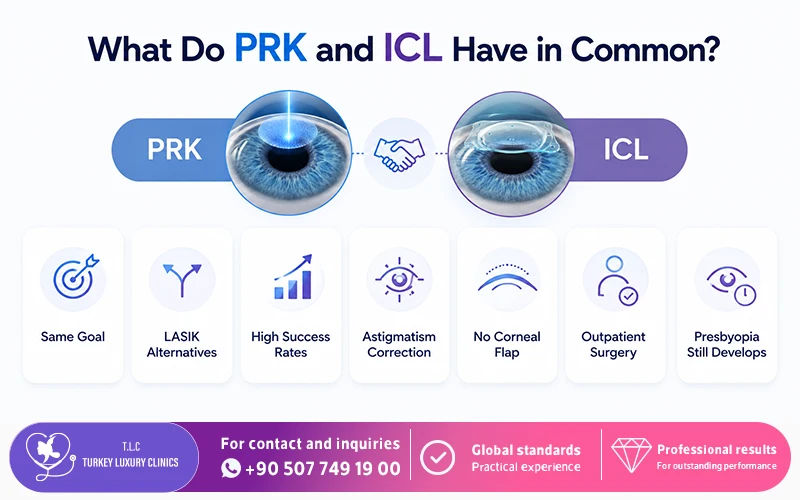
- Same Goal: Reduce dependence on glasses and contact lenses.
- LASIK Alternatives: Suitable for many patients who are not ideal LASIK candidates.
- High Success Rates: Frequently achieve 20/20 vision or better.
- Astigmatism Correction: Both can treat myopia and astigmatism.
- No Corneal Flap: Neither procedure creates a LASIK-style flap.
- Outpatient Surgery: Performed with numbing eye drops and same-day discharge.
- Presbyopia Still Develops: Neither procedure prevents age-related reading vision changes.
PRK vs ICL at a Glance
Feature | PRK | ICL |
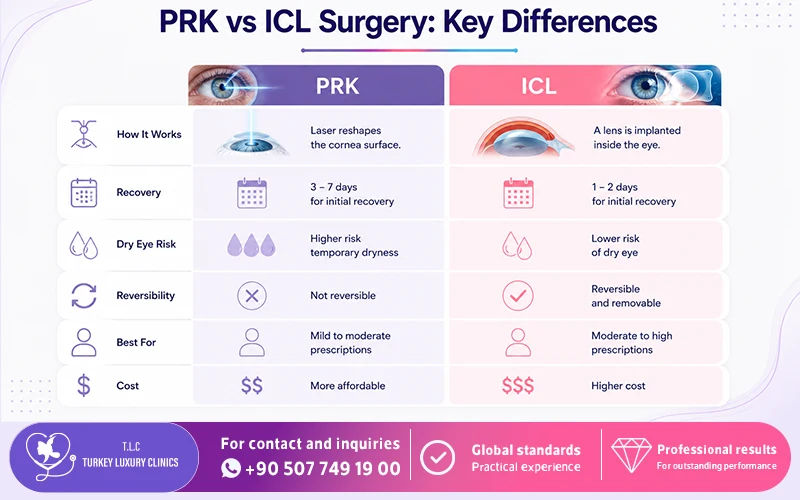
How It Works | Reshapes the cornea with a laser | Implants a lens inside the eye |
Reversibility | Permanent | Removable or replaceable |
Recovery Time | Days to months | 24–48 hours |
Pain & Discomfort | Moderate for several days | Minimal |
Prescription Range | Mild to moderate myopia | Moderate to very high myopia |
Dry Eye Risk | Higher | Lower |
Surgical Setting | Surface laser procedure | Intraocular lens procedure |
Average Cost | $2,300–$2,500 per eye | $4,000–$7,000 per eye |
How Do PRK and ICL Correct Vision?
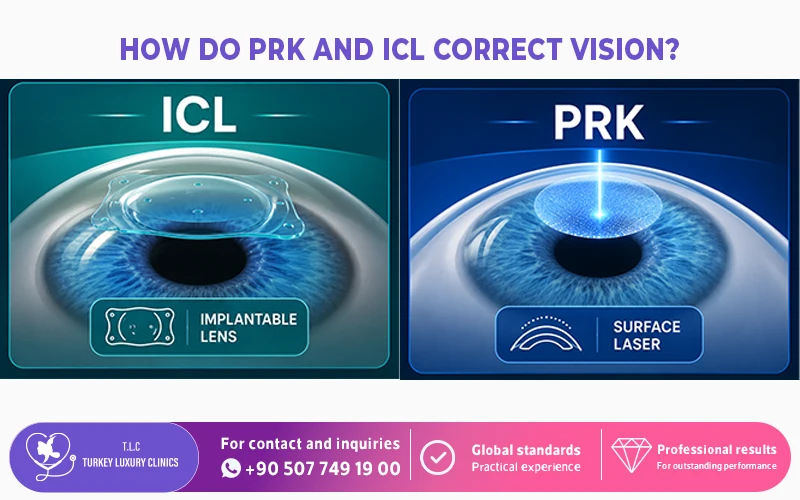
The core differences between PRK and ICL come from how each procedure corrects refractive errors. PRK permanently reshapes the surface of your eye using a laser, while ICL adds a prescription lens inside your eye, leaving your natural cornea completely unaltered.
How PRK (Photorefractive Keratectomy) Works
PRK is a laser vision correction procedure that reshapes the cornea to correct refractive errors. Unlike LASIK, no corneal flap is created.
- Epithelium Removal: The surgeon gently removes the thin outer layer of the cornea (epithelium).
- Corneal Reshaping: An excimer laser removes microscopic amounts of corneal tissue to change how light focuses inside the eye.
- Healing: A bandage contact lens is placed while the epithelium naturally regenerates over the following days.
How ICL (Implantable Collamer Lens) Works
ICL is an additive vision correction procedure that leaves the cornea untouched. Instead of reshaping the eye, it corrects vision by placing a lens inside the eye.
- Lens Insertion: A foldable Collamer lens is inserted through a small corneal incision.
- Lens Placement: The lens is positioned behind the iris and in front of the natural lens.
- Optical Correction: The implanted lens redirects light so it focuses accurately on the retina.
What Is EVO ICL?
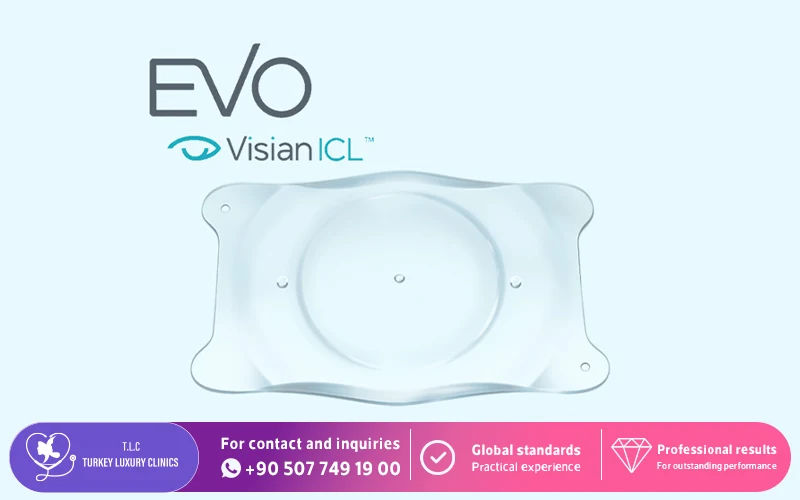
EVO ICL is the latest generation of the ICL. The key difference is that older ICL models required a pre-surgery laser procedure, while the EVO ICL features a central port that eliminates this step and significantly improves fluid flow within the eye.
TransPRK vs ICL
TransPRK (transepithelial PRK) is a “no-touch” version of PRK in which the excimer laser removes the corneal surface layer and reshapes the cornea in a single step, without a blade, brush, or alcohol. It may cause less discomfort and slightly faster surface healing than conventional PRK, but it still removes corneal tissue and has the same prescription and corneal thickness limits. Compared with ICL, TransPRK suits patients with mild to moderate myopia and healthy corneas, while ICL remains the better option for high myopia, thin corneas, or dry eyes.
Which Is Better: PRK or ICL?
There is no universally better procedure. The ideal choice depends on your refractive error, corneal thickness, dry eye status, visual expectations, and overall eye health.
When Is PRK the Better Choice?
PRK is often the preferred option in the following situations:
1. Low to Moderate Myopia (typically -1.00 to -5.50 D)
PRK is often favored because it can achieve outcomes comparable to ICL in lower prescriptions without the added cost, intraocular surgery, or implant-related considerations. Mild to moderate astigmatism can also be corrected effectively.
2. Thick, Healthy Corneas
PRK is commonly recommended when corneal thickness and topography allow safe laser reshaping. In these cases, the tissue-preserving advantages of ICL may provide little additional benefit.
3. Normal Corneal Topography
Patients with healthy corneal anatomy and no signs of keratoconus are often good candidates for PRK because the cornea can be safely reshaped while maintaining long-term stability.
4. Preference to Avoid Implants
Some patients prefer PRK because it corrects vision without leaving a lens inside the eye. Vision is improved by reshaping the cornea rather than implanting a permanent device.
5. Concern About Intraocular Surgery
PRK remains entirely on the corneal surface and does not involve operating inside the eye. This eliminates lens-related risks and complications associated with intraocular procedures.
6. Lower Cost
PRK is typically more affordable than ICL while still providing excellent visual outcomes for appropriately selected patients.
Overall, PRK is generally best suited for patients with low-to-moderate refractive errors, healthy corneas, and a preference for a non-implant, laser-based vision correction procedure.
When Is ICL the Better Choice?
ICL is often the preferred option in the following situations:
1. Moderate to High Myopia
ICL is frequently recommended for prescriptions above -6.00 D and is particularly beneficial for higher levels of myopia. Unlike PRK, it does not require removing increasing amounts of corneal tissue as prescriptions become stronger.
2. Very High Myopia (-8.00 D and Above)
Many surgeons favor ICL because it preserves corneal tissue, maintains excellent optical quality, and often delivers more predictable outcomes in higher prescriptions.
3. Thin or Borderline Corneas
ICL is commonly chosen when laser correction may remove too much corneal tissue. Because no corneal reshaping is required, the natural corneal structure and biomechanics are preserved.
4. Dry Eye Disease
ICL is often preferred for patients with pre-existing dry eye symptoms because it has minimal impact on corneal nerves, whereas PRK may temporarily worsen dryness during recovery.
5. Need for Premium Visual Quality
ICL may provide advantages in contrast sensitivity, visual clarity, and night vision, particularly in patients with moderate to high myopia. This is partly because the procedure preserves the natural shape of the cornea.
6. High Visual Demands
Frequent night drivers, pilots, and individuals in visually demanding professions may benefit from the optical advantages often associated with ICL.
7. Need for Faster Recovery
Significant visual improvement commonly occurs within 24 to 48 hours, whereas PRK recovery and visual stabilization typically take longer.
8. Preference for Reversibility
Unlike PRK, which permanently reshapes the cornea, the implanted lens can be removed or replaced if medically necessary in the future.
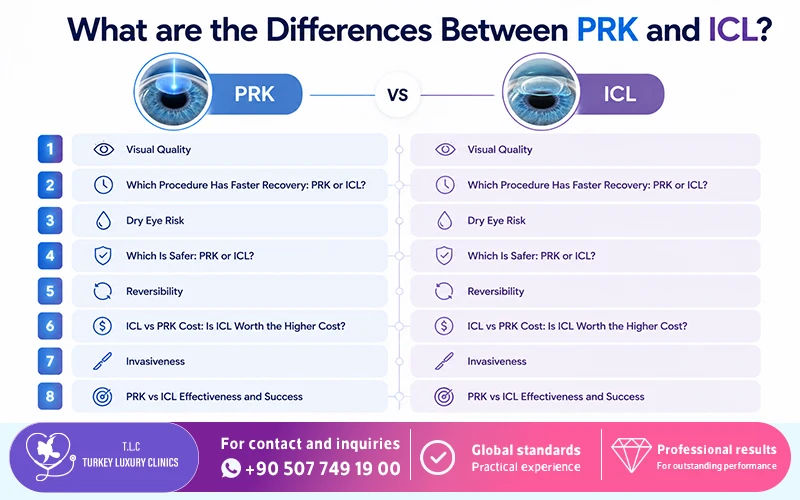
What are the Differences Between PRK and ICL?
1. Visual Quality
PRK: PRK can provide excellent long-term visual outcomes, but vision improves gradually. Most patients achieve functional vision within a few weeks, while final visual stability and sharpness may take 1 to 3 months.
ICL: ICL is known for delivering excellent visual quality, particularly in patients with moderate to high myopia. Because the procedure preserves the natural corneal shape, many patients experience sharper contrast sensitivity and better night vision compared with laser-based procedures for higher prescriptions.
2. Which Procedure Has Faster Recovery: PRK or ICL?
ICL generally offers faster visual recovery than PRK. Many patients notice significant visual improvement within 24 to 48 hours after surgery, whereas PRK requires a longer healing period and vision may continue stabilizing for several weeks to months.
PRK Recovery:
PRK recovery requires a gradual healing process. While the corneal surface typically heals within 3 to 5 days, achieving full visual clarity and stabilization often takes 1 to 3 months. During the first week, patients commonly experience discomfort, blurred vision, and light sensitivity.
ICL Recovery:
In contrast, ICL recovery is usually much faster because the corneal surface remains largely untouched. Most patients can resume normal daily activities sooner and experience rapid visual improvement within the first few days after surgery.
3. Dry Eye Risk
PRK: PRK may temporarily worsen dry eye symptoms because it affects corneal nerves involved in tear production. While symptoms often improve as the nerves regenerate, some patients may experience dryness for several months after surgery. This consideration is particularly important for patients with pre-existing dry eye disease, as PRK may temporarily aggravate their symptoms during the healing process.
ICL: ICL has a lower risk of postoperative dry eye because it does not require corneal reshaping or significant disruption of corneal nerves. For patients with pre-existing dry eye, it is often considered a favorable alternative to laser vision correction.
4. Which Is Safer: PRK or ICL?
For patients with healthy corneas and low-to-moderate prescriptions, PRK is often considered the lower-risk option because it avoids intraocular surgery. However, for patients with thin corneas or high myopia, ICL may actually be the safer and more effective choice because it preserves corneal tissue and avoids excessive laser correction.
From a surgical perspective, PRK is generally considered less risky because it is performed entirely on the corneal surface. In contrast, ICL is an intraocular procedure that involves implanting a lens behind the iris.
Although modern EVO ICL surgery has an excellent safety record, potential complications may include:
- Cataract formation
- Elevated intraocular pressure (glaucoma)
- Endothelial cell loss
- Lens repositioning or removal
- Intraocular infection (rare but potentially serious)
PRK avoids these intraocular risks but carries its own potential complications, including dry eye symptoms, corneal haze, regression, delayed healing, and night vision disturbances.
5. Reversibility
PRK: PRK permanently reshapes the cornea by removing tissue. Once the corneal tissue has been altered, the change cannot be reversed.
ICL: One of the key advantages of ICL is that the implanted lens can be removed or exchanged if necessary. Although the lens is intended to remain in place long term, the procedure offers a level of reversibility that laser vision correction cannot provide.
6. ICL vs PRK Cost: Is ICL Worth the Higher Cost?
PRK: In the United States, PRK typically costs between $1,500 and $5,500 per eye, making it one of the more affordable surgical vision correction options.
ICL: ICL generally costs between $4,000 and $7,000 per eye. The higher cost reflects the customized implant lens, additional measurements, and the complexity of intraocular surgery.
Is the extra cost worth it? For patients with high myopia, thin corneas, dry eye concerns, or a desire for faster recovery and lens reversibility, many ophthalmologists consider the additional cost of ICL justified. However, for patients with low-to-moderate prescriptions who are good laser candidates, PRK often provides excellent outcomes at a significantly lower cost.
7. Invasiveness
PRK: PRK is considered a minimally invasive surface procedure because all treatment is performed on the outer layers of the cornea. No instruments enter the inside of the eye, and no implant is left behind after surgery. Although PRK removes microscopic amounts of corneal tissue with a laser, the procedure remains confined to the corneal surface.
ICL: ICL is a more invasive procedure because it involves operating inside the eye and implanting a lens behind the iris. A small corneal incision is required to insert the lens, and the surgeon works within the eye's anterior chamber. However, despite being more invasive, ICL is often associated with faster visual recovery and may provide superior optical quality in patients with moderate to high myopia.
PRK is generally considered less invasive because it does not involve entering the eye or placing a permanent implant. ICL, while highly safe in appropriately selected patients, is an intraocular procedure and therefore carries a different risk profile related to the implanted lens and the structures inside the eye.
8. PRK vs ICL Effectiveness and Success
PRK and ICL both achieve excellent visual outcomes in appropriately selected patients. Most studies report that over 95% of patients achieve 20/20 to 20/40 vision after treatment.
PRK delivers highly predictable results for mild to moderate refractive errors and has decades of long-term clinical data supporting its effectiveness.
ICL also provides excellent visual acuity outcomes and may offer advantages in contrast sensitivity, night vision, and predictability in patients with moderate to high myopia because the cornea remains unaltered.
Are You Eligible for Both PRK and ICL? How to Decide?
Some patients may qualify for both PRK and ICL, particularly when they have refractive errors that fall within the treatment range of both procedures and no major anatomical limitations.
Patients who are often eligible for both include those with:
- Mild to moderate myopia.
- Mild to moderate astigmatism.
- Stable vision for at least one year.
- Healthy corneal topography with no signs of keratoconus.
- Sufficient corneal thickness for safe PRK treatment.
- Adequate anterior chamber depth and endothelial cell count for ICL implantation.
- No significant dry eye disease, cataracts, glaucoma, or other eye conditions that would limit candidacy.
When a patient qualifies for both procedures, the decision usually depends on factors such as recovery speed, visual quality expectations, preference for or against an implanted lens, reversibility, and budget considerations rather than medical eligibility alone.
PRK is often preferred by patients who are comfortable with a longer recovery period and prefer a lower-cost treatment option.
ICL is often chosen by patients who prioritize faster visual recovery, lens reversibility, and premium visual quality, particularly in low-light conditions.

Long-Term Complications of PRK vs ICL
Both PRK and ICL have excellent long-term safety records, but their potential complications differ because PRK reshapes the cornea while ICL involves an implanted lens inside the eye.
PRK Long-Term Complications
- Persistent Dry Eye Symptoms: A small percentage of patients may continue to experience dryness or fluctuating vision.
- Regression: Part of the vision correction may gradually diminish over time, particularly in higher prescriptions.
- Night Vision Disturbances: Some patients may notice halos, glare, or starbursts around lights.
- Corneal Haze: An uncommon complication that can affect visual clarity and contrast sensitivity.
- Corneal Ectasia: A rare but serious condition in which the cornea progressively weakens and bulges forward.

ICL Long-Term Complications
- Cataract Formation: Although uncommon with modern EVO ICL lenses, cataract development remains a potential long-term consideration.
- Elevated Eye Pressure: Some patients may develop increased intraocular pressure that requires monitoring or treatment.
- Additional Surgery: In rare cases, the implanted lens may need to be repositioned, exchanged, or removed.
- Endothelial Cell Loss: Long-term follow-up is recommended to monitor the health of the cornea.
- Future Cataract Surgery Considerations: Age-related cataracts can still develop later in life and may require additional surgery.
Who Is NOT a Candidate for PRK?
PRK may not be suitable for patients with:
- Very Thin Corneas: There may not be enough corneal tissue to safely perform laser reshaping.
- Keratoconus or Irregular Corneas: Abnormal corneal shape can increase the risk of instability after treatment.
- Unstable Prescription: Vision should remain stable for at least one year before surgery.
- Severe Dry Eye Disease: Significant dryness may worsen recovery and affect visual outcomes.
- Certain Medical Conditions: Some autoimmune diseases and conditions that impair healing may increase the risk of complications.
- Pregnancy or Breastfeeding: Hormonal changes can temporarily affect vision and refractive stability.
Who Is NOT a Candidate for ICL?
ICL may not be suitable for patients with:
- Thin Internal Eye Space (Shallow Anterior Chamber): There may not be enough room to safely place the lens inside the eye.
- Existing Cataracts: Patients who already have visually significant cataracts are usually better candidates for cataract surgery rather than ICL.
- Uncontrolled Glaucoma: Elevated eye pressure can increase the risk of complications after lens implantation.
- Active Eye Inflammation: Conditions such as uveitis may increase the risk of postoperative complications.
- Certain Retinal Disorders: Untreated retinal tears or other significant retinal conditions may need to be addressed before considering ICL surgery.
- Prescriptions Outside the Treatable Range: Extremely unusual prescriptions may fall outside the available ICL lens parameters.

PRK and ICL Cost in Turkey
Both PRK and ICL cost significantly less in Turkey than in the US or UK, often less than half the price, and most clinics offer all-inclusive packages that cover the eye exam, surgery, medications, and follow-up visits. As in other countries, ICL costs more than PRK because of the implanted lens and the complexity of intraocular surgery. For detailed prices, see our guides to PRK surgery cost and ICL eye surgery cost.
Not Sure Whether PRK or ICL Is Right for You?
The right choice depends on numbers only an eye exam can give: your prescription, corneal thickness, and the space inside your eye. If you already have recent eye test results or a prescription, send them to our team on WhatsApp for a free preliminary review. Our ophthalmologists will tell you whether PRK, ICL, or another option suits your eyes, and give you a clear price for treatment in Turkey before you make any travel plans.
Get a Free PRK vs ICL Assessment
FAQs About PRK vs ICL