

- What Is Stem Cell Therapy for a Herniated Disc?
- How Does Stem Cell Therapy Work for a Herniated Disc?
- What Is the Success Rate of Stem Cell Therapy for a Herniated Disc?
- Cost of Stem Cell Therapy for a Herniated Disc
- Who Is a Good Candidate for Stem Cell Therapy for a Herniated Disc?
- Who May Still Need Surgery?
- Stem Cell Therapy for L5-S1 Herniated Disc
- Stem Cell Therapy for Herniated Cervical Disc
- How Is Stem Cell Therapy for a Herniated Disc Performed?
- Recovery After Stem Cell Therapy for a Herniated Disc
- Is Stem Cell Therapy for a Herniated Disc Worth It?
- Is Stem Cell Therapy FDA-Approved for Herniated Discs?
- Risks and Side Effects of Stem Cell Therapy for Herniated Discs
- How Turkey Luxury Clinics Can Help You
- FAQs About Stem Cell Therapy for Herniated Disc
Can stem cell therapy actually help a herniated disc without surgery? For some carefully selected patients, it may help reduce inflammation and pain and improve function—but it cannot physically remove a herniated disc or decompress a severely pinched nerve.
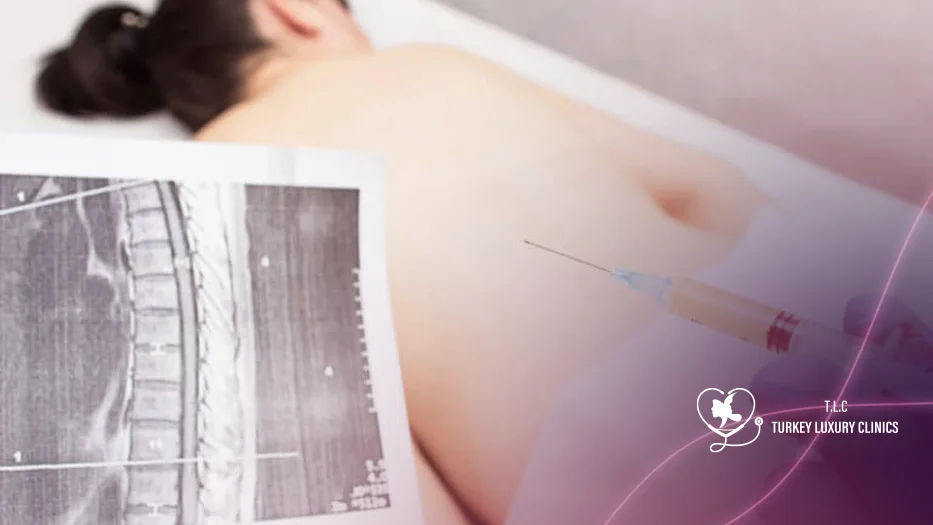
Stem cell therapy is an emerging, minimally invasive treatment that uses concentrated cells, usually from bone marrow or fat, injected into the damaged disc to support the local healing environment and potentially improve symptoms.
What Is Stem Cell Therapy for a Herniated Disc?
Stem cell therapy for a herniated disc is an experimental regenerative treatment in which a stem-cell-based or cell-containing preparation is injected into or around a damaged intervertebral disc. The treatment is being studied primarily for its potential to reduce inflammation and pain and support the biological environment of damaged or degenerative disc tissue.
Stem cells are cells capable of self-renewal and, depending on the type, developing into specialized cells. For spinal disc treatments, research has focused largely on mesenchymal stromal/stem cells (MSCs) and related cell preparations.
How Does Stem Cell Therapy Work for a Herniated Disc?
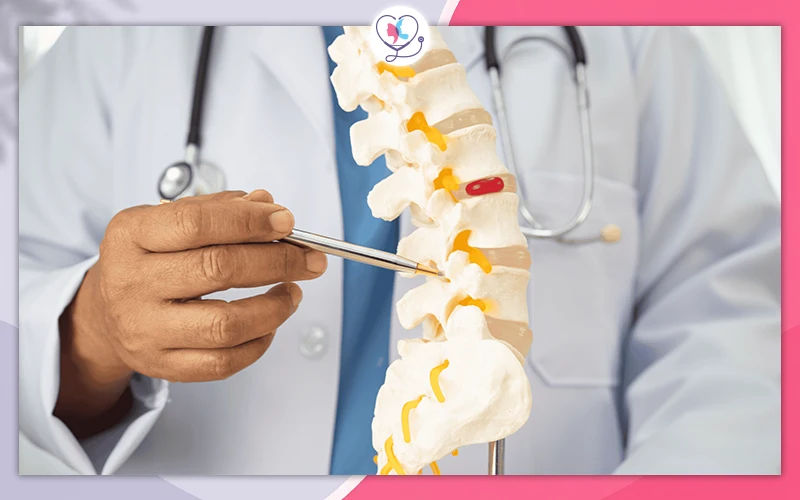
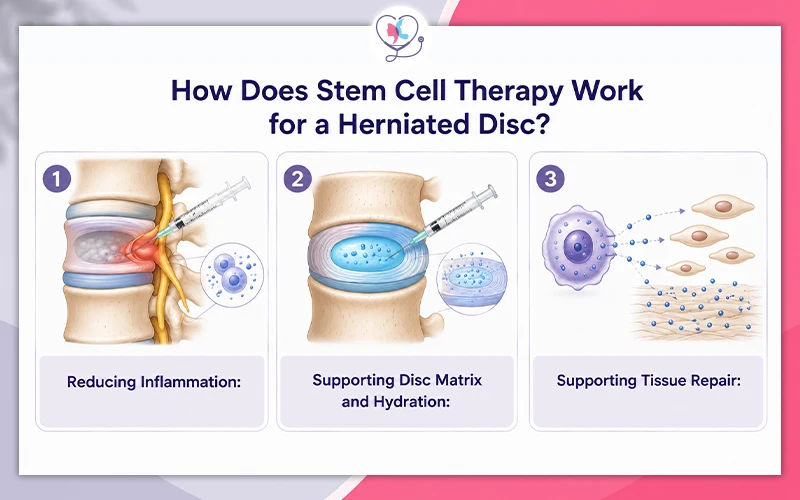
Researchers are investigating several mechanisms through which stem-cell-based therapies may affect damaged intervertebral discs:
1. Reducing Inflammation:
MSCs can release signaling molecules that may modulate inflammatory activity within the damaged disc.
Reducing this inflammatory environment may contribute to pain relief, although it does not physically remove the herniated portion of the disc.
2. Supporting Disc Matrix and Hydration:
Preclinical research suggests that MSCs may support the production of extracellular matrix components, including proteoglycans, that help the nucleus pulposus retain water.
Researchers are studying whether this could help preserve or improve disc tissue, but reliable regeneration of a herniated disc in humans has not been established.
3. Supporting Tissue Repair:
MSCs release growth factors and other signaling molecules that may influence surviving disc cells and the local repair environment.
Much of the proposed regenerative effect may therefore come from cell signaling rather than the injected cells simply becoming new disc tissue.
Does Stem Cell Therapy Work for a Herniated Disc?
Stem cell therapy may help reduce pain and improve function in some patients with disc-related back pain, but it has not been proven to reliably repair or structurally reverse a herniated disc.
Most clinical research has focused on mesenchymal stem cell (MSC) injections for degenerative disc disease and chronic discogenic low back pain, rather than on physically correcting a herniated disc that is compressing a nerve.
Current evidence suggests that intradiscal stem cell therapy may:
- Reduce pain in some patients with chronic disc-related back pain.
- Improve physical function and disability scores.
- Reduce inflammatory activity within the damaged disc.
- Potentially support the biological environment of degenerating disc tissue.
However, stem cell injections do not remove or dissolve the herniated portion of the disc, and they cannot reliably relieve significant mechanical compression of a nerve or the spinal cord.
A recent systematic review and meta-analysis of randomized trials found that intradiscal MSC injections produced modest improvements in pain and function in patients with chronic low back pain caused by degenerative disc disease, but the evidence remains limited and treatment protocols are not yet standardized.
Therefore, symptom improvement after stem cell therapy should not be interpreted as proof that the herniated disc has regenerated.
What Stem Cell Therapy Cannot Do for a Herniated Disc
Stem cell therapy cannot:
- Remove or shrink a herniated disc fragment that is mechanically compressing a nerve.
- Immediately decompress a pinched nerve or spinal cord.
- Reliably repair a large annular tear or restore severely damaged disc structure.
- Reverse advanced disc degeneration or severe disc collapse.
- Correct spinal instability, deformity, or significant spinal stenosis.
- Replace surgery when there is severe or progressive neurological compression.
- Guarantee disc regeneration or complete structural healing on MRI.
- Reliably treat progressive muscle weakness, foot drop, or cauda equina syndrome, which require urgent specialist evaluation.
What Is the Success Rate of Stem Cell Therapy for a Herniated Disc?
The success rate of stem cell therapy for a herniated disc is not yet firmly established, but studies of intradiscal stem cell therapy for degenerative and disc-related pain suggest that approximately 50–80% of carefully selected patients may experience meaningful pain relief or functional improvement.
Results vary because studies use different stem cell types, doses, patient-selection criteria, follow-up periods, and definitions of “success.”
Research has reported:
- Around 50–55% of patients experienced meaningful pain relief at six months in a 2026 review of emerging biologic therapies.
- A systematic review and meta-analysis of randomized controlled trials reported that 85% of patients in one included study had significantly reduced lumbar pain and disability at three months. However, the review also noted inconsistent results across trials and a lack of high-quality evidence.
Importantly, pain relief does not mean the herniated disc has fully healed or regenerated. Most studies measure improvements in pain, mobility, disability, and quality of life rather than complete structural repair on MRI.
Overall, stem cell therapy appears most promising for carefully selected patients with disc degeneration and chronic disc-related pain, while evidence specifically proving that stem cells can repair a herniated disc remains limited.

Cost of Stem Cell Therapy for a Herniated Disc
Stem cell therapy for a herniated disc typically costs about $5,000–$15,000 per treatment in the United States, although some specialized spine procedures may cost $20,000 or more. International prices can be lower, with treatments in countries such as Mexico or Thailand often ranging from roughly $1,000–$10,500, depending on the clinic and treatment package.
The final cost depends on the number of discs treated, cell source, cell processing method, imaging guidance, physician fees, facility costs, and whether more than one treatment session is recommended.
Stem cell therapy for back or disc pain is also often not covered by standard health insurance, especially when the treatment is considered investigational, so patients may need to pay the full cost out of pocket.
Stem cell therapy for a herniated disc in Turkey costs around $5,000–$13,000, depending on the type and number of cells used, the number of discs treated, and whether fluoroscopy or CT guidance is required for the injection.
The price includes the specialist consultation, medical assessment, cell collection or preparation, laboratory processing, image-guided spinal injection, and follow-up care. Medical-tourism packages may also include airport transfers, translation, and local patient coordination.

Who Is a Good Candidate for Stem Cell Therapy for a Herniated Disc?
An ideal candidate for intradiscal stem cell therapy is a patient with chronic disc-related back pain, mild-to-moderate disc degeneration on MRI, and persistent symptoms despite appropriate conservative treatment, without severe nerve compression or a major neurological deficit.
Current research emphasizes careful patient selection because the strongest clinical rationale for intradiscal cell therapy is discogenic pain associated with degenerative disc disease, rather than every type of herniated disc.
Potential candidates typically have:
- Mild-to-moderate symptomatic disc degeneration, with enough remaining disc structure rather than advanced collapse.
- Chronic axial back or neck pain originates from the affected disc.
- Symptoms that have not improved sufficiently with conservative care, such as physical therapy, activity modification, or appropriate medications.
- Research on intradiscal therapies commonly selects patients with persistent pain and disability despite conservative treatment.
- No progressive neurological deficit or major mechanical nerve compression.
- Realistic expectations: the goal is potential pain and functional improvement, not guaranteed regeneration or physical removal of the herniated disc.
Patients whose main problem is sciatica or arm pain caused by a herniated disc physically compressing a nerve are less suitable for intradiscal stem cell therapy.
Stem cells do not mechanically remove the disc fragment pressing on the nerve, and the National Spine Health Foundation specifically notes limited expected value for radicular pain caused by disc herniation or spinal stenosis.

Who May Still Need Surgery?
Stem cell therapy should not be used to delay appropriate surgical evaluation when the herniated disc is causing significant or progressive nerve compression. International spine guidance recommends surgery for lumbar disc herniation when there is cauda equina syndrome, progressive neurological impairment, severe motor deficit, or persistent symptoms after an adequate course of conservative treatment.
Surgery may therefore be necessary or more appropriate when there is:
- Progressive or severe muscle weakness, including significant motor loss or foot drop. Earlier surgery may improve the chance and speed of motor recovery in patients with major deficits.
- Cauda equina syndrome, particularly new bladder or bowel dysfunction, saddle-area sensory loss, or other signs of severe compression. This requires urgent medical assessment.
- Persistent disabling radicular pain from nerve compression that does not improve with appropriate conservative treatment.
- A structural problem that needs mechanical decompression, because an intradiscal cell injection cannot physically remove a herniated fragment compressing a nerve.
- Significant spinal instability or another structural abnormality for which regenerative injection would not correct the underlying mechanical problem.
Stem Cell Therapy for L5-S1 Herniated Disc
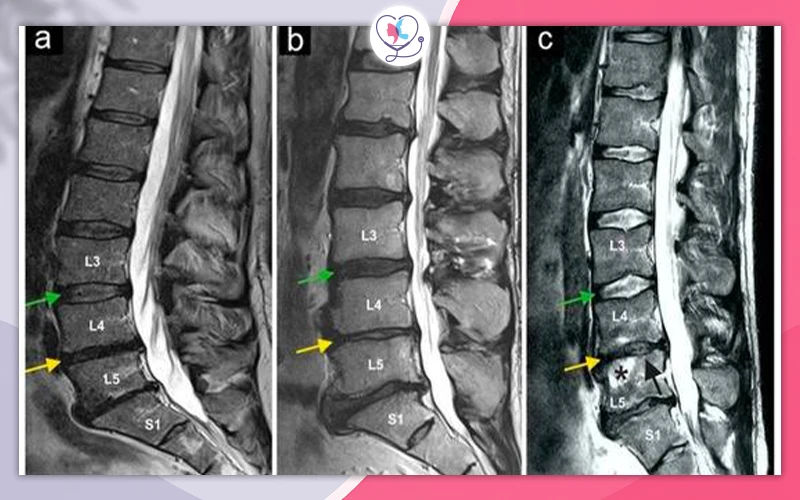
Stem cell therapy for an L5-S1 herniated disc is an investigational, minimally invasive option that may reduce inflammation and lower-back or leg pain, particularly in mild-to-moderate disc degeneration when conservative treatments fail.
Some patients report pain and functional improvement within 4–12 weeks, but evidence of structural disc healing on MRI remains limited. It is generally not suitable for severe disc collapse, spinal instability, or significant nerve compression with progressive weakness or numbness, which may require surgical decompression.
Stem Cell Therapy for Herniated Cervical Disc
Stem cell therapy for a bulging or herniated cervical disc is an emerging, minimally invasive regenerative treatment that uses mesenchymal stem cells (MSCs), injected directly into the damaged disc under imaging guidance, to target disc-related neck pain and degeneration. It remains investigational, with less clinical evidence for cervical discs than for lumbar degenerative disc disease.
While injections cannot physically shrink a large disc protrusion or fully repair deep tears in the disc wall, early studies of stem cell therapy for intervertebral disc disease have reported pain reduction and functional improvement. However, results vary, and long-term effectiveness remains uncertain.

How Is Stem Cell Therapy for a Herniated Disc Performed?
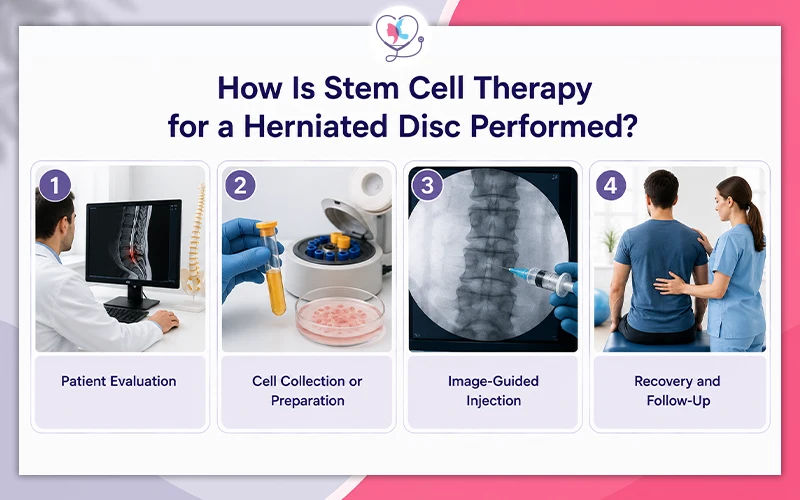
1. Patient Evaluation
MRI and clinical examination are used to determine the location and severity of disc damage and whether symptoms are likely coming from the affected disc.
2. Cell Collection or Preparation
Depending on the treatment being investigated or offered, cells may come from bone marrow, adipose tissue, or another prepared cell source.
3. Image-Guided Injection
The cell preparation is delivered to the targeted disc using fluoroscopy or another imaging technique to guide needle placement.
4. Recovery and Follow-Up
Patients are monitored after the injection and may gradually return to activity according to the treating physician's protocol. Improvements, when they occur, are generally evaluated over subsequent weeks and months.
Recovery After Stem Cell Therapy for a Herniated Disc
Recovery from an intradiscal stem cell injection is usually much shorter than recovery from major spine surgery. Patients may return to light daily activities within a few days, while improvements in pain and function—if treatment is effective—typically develop gradually over several weeks to months. Recovery protocols vary according to the type of cell therapy, number of discs treated, and the treating physician's instructions.
Recovery Timeline: What to Expect
Timeline | What to Expect |
First 1–3 days | Mild soreness may occur; light daily activity is usually possible. |
First 1–2 weeks | Gradually increase activity; avoid heavy lifting and high-impact exercise if advised. |
Weeks 2–6 | Gentle rehabilitation or physical therapy may begin if cleared by your doctor. |
1–3 months | Pain and function may begin to improve in patients who respond to treatment. |
3–6+ months | Improvements may continue, but complete disc regeneration is not guaranteed. |
Stem Cell Therapy Results Timeline for a Herniated Disc
Stem cell therapy results are usually gradual rather than immediate. Some patients may notice early pain relief within 2–6 weeks, while more noticeable improvements in pain and function may develop over 2–3 months. Results vary, and disc regeneration is not guaranteed.
Timeline | Possible Results |
1–2 weeks | Early changes may be limited; soreness from the injection usually settles. |
2–6 weeks | Some patients may begin noticing reduced pain and improved daily comfort. |
2–3 months | More noticeable improvements in pain, mobility, and function may appear in responders. |
3–6 months | Improvements may continue as treatment response is monitored. |
6–12+ months | Longer-term follow-up evaluates whether pain and functional improvements persist. |
Is Stem Cell Therapy for a Herniated Disc Worth It?
Stem cell therapy has potential benefits, but it also has important limitations. Here is a quick comparison:
Potential Benefits | Limitations |
Minimally invasive: Uses image-guided injections rather than open surgery. | Still experimental: Not FDA-approved for treating disc disease or back pain. |
Potential pain relief: Some studies report reduced pain and disability. | Results vary: Not every patient experiences meaningful improvement. |
May reduce inflammation: MSCs may help regulate inflammatory responses. | Cannot remove a herniation: It does not physically decompress a pinched nerve. |
Shorter recovery: Usually less downtime than major spine surgery. | Expensive: Treatment is often paid out of pocket. |
May improve function: Selected patients may experience better mobility and function. | Regeneration is unproven: Disc repair or regrowth cannot be guaranteed. |
Bottom line: Stem cell therapy may be worth considering for carefully selected patients with chronic disc-related pain and mild-to-moderate degeneration, but it is not a proven replacement for surgery when significant nerve compression or neurological deficits are present.
Is Stem Cell Therapy FDA-Approved for Herniated Discs?
No. Stem cell therapy is not FDA-approved specifically for treating herniated discs or other orthopedic conditions such as back pain or degenerative disc disease. In the United States, these treatments are generally considered investigational.
Some stem cell-based products are FDA-approved for specific blood and immune-system disorders, but these approvals do not extend to intradiscal injections or the treatment of herniated discs.
Patients considering stem cell therapy should therefore ask whether the treatment is part of a clinical trial, what type of cells are being used, and what evidence supports the proposed treatment.

Risks and Side Effects of Stem Cell Therapy for Herniated Discs
Stem cell therapy for herniated discs is generally described as minimally invasive, but intradiscal injections still carry risks, and long-term safety data remain limited.
Common or temporary side effects may include:
- Injection-site pain or soreness
- Swelling, bruising, or redness
- Temporary increase in back or neck pain
- Short-term inflammation or stiffness
Less common but potentially serious complications include:
- Infection, including infection within the disc (discitis)
- Bleeding
- Nerve injury, potentially causing pain, numbness, or weakness
- Cerebrospinal fluid (CSF) leak from accidental dural puncture
- Immune or allergic reactions, particularly with donor-derived cells
- Abnormal or unintended tissue growth, a theoretical or product-dependent concern
- No meaningful improvement or worsening symptoms
How Turkey Luxury Clinics Can Help You
Not sure whether stem cell therapy is appropriate for your herniated disc? Turkey Luxury Clinics can help you connect with experienced specialists in Turkey, review your treatment options, and understand expected costs before you travel.
Send us your MRI or medical reports for a personalized treatment assessment and cost estimate.
FAQs About Stem Cell Therapy for Herniated Disc