

- Similarities Between LASEK and PRK
- What Is LASEK vs PRK?
- What Is the Difference Between LASEK and PRK?
- Which Is Better: LASEK or PRK?
- LASEK vs PRK: The 6 Major Differences
- Are You a Good Candidate for LASEK or PRK?
- LASEK vs PRK Recovery Comparison
- LASEK vs PRK Results: Is One Better?
- Are There Cost Differences Between PRK and LASEK Eye Surgery?
- How Does TransPRK Compare With LASEK?
- LASEK vs Epi-LASIK vs PRK
- How Do LASEK and PRK Compare With LASIK and SMILE?
- Why Choose Turkey for PRK or LASEK?
- Book Your PRK or LASEK Consultation with Turkey Luxury Clinics
- FAQs About LASEK vs PRK
The core difference between PRK and LASEK vision correction lies entirely in how the surgeon manages the ultra-thin outer layer of the eye—the epithelium—at the beginning of the procedure.
This difference directly influences early postoperative comfort, pain levels, healing speed, and visual recovery, while having no meaningful impact on long-term visual outcomes or stability once healing is complete.
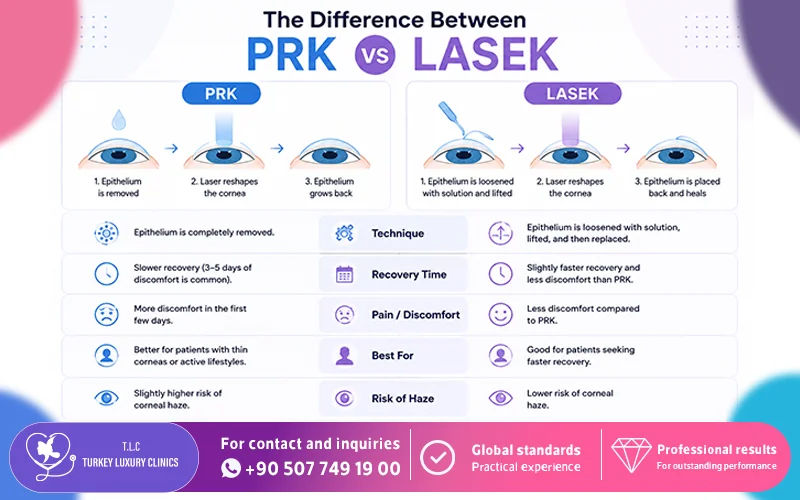
Although LASEK and PRK achieve virtually identical long-term vision results, they differ in epithelial management, postoperative comfort, and early recovery. The table below summarizes the key differences.
PRK vs LASEK at a Glance
Feature | LASEK | PRK |
Epithelium | Preserved and repositioned | Removed and regenerated |
Early Discomfort | Mild to moderate | Moderate to severe |
Initial Recovery | Slightly faster | Slightly slower |
Best For | Patients seeking a smoother early recovery | Very thin corneas and high-impact lifestyles |
Long-Term Results | Equivalent to PRK | Equivalent to LASEK |
Similarities Between LASEK and PRK
- Both are flap-free laser eye surgeries.
- Both are suitable for patients with thin corneas.
- Both avoid flap-related complications associated with LASIK eye surgery.
- Both use the same excimer laser technology.
- Both achieve nearly identical long-term visual outcomes.
- Both are flap-free laser eye surgeries designed for patients who may not be ideal candidates for LASIK eye surgery, particularly those with thin corneas, dry eyes, or active lifestyles.
What Is LASEK vs PRK?
LASEK
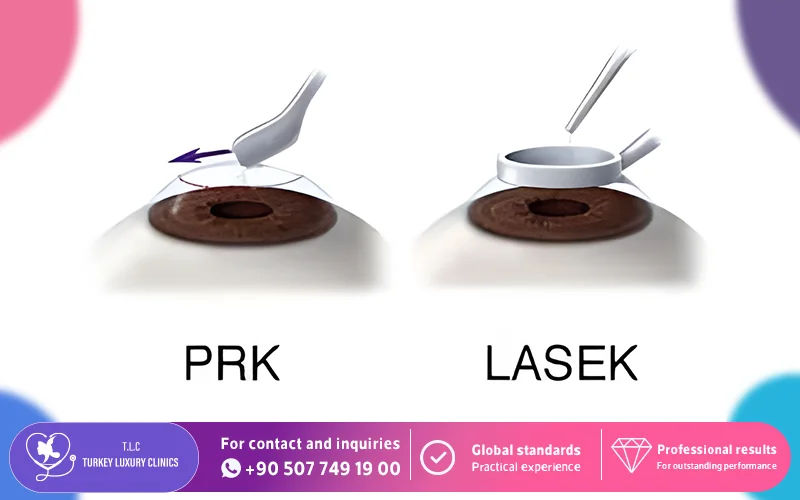
LASEK (Laser-Assisted Subepithelial Keratectomy) involves gently loosening the epithelial layer with a diluted alcohol solution and moving it aside before laser treatment. After the cornea is reshaped, the epithelial layer is repositioned and covered with a protective bandage contact lens.
The goal of LASEK is to preserve the surface tissue while avoiding the creation of a corneal flap, making it a suitable option for patients with thinner corneas or those who are not ideal LASIK candidates.
PRK
PRK (Photorefractive Keratectomy) is the original form of laser vision correction and has been performed successfully for decades. Instead of preserving the epithelial layer, the surgeon completely removes it before applying the laser treatment.
Following surgery, the epithelium naturally regenerates over several days while a bandage contact lens protects the eye during healing.
Because PRK does not require flap creation or epithelial repositioning, it remains one of the most trusted procedures for patients with thin corneas, athletes, military personnel, and individuals at higher risk of eye trauma.
What Is the Difference Between LASEK and PRK?
The primary difference between LASEK and PRK lies in how the surgeon manages the cornea’s outermost layer, known as the epithelium, before reshaping the cornea with an excimer laser.
In LASEK, the epithelial layer is gently loosened, preserved, and repositioned after treatment. In PRK, the epithelium is completely removed and allowed to regenerate naturally during healing.
This difference mainly affects early recovery, postoperative comfort, and epithelial healing. Once healing is complete, both procedures provide comparable long-term vision quality, stability, and patient satisfaction.
Which Is Better: LASEK or PRK?
There is no universally better option between LASEK and PRK. Both procedures use the same excimer laser technology and deliver nearly identical long-term visual outcomes, including clarity, stability, and patient satisfaction.
The main difference lies in early recovery: LASEK may offer slightly less discomfort because the epithelial layer is preserved, while PRK is often preferred for its long clinical track record and suitability for high-impact lifestyles.
In most cases, the choice depends on corneal thickness, lifestyle, and surgeon recommendation rather than final visual results.
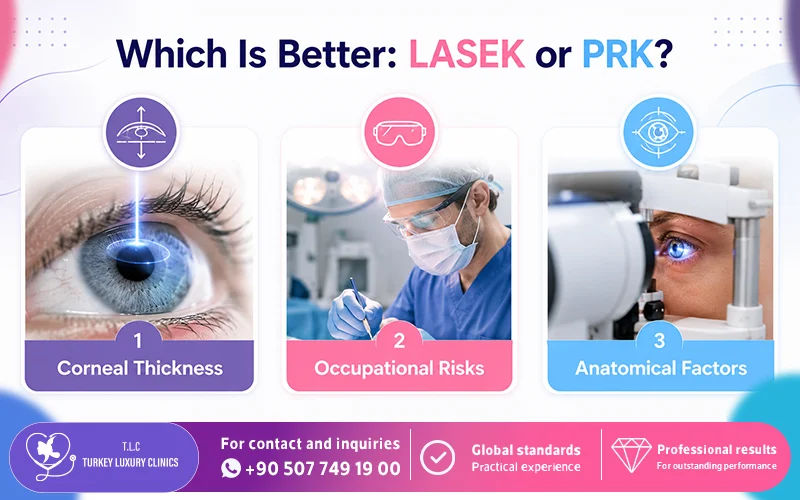
- Corneal Thickness: Both PRK and LASEK are suitable for patients with thinner corneas because neither procedure requires a corneal flap. For extremely thin corneas, many surgeons prefer PRK due to its long clinical track record.
- Occupational Risks: People involved in contact sports or high-risk professions, such as military personnel or law enforcement officers, are often considered excellent candidates for surface procedures because no permanent corneal flap is created.
- Anatomical Factors: The natural shape, curvature, and overall condition of your cornea help determine which procedure is likely to provide the safest healing process and most predictable visual outcome.
For patients seeking slightly lower early discomfort and faster epithelial healing, LASEK may offer a modest advantage. For individuals involved in contact sports, military service, aviation, or other high-impact activities, PRK remains one of the most trusted and extensively studied options available.
The best choice is determined by a detailed eye examination that evaluates corneal thickness, refractive error, ocular surface health, lifestyle requirements, and long-term visual goals.
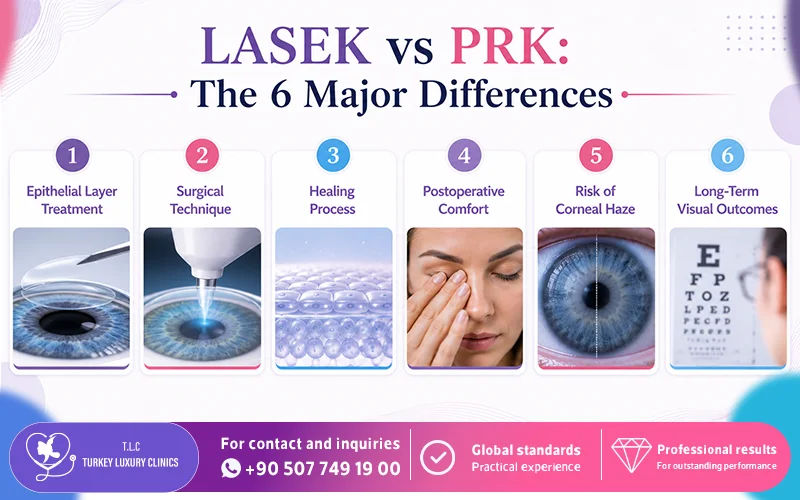
LASEK vs PRK: The 6 Major Differences
Both LASEK and PRK belong to the same family of surface laser eye surgery procedures and use the same excimer laser technology to reshape the cornea. The primary difference lies in how the surgeon treats the epithelium, the thin outer layer covering the cornea. Understanding these distinctions can help you determine which procedure may be better suited to your eyes and lifestyle.
1. Epithelial Layer Treatment
The fundamental medical distinction between these two procedures lies entirely in the fate of the epithelium—the ultra-thin, rapidly regenerating outer skin of the eye.
- LASEK: The epithelial layer is preserved. It is chemically loosened using a specialized, diluted alcohol solution for roughly 20 seconds, gently slid aside as an intact living sheet, and then carefully rolled back into its original position to cover the treated corneal bed.
- PRK: The epithelial layer is discarded. The central cells are completely removed—either mechanically with a specialized surgical brush or vaporized using an automated, "no-touch" laser (TransPRK). Your body must build a brand-new epithelial layer from scratch.
2. Surgical Technique
From a surgeon's perspective, the technical complexity and manual handling during the operation varies significantly.
- LASEK: Requires high manual dexterity. The surgeon must meticulously manage, smooth out, and realign the fragile epithelial sheet without tearing it, ensuring it perfectly hinges and repositions over the laser ablation site.
- PRK: Mechanically simpler and highly uniform. In traditional PRK, the surface layer is smoothly brushed away. In modern Transepithelial PRK (TransPRK), the entire process is completely automated; a single laser profile removes the surface cells and corrects the underlying vision prescription in one continuous step.
3. Healing Process
The cellular mechanics of how your eye closes the surgical site after you leave the operating room alter the trajectory of your early recovery.
- LASEK: Because your own cells are laid back down, they provide immediate structural coverage. Cellular healing occurs underneath this protective layer, focusing primarily on re-anchoring the cellular sheet to the basement membrane.
- PRK: Leaves a temporary, round surface abrasion or raw zone on the center of the eye. Healing requires the peripheral epithelial cells to divide, multiply, and actively migrate inward from the outer edges to meet in the center, completely closing the gap over a few days.
4. Postoperative Comfort
Because the cornea is one of the most nerve-dense structures in the human body, surface alteration directly impacts your pain scores during the first 3 to 5 days.
- LASEK: Typically yields lower to moderate discomfort. Because the preserved epithelial sheet is put back in place, it acts as a natural biological shield, keeping air and the blinking eyelid from directly scraping against sensitive, exposed nerve endings.
- PRK: Generally results in a higher level of temporary burning, tearing, and foreign-body sensation. The corneal nerve endings remain fully exposed and highly sensitive until the new cell layer grows completely over the central zone.
5. Risk of Corneal Haze
Corneal haze is a faint, temporary clouding of the cornea caused by an aggressive healing response (fibroblastic activity) as the surface cells stabilize over the laser-treated area.
- The Clinical Reality: Historically, PRK carried a slightly higher risk of late-stage haze than LASEK due to the complete removal of the tissue. However, modern ophthalmic protocols have completely leveled this playing field. Surgeons now routinely apply a specialized medication called Mitomycin-C (MMC) for a few seconds immediately after the laser ablation in both procedures. This safely suppresses the aggressive cellular response, reducing the modern incidence of clinical haze to less than 1%.
6. Long-Term Visual Outcomes
When patients ask which procedure delivers sharper vision down the road, the clinical consensus is absolute.
- The Equivalence: There is no difference in final visual acuity. Multiple large-scale, peer-reviewed clinical trials tracking surface ablation have proven that by week 4 to month 3, the visual stability, contrast sensitivity, and 20/20 success rates of LASEK and PRK are identical. Both offer exceptional permanent vision correction while preserving the deep structural architecture of your cornea.
Are You a Good Candidate for LASEK or PRK?
Both procedures are excellent alternatives to LASIK for patients with thin corneas, active lifestyles, or concerns about flap-related complications. However, certain clinical and lifestyle factors may make one option more suitable than the other.
LASEK May Be a Better Choice If:
1. Thin Corneas: Your corneal thickness is below the ideal range for LASIK, but sufficient for surface ablation.
2. Moderate Prescription: You want to correct nearsightedness, farsightedness, or astigmatism without creating a deep corneal flap.
3. Lower Pain Tolerance: You would prefer a potentially more comfortable early recovery period. The repositioned epithelial layer acts as a temporary biological bandage that may reduce discomfort during the first few days after surgery.
4. Tissue Preservation Preference: You prefer preserving and repositioning the natural epithelial layer rather than removing it completely.
PRK May Be a Better Choice If:
1. Contact Sports or High-Trauma Activities: You participate in martial arts, rugby, boxing, wrestling, or other activities where eye injuries are more likely.
2. Military, Aviation, or Law Enforcement Careers: You work in environments where maximum corneal stability and long-term structural reliability are priorities.
3. Very Thin or Irregular Corneas: Your corneal anatomy makes complete epithelial regeneration a more suitable approach than epithelial preservation.
4. History of Surface Irregularities: You have recurrent corneal erosions, epithelial basement membrane abnormalities, or other surface conditions that may make PRK preferable.
5. Preference for the Most Established Surface Procedure: You want the longest-standing and most widely studied surface-ablation technique available.
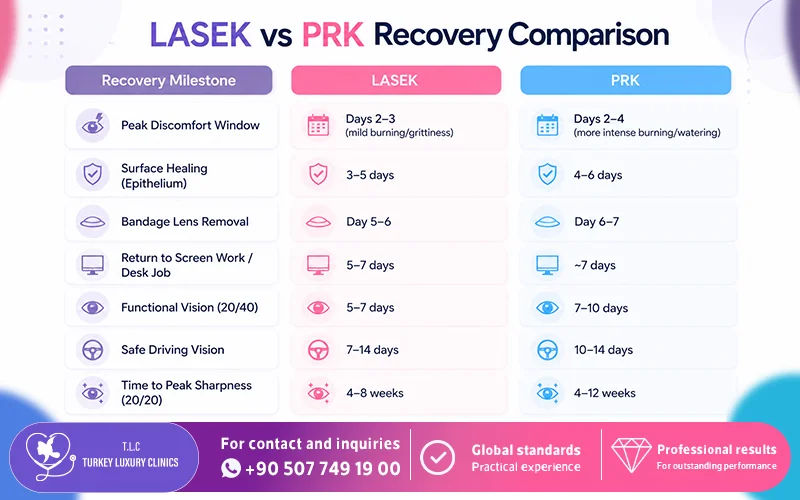
LASEK vs PRK Recovery Comparison
Recovery Milestone | LASEK | PRK |
Peak Discomfort Window | Days 2–3 Mild burning | Days 2–4 More intense burning |
Epithelium Healing | 3–5 days | 4–6 days |
Bandage Lens Removal | Day 5–6 | Day 6–7 |
Return to Screen Work or Desk Job | 5–7 days | 7 days |
Functional Vision (20/40) | 5–7 days | 7–10 days |
Safe Driving Vision | 7–14 days | 10–14 days |
Time to Peak Sharpness (20/20) | 4–8 weeks | 4–12 weeks |
LASEK offers a slightly gentler early recovery compared to PRK. Because LASEK repositions the eye’s outer layer (epithelium) to act as a natural biological bandage, early postoperative discomfort is generally lower. In PRK, this layer is completely removed, leaving the corneal surface temporarily exposed. As a result, patients often experience slightly higher discomfort and a slower initial healing phase.
LASEK vs PRK Results: Is One Better?
Long-term vision results for LASEK and PRK are nearly identical, with over 90% of patients achieving 20/20 to 20/40 vision.
Visual Acuity Outcomes
Studies show no statistically significant difference in effectiveness between LASEK and PRK. Both yield stable, long-lasting visual outcomes that remain stable for decades
20/20 Vision Rates
Clinical studies have consistently shown that approximately 92% to 98% of patients who undergo either LASEK or PRK achieve 20/20 vision or better within three to six months after surgery.
20/40 Vision Rates
More than 99% of patients achieve 20/40 vision or better, allowing them to perform everyday activities and meet driving requirements without corrective lenses.
Visual Benchmark | LASEK Success Rate | PRK Success Rate | Clinical Significance |
20/20 Vision or Better | 92%–95% | 93%–98% | Statistically equivalent long-term visual outcomes |
20/40 Vision (Driving Standard) | >99% | >99% | Functional independence from glasses for most daily activities |
Stability of Results and Regression Risk
Once the excimer laser reshapes the corneal stroma by removing microscopic amounts of tissue, those structural changes are considered permanent. However, because the eye continues to undergo natural biological processes, a small degree of refractive regression can occasionally occur over time.
Long-term ophthalmic studies indicate that the regression rate for both LASEK and PRK is relatively low, typically ranging from 2% to 5% over ten years.
Patient Satisfaction and Long-Term Studies
Long-term patient satisfaction rates for both LASEK and PRK consistently exceed 95%. Both LASEK and PRK patients show comparable satisfaction rates once healing is complete.
By three months, most patients report excellent visual quality, reduced dependence on corrective lenses, and a high level of overall satisfaction with their results.
Several randomized clinical studies have directly compared LASEK and PRK by treating one eye with LASEK and the other with PRK in the same patient. These studies have followed patients for up to 5–10 years and consistently found no clinically meaningful differences in:
- Final visual acuity
- Contrast sensitivity
- Long-term stability
- Patient satisfaction
- Regression rates
Want to see what patients say after surgery? Read our guide: PRK Surgery Reviews: Real Experiences, Recovery & Results.
Are There Cost Differences Between PRK and LASEK Eye Surgery?
PRK and LASEK are typically priced similarly, with treatment costs influenced more by the clinic, surgeon experience, technology used, and geographic location than by the procedure itself. In Turkey, both procedures generally cost between $800 and $2,500 per eye, depending on the technology used and the surgeon's experience. For a detailed breakdown of PRK surgery costs, financing options, and country-by-country price comparisons, read our guide: How Much Does PRK Surgery Cost? [2026 Prices].
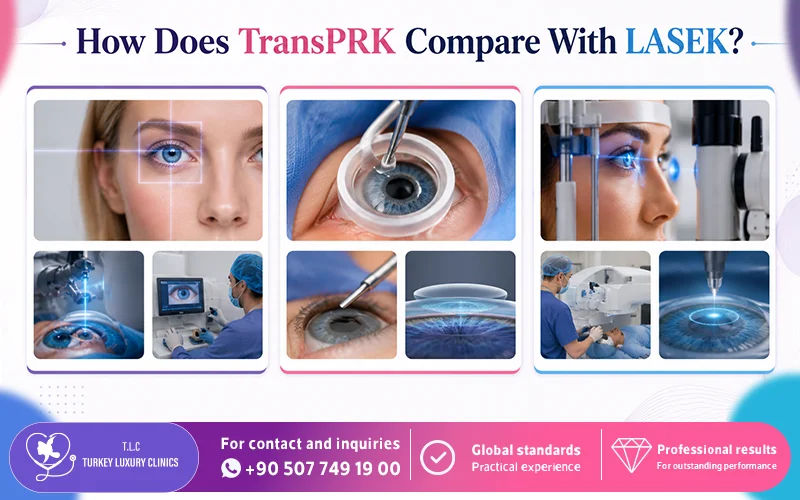
How Does TransPRK Compare With LASEK?
TransPRK (Transepithelial PRK), often marketed as "No-Touch SmartSurfACE," is an all-laser evolution of traditional PRK.
The Technical Difference: In LASEK, the epithelium is loosened with a diluted alcohol solution and manually rolled back by the surgeon. In TransPRK, no alcohol or manual instruments touch the eye. Instead, a single, continuous laser profile vaporizes the epithelial layer before immediately reshaping the underlying cornea.
The Clinical Takeaway: TransPRK eliminates the manual handling of LASEK and the mechanical scraping of traditional PRK, resulting in slightly faster surface healing and reduced post-operative pain compared to traditional PRK.
LASEK vs Epi-LASIK vs PRK
Patients often get confused by Epi-LASIK, which is another variation of surface ablation designed to avoid the use of alcohol.
PRK removes the epithelium mechanically or via laser.
LASEK uses an alcohol solution to chemically loosen the epithelium so it can be pushed aside as a living sheet.
Epi-LASIK uses a mechanized, blunt separation device (an epikeratome) to mechanically separate the epithelial sheet from the cornea without chemicals.
The Clinical Takeaway: While Epi-LASIK was designed to combine the chemical-free nature of PRK with the epithelial preservation of LASEK, long-term studies show no clinical superiority in vision or pain management. Consequently, most modern clinics favor TransPRK or LASEK over Epi-LASIK.
How Do LASEK and PRK Compare With LASIK and SMILE?
Procedure | Recovery | Flap | Thin Corneas | Dry Eye Risk |
PRK | Slowest | No | Excellent | Low |
LASEK | Slow | No | Excellent | Low |
LASIK | Fast | Yes | Limited | Higher |
SMILE | Fast | Small Incision | Good | Lower than LASIK |
While LASIK and SMILE (Small Incision Lenticule Extraction) offer rapid visual recovery within 24 to 48 hours, they require carving into the deeper stromal layers of your cornea.
PRK and LASEK preserve the structural integrity of the deeper stroma, making them the safest options for patients with thin corneal tissue. Furthermore, because PRK and LASEK do not sever the deeper corneal nerve plexus responsible for triggering tear production, their long-term incidence of chronic dry eye syndrome is significantly lower than that of LASIK.
Why Choose Turkey for PRK or LASEK?
Turkey has become one of the leading destinations for laser eye surgery thanks to its advanced ophthalmic technologies, highly experienced surgeons, competitive prices, and comprehensive treatment packages that cover both diagnosis and post-operative care.
Book Your PRK or LASEK Consultation with Turkey Luxury Clinics
At Turkey Luxury Clinics, our ophthalmology specialists assess each patient individually using advanced corneal mapping and detailed diagnostic testing. Based on your eye condition, lifestyle, and visual needs, we recommend the most suitable procedure to ensure the safest and most effective outcome.
FAQs About LASEK vs PRK