


- A Real Patient's 6-Month PRK Journey
- What Real Patients Say About PRK Surgery
- How Patients Felt Before PRK Surgery
- What Patients Say About the Procedure
- What Do Patient Reviews Say About PRK Surgery Recovery?
- When Does Vision Return After PRK?
- Do People Regret PRK?
- What Do PRK Surgery Patients Say About Complications?
- Was PRK Worth It?
- Thinking About PRK?
- FAQs About PRK Eye Surgery Reviews
Patient reviews regarding PRK laser eye surgery show that 90% of PRK patients achieve 20/40 vision or better without glasses, while overall satisfaction rates exceed 95%.
This makes PRK (Photorefractive Keratectomy) a safe and effective alternative to LASIK, particularly for patients with thin corneas.
However, reviews consistently highlight a 3 to 5-day recovery period accompanied by mild-to-moderate pain and temporary blurry vision before full stabilization.
Many patients summarize their recovery with a simple phrase: "First month rough, three months good, six months great."
Real-world feedback highlights the following key points:
- The Pros: Excellent long-term results, no risk of flap dislocation (preferred by the military), and reduced long-term dry eye issues compared to LASIK.
- The Cons: The first few days feature severe light sensitivity and pain. Visual clarity fluctuates, taking 1 to 3 months to fully stabilize.
A Real Patient's 6-Month PRK Journey
One patient summarized their recovery experience as follows:
Days 1–3: The Mental Battle
“I spent my first three days locked in a pitch-black room, fully dependent on audiobooks because looking at a phone screen felt like staring into the sun. My eyes were streaming tears constantly, accompanied by an intense, gritty sensation like sand trapped under my eyelids. Keeping up with my prescribed eye drops every few hours was a mental battle, especially on Day 3 when discomfort peaked and I questioned my decision.”
Day 5: The Pain Vanished
“By Day 5, a massive shift happened—the physical pain vanished as the surface layer of my cornea healed over. However, my vision started fluctuating wildly; my right eye was suddenly crystal clear, while my left eye remained frustratingly hazy and out of focus. It required a lot of patience, as reading text or driving was still out of the question.”
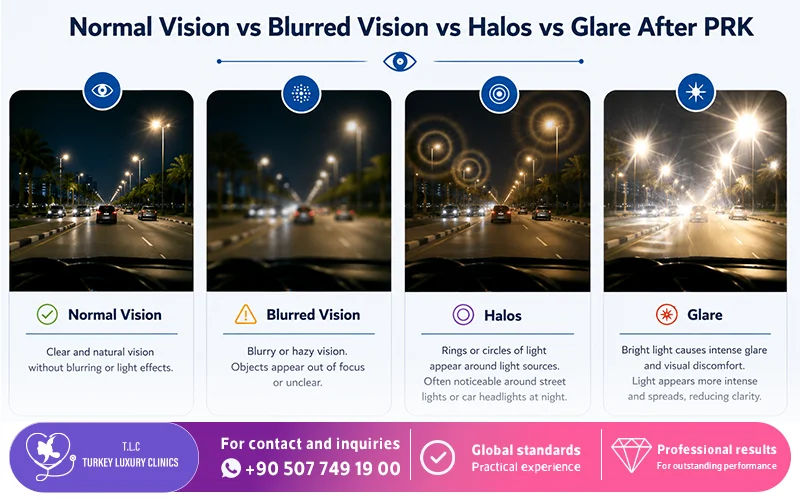
Month 3: Goodbye Halos
“By the three-month mark, the frustrating daily vision fluctuations finally stopped, and both eyes balanced out. The stubborn night halos and starbursts around oncoming headlights faded away to a point where I felt completely safe driving in the dark. My eyes still felt a bit dry in the mornings, but artificial tears easily managed it.”
Month 6: Complete Freedom
“Now, at Month 6, my vision has fully stabilized at a razor-sharp 20/15. The morning dryness is completely gone, and my eyes feel completely normal. The lifestyle freedom is unbelievable—I can wake up, exercise, and go about my day without reaching for glasses. The painful first week is just a distant memory; it was worth every single second.”
What Real Patients Say About PRK Surgery
First Month Rough, Three Months Good, Six Months Great
Many patients describe PRK as a procedure that rewards patience. While the recovery period can be challenging, long-term reviews are overwhelmingly positive and frequently mention life-changing improvements in vision and quality of life. Many patients achieve excellent visual outcomes and describe the procedure as life-changing once the healing process is complete.
Patients frequently report sharper vision, freedom from glasses or contact lenses, and significant improvements in their daily quality of life. Those with thin corneas or active lifestyles often appreciate that PRK avoids the creation of a corneal flap, making it a popular alternative to LASIK among athletes and military personnel.
How Patients Felt Before PRK Surgery
Most Patients Feel Anxious Before Surgery
Before surgery, most patients describe feeling anxious or afraid of the procedure itself. Others were concerned about pain, blurry vision during recovery, possible complications, and uncertainty about whether the slower healing process will ultimately be worth it. Some patients mentioned they were prescribed an oral sedative (like Valium or Xanax) to help patients relax before heading into the laser room.
Interestingly, those who later report excellent outcomes often say their fear before surgery was worse than the surgery itself.
Expert Perspective: Patients typically experience a mix of excitement and anxiety before PRK (Photorefractive Keratectomy) surgery. While the anticipation of ditching glasses and contacts is thrilling, it is completely normal to feel nervous about undergoing laser eye surgery.
What Patients Say About the Procedure
Most Patients Say the Procedure Was Easier Than Expected
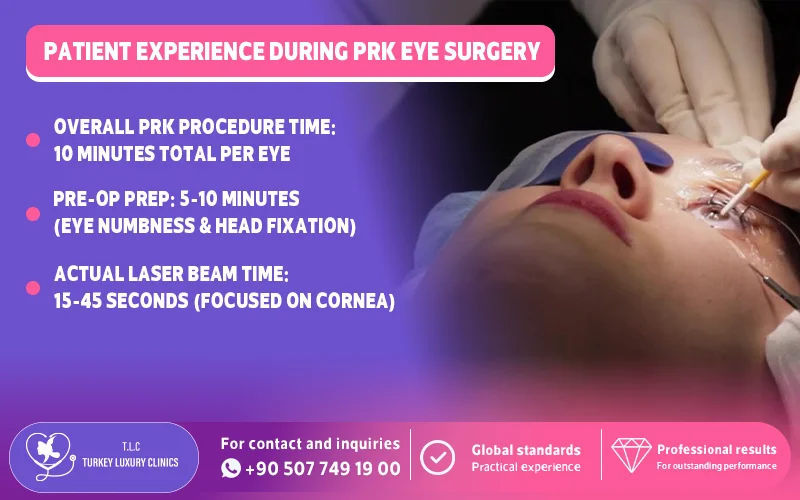
Most patients are surprised by how easy the PRK procedure actually feels. Reviews consistently describe the surgery as quick, painless, and far less intimidating than expected, due to the numbing eye drops used throughout the treatment. Some patients mention noticing a faint smell from the laser, while others recall that their anxiety in the waiting room was far more uncomfortable than the procedure itself.
The real challenge begins after leaving the clinic.
Expert Perspective: Eye surgeons consistently describe PRK as a straightforward procedure that typically takes only a few minutes per eye. The numbing drops used during treatment are highly effective, which explains why many patients report little to no pain during the laser portion of the surgery.
What Do Patient Reviews Say About PRK Surgery Recovery?
A common theme in patient reviews is that PRK recovery feels challenging in the beginning, and rewarding in the end. Most patients later say they are glad they went through it because of the improvement in their vision.
PRK Recovery is the Hardest Period
Patient reviews consistently describe recovery as the most difficult part of the PRK journey. During the first few days, many patients experience blurry vision, light sensitivity, tearing, dryness, and a burning or gritty sensation in the eyes. Despite these early difficulties, long-term satisfaction remains remarkably high. As vision gradually improves over the following weeks and months, many patients report that the discomfort fades from memory while the benefits of clear vision remain.
This explains why one of the most common conclusions found in PRK reviews is simple: The recovery was difficult, but the result was worth it.
Day 3 Is the Hardest Part of PRK Recovery
Day 3 is frequently described in patient reviews as the most difficult stage of PRK recovery. By this point, discomfort often peaks, vision may be at its blurriest, and light sensitivity can feel overwhelming. Many patients say this is when they begin questioning their decision, worrying that their recovery is not progressing normally. However, surgeons consider this a predictable part of the healing process rather than a sign of a poor outcome.
Interestingly, some of the most positive long-term reviews come from patients who also described Day 3 as their lowest point. As healing progresses and vision improves, those early doubts often fade. For many PRK patients, Day 3 is not a sign that something is wrong—it's simply the toughest part of the journey before recovery starts to feel easier.
Expert Perspective: PRK recovery symptoms are caused by the regeneration of the cornea's outer epithelial layer, which is intentionally removed during the procedure. As the surface heals, patients commonly experience burning, tearing, light sensitivity, and blurry vision. For most patients, the worst symptoms improve within 7 to 10 days, although dry eye, visual fluctuations, glare, and halos can take several weeks or months to fully settle. To support healing, surgeons typically prescribe antibiotic drops, steroid drops, and artificial tears.
When Does Vision Return After PRK?
Time | Typical Experience |
Day 1 | Functional but blurry vision |
Days 2–3 | Vision may worsen slightly |
Week 1 | Bandage lens removed |
Month 1 | Significantly clearer vision |
Month 3 | Near-final results |
Months 6–12 | Full stabilization |
Vision recovery after PRK is gradual and often slower than patients expect. Unlike LASIK’s instant clarity, your vision won’t return immediately. On Day 1, your sight is highly functional but blurry, similar to looking through a foggy window. By Day 3, vision often drops slightly as new cells cluster over your central visual axis. At the 1-week mark, the bandage lens comes out, restoring functional vision for daily tasks. Your sight becomes significantly clearer by Month 1, hits near-final results by Month 3, and achieves full stabilization and crisp night vision between Months 6 and 12.
Expert Perspective: PRK delivers excellent long-term visual outcomes, with studies reporting that 90% to 98% of patients achieve 20/40 vision or better without glasses, while up to 94% achieve 20/20 vision or better after healing is complete. Although recovery is gradual and often takes several months, the final visual results are highly stable and predictable.

Do People Regret PRK?
Yes, but usually only during the first few days of recovery. Reviews frequently describe a brief period of “buyer’s remorse” between Days 2 and 4, when light sensitivity, tearing, discomfort, and blurry vision are often at their worst. One patient summarized the experience by saying, “By Day 3, I genuinely thought I had made a mistake.”
Many patients admit they questioned their decision during this stage, worrying that their recovery was not progressing normally. However, these feelings typically fade as healing progresses and vision improves. By the end of the first week, many reviewers report feeling more confident about their recovery and increasingly satisfied with their decision.
What Do PRK Surgery Patients Say About Complications?
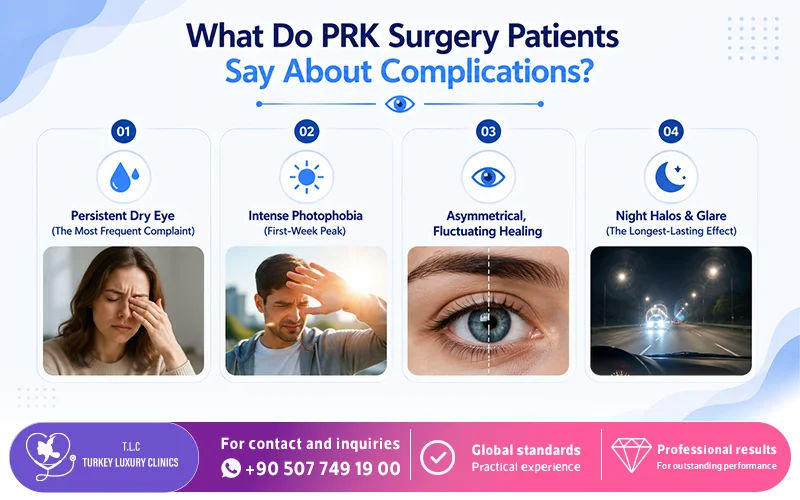
Real patient reviews highlight that severe medical complications are extremely rare. The vast majority of patients report a predictable set of non-threatening, temporary side effects during their recovery:
- Persistent Dry Eye (The Most Frequent Complaint): Mentioned in over 70% of patient reviews. It peaks between Weeks 2 and 6 as corneal nerves begin to regenerate. Patients stress that carrying preservative-free lubricating drops everywhere is an absolute necessity for the first 3 months.
- Intense Photophobia (First-Week Peak): Nearly all patients report extreme light sensitivity, but it is highly short-lived—strictly dominating Days 1 to 4. Reviews frequently recommend keeping recovery rooms completely dark and wearing indoor sunglasses.
- Asymmetrical, Fluctuating Healing: A very common source of anxiety in reviews is "uneven recovery," where one eye achieves clear vision weeks before the other. Patients often note that vision fluctuates daily in sharpness until it stabilizes around Weeks 4 to 6.
- Night Halos & Glare (The Longest-Lasting Effect): Highly prevalent during night driving within the first 1 to 3 months. While some reviews note mild starbursts persisting up to Month 6, patients consistently confirm they naturally fade away as the corneal surface completely smooths out.
Expert Perspective: Most side effects reported after PRK are temporary and related to the normal healing process. Dry eye, glare, halos, and fluctuating vision typically improve as the corneal surface stabilizes, although recovery speed varies between patients.
Was PRK Worth It?
For most patients, the answer is yes. Despite a painful first week and months of fluctuating vision, patient consensus is overwhelmingly positive. Reviewers love the complete freedom from glasses, enhanced self-confidence, and the fact that PRK eliminates the long-term structural risks of a LASIK flap, making it perfect for active lifestyles or military personnel.
The ultimate verdict across thousands of independent diaries remains incredibly consistent: patients passionately dislike the initial recovery process, but they absolutely love their final, crisp visual results. The vast majority explicitly state, "I would do it all over again."
Thinking About PRK?
Not everyone is an ideal candidate for PRK. A professional eye evaluation is the best way to determine whether the procedure is right for you.
Book your free consultation with Turkey Luxury Clinics and receive a personalized assessment from an experienced refractive surgeon.
Interesting reads:
How Much Does PRK Surgery Cost? [2026 Prices]
LASEK vs PRK: Differences, Recovery, Results & Which Is Better?
FAQs About PRK Eye Surgery Reviews