


- What is Stem Cell Therapy for Knees?
- How Much Does Stem Cell Therapy for Knees Cost?
- Stem Cell Therapy for Knees Cost by Country
- How Does Stem Cell Therapy for Knees Work?
- How Long Does Stem Cell Therapy Last for Knees?
- What Knee Conditions Are Treated With Stem Cell Therapy?
- Does Stem Cell Therapy Really Work for Knees?
- What Is the Success Rate of Stem Cell Therapy for Knees?
- What are the Mesenchymal stem cells (MSCs)?
- Step-By-Step Stem Cell Therapy for Knees Cartilage
- Pros and Cons of Stem Cell Therapy for Knees
- Is Stem Cell Therapy for Knees Worth It?
- Stem Cell Therapy for Knees at Turkey Luxury Clinics
Stem cell therapy for knees is a regenerative treatment being studied for knee osteoarthritis, cartilage damage, and certain joint injuries. It is an innovative and promising approach that may help reduce pain, improve knee function, and potentially delay the need for surgery in some patients, although results vary.
The treatment involves injecting stem cells or stem-cell-containing preparations into the knee to reduce inflammation and support tissue repair. However, evidence that it can reliably regrow substantial amounts of lost cartilage remains limited.
In 2026, the global cost of stem cell therapy for knees ranges from $2,000 to $12,000 per knee, although prices can reach $25,000 or more depending on the country, cell source, and treatment protocol.
What is Stem Cell Therapy for Knees?
Stem cell therapy is believed to use the body's own healing mechanisms to help repair and slow the deterioration of body tissues, such as cartilage. This advanced therapeutic option aims to: slow and repair your damaged cartilage - decrease inflammation and reduce pain - and possibly delay or prevent the need for knee replacement surgery.
Stem cells are a special type of cells that have two important properties; they can make more cells like themselves. That is, they self-renew. They also can become other cells like liver - kidney and other specialized cells in a process known as differentiation.
You can find stem cells in almost any part of your body. They are essential for the maintenance of your tissues in case of an accident or injury as it’s your body’s mechanism to heal on its own.
How Much Does Stem Cell Therapy for Knees Cost?
Stem cell therapy for knees typically costs $2,000–$12,000 per knee worldwide, although prices can reach $25,000 or more depending on the country, cell source, and treatment protocol.
Costs vary considerably by location. Treatment typically ranges from $3,000–$12,000 per knee in the United States, compared with approximately $3,000–$5,500 in Turkey and $2,000–$4,000 in Mexico. More complex protocols and some treatments in Western Europe may cost significantly more.
The final cost depends on the stem cell source, harvesting and laboratory processing, treatment protocol, imaging guidance, clinic, and whether one or both knees are treated.
Prices can be higher for more complex protocols or donor-derived products, and additional charges may apply for consultations, MRI or X-ray imaging, image-guided injection, rehabilitation, and follow-up care.
Stem Cell Therapy for Knee Cost by Cell Source
Stem Cell Source / Treatment | Estimated Cost per Knee |
BMAC (Bone Marrow Aspirate Concentrate) | 3,000–8,000 |
Adipose-Derived SVF | 4,000–12,000 |
Umbilical Cord / Birth Tissue | 5,000–15,000 |
What Additional Costs Should You Expect?
- Initial consultation: about 200–500
- Diagnostic imaging: about 100–3,000
- Ultrasound or fluoroscopic guidance: about 500–1,500
- Post-treatment physical therapy: about 450–2,400
What Affects the Cost of Stem Cell Therapy for Knees?
The cost of stem cell therapy for knees varies based on several factors:
- Stem cell source: Autologous bone marrow or adipose-derived cells may be priced differently from donor-derived cells.
- Cell processing and dose: More extensive laboratory processing and higher cell doses can increase the treatment cost.
- Injection technique: Image-guided delivery and more complex injection procedures may increase procedural fees.
- Number of knees and sessions: Treating both knees or requiring multiple sessions increases the total cost.
- Country and clinic: Prices vary considerably between countries and treatment centers due to differences in medical fees, regulations, and treatment protocols.
- Additional services: Imaging, consultations, rehabilitation, accommodation, and medical travel services may be included in the package or charged separately.
Stem Cell Therapy for Knees Cost by Country
Country | Typical Stem Cell Therapy Cost for Knee |
United States | 5,000–12,000 |
Germany / Western Europe | 6,500–25,000 |
United Kingdom | 6,300–10,000 |
Spain | 6,500–10,500 |
Israel | 4,000–6,000 |
Colombia | 5,000–9,000 |
Turkey | 3,000–5,500 |
Thailand | 3,000–5,000 |
Mexico | 2,000–4,000 |
India | 3,000–7,000 |
Does Insurance Cover Stem Cell Therapy for Knees?
In the United States, stem cell therapy for knee pain or osteoarthritis is generally considered investigational or experimental, so it is usually not covered by private insurance, Medicare, or Medicaid. Patients typically pay out of pocket, although individual policies and eligible HSA/FSA use may vary.
How Does Stem Cell Therapy for Knees Work?
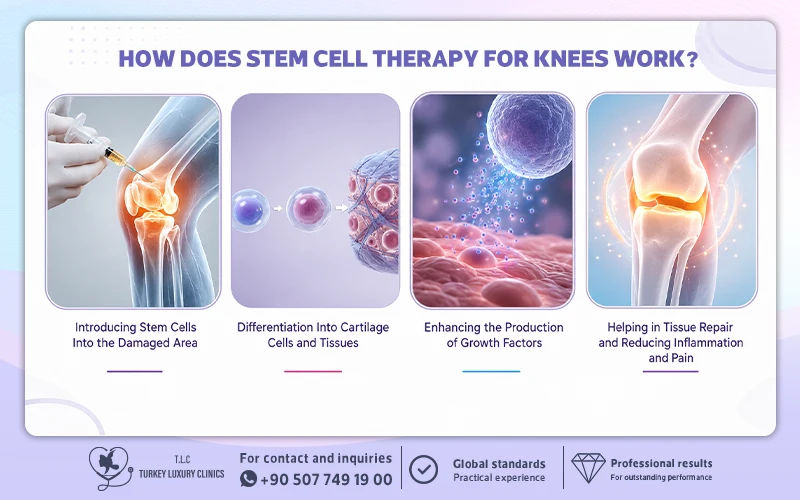
Stem cell therapy for knees works by delivering regenerative cells—most commonly mesenchymal stromal/stem cells (MSCs) or cell-containing preparations derived from bone marrow or adipose tissue—into the affected knee joint.
Rather than simply turning into new cartilage, these cells are thought to work primarily through paracrine signaling. They release growth factors, cytokines, and other signaling molecules that may:
- Modulate inflammation within the knee joint.
- Support the body's natural tissue-repair processes.
- Influence cartilage and surrounding joint cells involved in tissue maintenance.
- Reduce pain and improve joint function in some patients with knee osteoarthritis.
Although stem cells have the biological potential to differentiate into cartilage-forming cells under certain conditions, clinical evidence that knee injections reliably regenerate substantial amounts of lost cartilage remains limited. Current research more consistently supports potential improvements in pain and function than complete cartilage restoration.
How Long Does Stem Cell Therapy Last for Knees?
The benefits of stem cell therapy for knees may last 2–5 years in some patients with mild to moderate knee osteoarthritis, although results vary considerably. Some sources report shorter improvements of 6 months to 2 years, while selected patients may experience relief for 5 years or longer.
Stem cell injections are not considered a permanent cure for knee osteoarthritis. How long the results last depends on the severity of cartilage damage, age, overall health, body weight, activity level, and the type of treatment used.
A typical results timeline may include:
- 2–6 weeks: Early improvements in pain or stiffness may begin.
- 3–6 months: Improvements may become more noticeable as the biological response develops.
- 1–2 years: Some patients continue to report pain relief and improved knee function.
- 2–5+ years: Longer-lasting benefits have been reported in some patients, particularly those with mild to moderate osteoarthritis.
Patients with advanced bone-on-bone arthritis may have less predictable or shorter-lasting benefits than those with earlier-stage joint damage.
What Knee Conditions Are Treated With Stem Cell Therapy?
Stem cell therapy for knees is primarily explored for knee osteoarthritis and cartilage damage, particularly in patients with mild to moderate degenerative joint changes. It may also be used or investigated for other knee injuries involving the meniscus, ligaments, and tendons.
Conditions commonly treated or studied include:
- Knee osteoarthritis (OA): Particularly mild to moderate degenerative arthritis.
- Cartilage damage: Including localized cartilage defects and degeneration.
- Meniscus injuries: Such as partial tears or degenerative meniscal damage.
- Ligament injuries: Including some partial ligament tears or strains.
- Patellar tendon injuries: Including chronic tendon degeneration or tendinopathy.
However, stem cell therapy is not an established cure for these conditions, and evidence varies depending on the condition and cell preparation. The strongest clinical research in the knee currently focuses on knee osteoarthritis and cartilage-related problems.
Does Stem Cell Therapy Really Work for Knees?
Stem cell therapy for knee pain and osteoarthritis shows mixed results. Some patients experience reduced pain and improved knee function, particularly with mild to moderate osteoarthritis, but the treatment does not work for everyone, and there is still limited evidence that stem cell injections can reliably regrow damaged knee cartilage.
Clinical results vary depending on the severity of joint damage, the type and source of stem cells, the treatment protocol, and individual patient factors. People with advanced bone-on-bone osteoarthritis may be less likely to benefit than those with earlier-stage joint degeneration.
Stem cells appear to act primarily by modulating inflammation and releasing biological signals that may support tissue repair, rather than simply replacing damaged cartilage with new cartilage.
Can Stem Cells Regrow Knee Cartilage?
Stem cells may support cartilage repair, but there is currently limited evidence that they can reliably regrow substantial amounts of lost knee cartilage. Research shows more consistent improvements in pain and knee function than complete cartilage regeneration.
For patients with advanced bone-on-bone osteoarthritis, stem cell therapy is not a proven method for rebuilding lost cartilage or reversing the disease.
What Is the Success Rate of Stem Cell Therapy for Knees?
The reported success rate of stem cell therapy for knees is around 60% to 80% for reducing pain and improving mobility, particularly in appropriately selected patients with mild-to-moderate knee osteoarthritis. However, there is no single universally accepted success rate because studies use different stem cell preparations, treatment protocols, patient groups, and definitions of “success.”
Clinical research suggests that some patients experience meaningful improvements in knee pain and function within 3 to 12 months after treatment. Results are generally more favorable in people with mild-to-moderate osteoarthritis (Grades 1–3), while patients with severe Grade 4 or bone-on-bone arthritis tend to have less predictable outcomes.
It is also important to distinguish symptom improvement from cartilage regeneration or avoiding knee replacement. A reduction in pain or improvement in mobility does not necessarily mean that damaged cartilage has been fully restored or that the underlying osteoarthritis has been reversed.
Types of Stem Cells Used in Regenerative Medicine
Stem cells are classified according to their differentiation potential, meaning the range of specialized cells they can develop into. The main types include totipotent, pluripotent, multipotent, oligopotent, and unipotent stem cells.
For stem cell therapy for knees, the most relevant group is multipotent mesenchymal stem cells (MSCs) because they are widely studied in orthopedic and regenerative medicine for their potential role in reducing inflammation and supporting cartilage and joint tissue repair.
Totipotent Stem Cells
Totipotent stem cells have the broadest developmental potential and can develop into all cell types, including tissues involved in early embryonic development. They occur only during the earliest stages after fertilization and are not typically used in knee stem cell therapy.
Pluripotent Stem Cells
Pluripotent stem cells can develop into nearly any specialized cell type in the body, including nerve, muscle, and liver cells. They include embryonic stem cells (ESCs) and induced pluripotent stem cells (iPSCs). Although important in regenerative medicine research, they are not the main type currently studied for routine knee injections.
Multipotent Stem Cells
Multipotent stem cells can develop into a more limited range of related cell types. Mesenchymal stem cells (MSCs) are the most relevant example for knee treatment and may be obtained from sources such as bone marrow, adipose tissue, or donor-derived tissues.
MSCs are widely studied for knee osteoarthritis, cartilage damage, joint inflammation, and orthopedic injuries, mainly because of their anti-inflammatory and cell-signaling effects rather than because they simply replace damaged cartilage.

What are the Mesenchymal stem cells (MSCs)?
Mesenchymal Stem Cells (MSCs) are multipotent adult stem cells found in various tissues like bone marrow, fat, and umbilical cord. They are a key example of multipotent stem cells.
Characteristics of MSCs
- Differentiation into bone (osteocytes), cartilage (chondrocytes), and fat (adipocytes)
- Found in adult tissues such as bone marrow, adipose tissue, skin, and menstrual blood
- Exhibit strong anti-inflammatory and immunomodulatory effects
- Support tissue repair mainly through paracrine signaling rather than direct cell replacement
- Widely studied in orthopedics, sports medicine, and regenerative therapies
- Used in conditions involving cartilage degeneration, joint inflammation, and tissue damage
- Lower ethical concerns and reduced tumor risk compared to pluripotent stem cells.

And the MSCs are the most important type of stem cells
We are highlighting MSCs (Mesenchymal Stem Cells) because they are your body's natural repair cells, acting as "signaling hubs" that eliminate inflammation and modulate your immune system as necessary.
And most importantly, MSCs promote tissue regeneration (bone, cartilage, muscle, nerves) by releasing growth factors and signaling other cells to heal injuries, making them vital for regenerative medicine. Their ability to differentiate, immune-evasiveness, and secretion of healing molecules make them powerful tools for treating various diseases.
MSCs are also effectively used in many cases such as managing stem cell therapy for osteoarthritis as it may be possible to use stem cell therapy to promote faster healing and reduce inflammation and pain.
Step-By-Step Stem Cell Therapy for Knees Cartilage
The whole procedure is super simple and won’t cause you any pain. It starts with harvesting stem cells (usually from your bone marrow or fat), processing them to concentrate the regenerative cells, and then injecting this concentrated solution into the damaged knee joint under imaging guidance, followed by physical therapy for healing.
Knee stem cell therapy is generally an outpatient procedure with no general anesthesia required as it’s a non-invasive solution. Side effects for stem cell therapy for knees may include pain and swelling at the injection site, but generally they are temporary and easily managed with medication.
Pros and Cons of Stem Cell Therapy for Knees
Benefits of stem cell therapy for knee arthritis include minimal recovery time, lower risks compared to surgery, and the potential to regenerate knee joint tissue naturally. However, risks are considered less common but can include pain, swelling, and rarely an infection.
Pros of Stem Cell Therapy for Knees
- It is a relatively non-invasive procedure with a quick recovery.
- Reduces chronic knee pain caused by inflammation or cartilage damage.
- Stem cell therapy for joints could regrow the normal cartilage covering the joint.
- Decreases inflammation and calms the joint environment.
- Improves mobility and function and eliminates joint stiffness.
- May support cartilage repair and results are highly promising.
- Delays knee replacement surgery for some patients.
- Uses the body’s own cells which reduces the risk of rejection or allergic reactions.
- An outpatient procedure and it can be performed in one day with same-day discharge.

Cons Of Stem Cell Therapy for Knees
Cons of stem cell therapy for knees include high out-of-pocket costs, lack of strong scientific proof for effectiveness (many studies are small or biased), potential for unregulated treatments from some clinics, risks like infection or unintended cell growth (bone instead of cartilage), and inconsistent results due to varying preparation methods, making it a costly gamble with uncertain outcomes for cartilage repair.
You can always avoid or eliminate any chance of side effects or risks by choosing a certified clinic and surgeon to inject top-quality stem cell injection in your knees, which you can safely find at Turkey Luxury Clinics.
Is Stem Cell Therapy for Knees Worth It?
Stem cell therapy for knees may provide modest improvements in pain and function for some patients with knee osteoarthritis, but current evidence does not clearly show that the benefits justify the high out-of-pocket cost for everyone.
A 2025 Cochrane review found that stem cell injections may slightly improve knee pain and function compared with placebo, while evidence about longer-term benefits and structural improvement remains uncertain. Treatment can also cost several thousand dollars per knee and is generally not covered by insurance in the United States.
Stem cell therapy may therefore be more reasonable for carefully selected patients seeking a non-surgical option after considering established conservative treatments. However, patients should not expect the treatment to reliably regrow lost cartilage, reverse advanced osteoarthritis, or eliminate the need for knee replacement.
Stem Cell Therapy for Knees at Turkey Luxury Clinics
Knee Stem cell therapy can effectively treat knee pain and injuries, with success rates ranging from 70-80% for mild to moderate knee osteoarthritis, especially for early-stage knee problems like mild arthritis or small cartilage tears.
In addition to that, stem cells for knees can also be used to treat more advanced knee problems, such as osteoarthritis, but does it really work? Well, the knee arthrtities stem cell therapy in such cases is still being studied but studies are very promising.
Treatment with stem cell therapy for knee cartilage is showing outstanding results! At Turkey Luxury Clinics, we offer stem cell therapy for knees in the hand of the one and only Humam Baki.
Dr. Humam BAKI has over 15 Years of experience in orthopedic surgery, he is a top professional especially when it comes to applying modern technology to optimize the results, and currently he is providing his services at Gaziosmanpasa hospital, Istanbul.
You can easily manage knee pain without going through surgery, and that’s by stem cell injection for knees. Reach out to Turkey Luxury Clincs and book an online free consultation with Dr.Humam Baki right away.
Copyrights © Turkey Luxury Clinics