

- LASIK vs PRK vs SMILE vs ICL at a Glance
- Which Vision Correction Procedure Is Best
- LASIK vs PRK vs SMILE vs ICL: How Each Procedure Works
- Are You a Candidate for LASIK, PRK, SMILE, or EVO ICL?
- Choosing Between LASIK, PRK, SMILE, and ICL Based on Corneal Thickness
- Choosing Between LASIK, PRK, SMILE, and ICL Based on Refractive Error
- Choosing Between LASIK, PRK, SMILE, and ICL Based on Dry Eye Risk
- Choosing Between LASIK, PRK, SMILE, and ICL Based on Lifestyle
- LASIK vs PRK vs SMILE vs ICL Recovery Timeline Comparison
- LASIK vs PRK vs SMILE vs ICL Pain Comparison
- LASIK vs PRK vs SMILE vs ICL Cost Comparison
- LASIK vs PRK vs SMILE vs ICL Safety, Risks, and Side Effects
- LASIK vs PRK vs SMILE vs ICL Long-Term Results
- Which Vision Correction Procedure Is Right for You?
- FAQs About LASIK vs PRK vs SMILE vs ICL
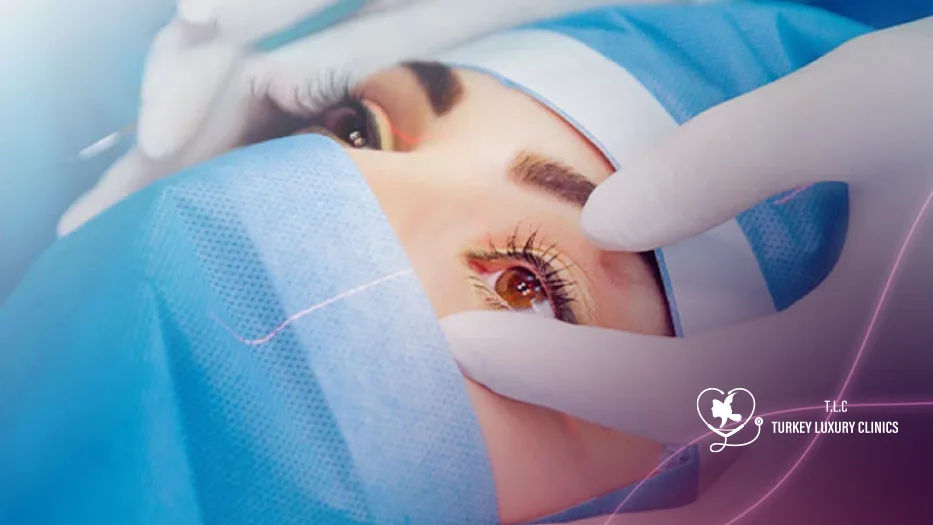
LASIK, PRK, SMILE, and ICL are the four main vision correction procedures used to treat myopia, hyperopia, and astigmatism.
While they all aim to achieve clear vision without glasses or contact lenses, they differ significantly in how they work inside the eye, and that difference is what determines who qualifies for each option.
LASIK offers the fastest visual recovery, PRK is preferred for thin corneas, SMILE typically causes less dry eye and uses a minimally invasive approach, and ICL is best for high prescriptions or patients who are not candidates for laser surgery.
The best option is not universal and depends on eye examination findings rather than the procedure itself.
Choosing between these procedures is not about which is best overall, but about matching the technique to corneal thickness, prescription level, eye health, and lifestyle needs.
LASIK vs PRK vs SMILE vs ICL at a Glance
Feature | LASIK | PRK | SMILE | ICL |
How it Works | Corneal flap + laser reshaping | Surface layer removed + laser reshaping | Internal lenticule removed via small incision | Implantable lens inside eye |
Recovery Speed | Very fast (24 hours) | Slow (days–weeks) | Fast (2–3 days) | Fast (days) |
Best For | Standard cases, fast recovery | Thin corneas, active lifestyle | Myopia + dry eye tendency | High myopia, non-laser candidates |
Dry Eye Risk | Moderate | Lower | Lowest among laser options | Minimal corneal impact |
Reversibility | No | No | No | Yes |
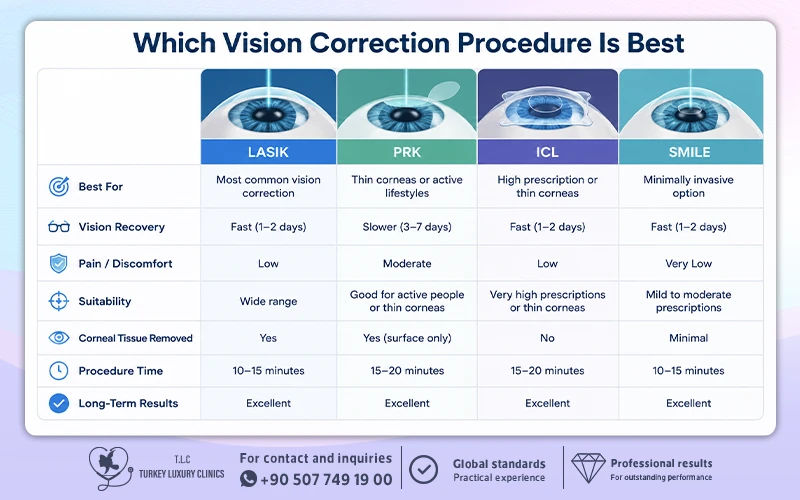
Which Vision Correction Procedure Is Best
There is no single “best” procedure among LASIK, PRK, SMILE, and ICL. All four achieve excellent visual outcomes, but they differ in technique, recovery profile, and suitability for specific eye conditions. LASIK is often associated with the fastest visual recovery, PRK is preferred for corneal safety in thinner corneas, SMILE offers a flapless minimally invasive approach with lower dry-eye impact, and ICL is reserved for high prescriptions or patients not eligible for laser surgery. PRK excels for irregular corneas and ICL handles extreme myopia. Quick decision map:
If You... | Commonly Preferred Option |
Want the fastest visual recovery | LASIK |
Have thin or borderline corneas | PRK or EVO ICL |
Have dry eyes or dry-eye risk | SMILE or EVO ICL |
Have high myopia (-8D or greater) | EVO ICL |
Participate in contact sports | PRK or SMILE |
Want a reversible procedure | EVO ICL |
The final recommendation depends on a detailed eye examination, including corneal thickness, corneal shape, prescription strength, tear film quality, and overall eye health.
LASIK vs PRK vs SMILE vs ICL: How Each Procedure Works
Procedure | How It Works |
LASIK | A femtosecond laser creates a thin corneal flap, and an excimer laser reshapes the underlying corneal tissue to correct refractive errors. |
PRK | The outer epithelial layer is removed, and an excimer laser reshapes the corneal surface without creating a flap. |
SMILE | A femtosecond laser creates a small lenticule inside the cornea, which is removed through a tiny incision to change the cornea's shape. |
EVO ICL | A biocompatible Collamer lens is implanted behind the iris to correct vision without removing corneal tissue. |
Are You a Candidate for LASIK, PRK, SMILE, or EVO ICL?
Many patients are eligible for more than one vision correction procedure. In fact, individuals with mild to moderate refractive errors, healthy corneas, and no significant dry-eye symptoms are often suitable candidates for LASIK, PRK, SMILE, or EVO ICL.
When multiple procedures are considered safe and effective, LASIK is frequently chosen because of its rapid visual recovery, predictable outcomes, and widespread availability. However, many patients may achieve similar long-term vision results with PRK, SMILE, or EVO ICL depending on their preferences and treatment goals.
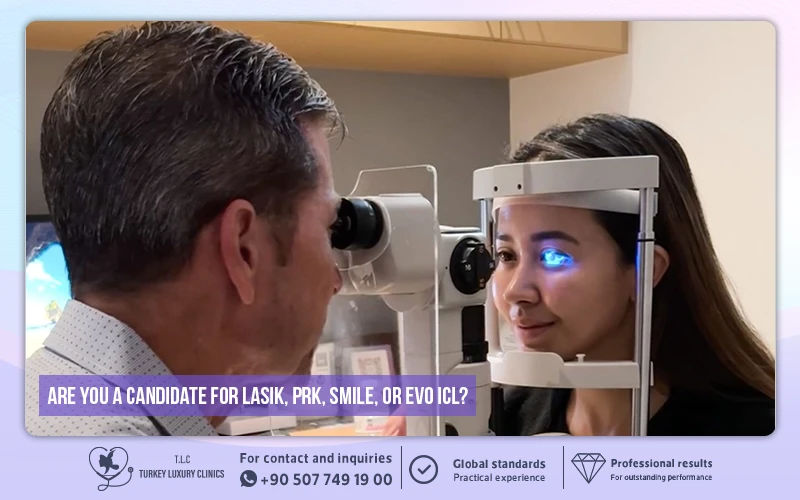
The decision becomes more important when specific factors are present, such as thin corneas, high myopia, dry-eye disease, participation in contact sports, or a preference for a reversible procedure. In these situations, one option may offer safety or recovery advantages over the others, making a comprehensive eye examination essential before choosing the most appropriate treatment.
LASIK Candidacy
LASIK is typically suitable for patients with mild to moderate myopia, hyperopia, or astigmatism who have adequate corneal thickness and stable vision. Most LASIK candidates have prescriptions ranging from approximately -1.00D to -8.00D of myopia, although eligibility ultimately depends on corneal measurements and residual tissue calculations.
Patients should generally have healthy corneas, no significant dry-eye disease, and no evidence of progressive corneal disorders such as keratoconus.
Patients who may need alternative options:
- Thin corneas
- Significant dry eye
- High-impact sports participants
- Very high myopia
PRK Candidacy
PRK is often considered for patients who qualify for laser vision correction but have less corneal tissue available for LASIK. It can treat many of the same refractive errors as LASIK, including myopia, hyperopia, and astigmatism.
Because PRK does not require flap creation, it is frequently recommended for military personnel, athletes, and patients with borderline corneal thickness.
Patients who may need alternative options:
- Individuals requiring the fastest possible recovery
- Patients unwilling to accept a longer healing period
SMILE Candidacy
SMILE is primarily designed for patients with myopia and myopic astigmatism. It is often selected by patients seeking a minimally invasive procedure and those concerned about postoperative dry-eye symptoms.
Many SMILE candidates have mild to high myopia, commonly up to approximately -10.00D depending on individual eye characteristics and surgeon preference.
Patients who may need alternative options:
- Hyperopia patients
- Certain complex refractive errors
- Patients whose prescription falls outside SMILE treatment parameters
EVO ICL Candidacy
EVO ICL is commonly recommended for patients with moderate to very high myopia, often ranging from approximately -3.00D to -20.00D. It is also frequently considered for individuals with thin corneas, significant dry-eye symptoms, or eyes that are not ideal candidates for laser vision correction.
Unlike laser procedures, EVO ICL does not remove corneal tissue, making it a valuable option when corneal preservation is important.
Patients who may need alternative options:
- Patients uncomfortable with an intraocular procedure
- Individuals who are already excellent candidates for simpler laser-based correction
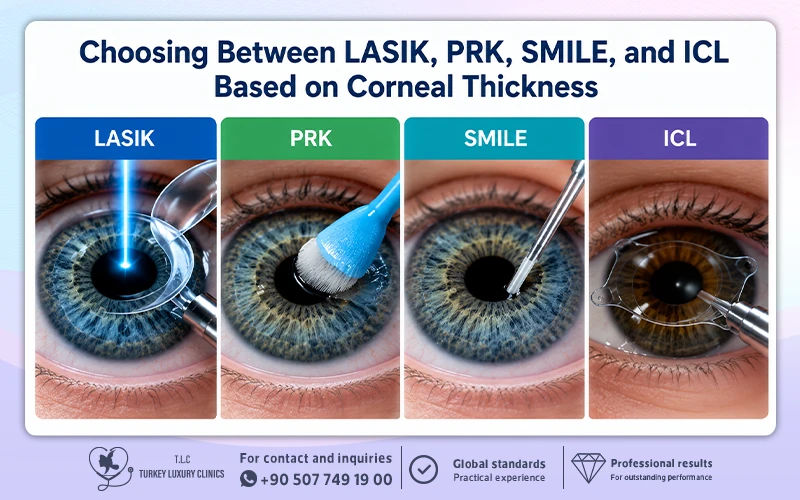
Choosing Between LASIK, PRK, SMILE, and ICL Based on Corneal Thickness
If your corneas are too thin for safe LASIK treatment, EVO ICL is often the preferred option because it corrects vision without removing corneal tissue.
Among laser procedures, PRK is usually the first choice for patients with borderline corneal thickness because it preserves more corneal tissue than LASIK. SMILE may also be suitable in some cases when additional corneal preservation is desired.
Corneal Thickness Situation | Preferred Option | Usually Avoided |
Borderline Thin Cornea | PRK, SMILE, EVO ICL | LASIK |
Very Thin Cornea | EVO ICL | LASIK, SMILE |
Thin Cornea + High Myopia | EVO ICL | Most laser procedures |
Choosing Between LASIK, PRK, SMILE, and ICL Based on Refractive Error
Condition | Best Option | To Avoid / Not Suitable |
Mild Myopia (-1 to -3D) | LASIK, SMILE, PRK | ICL (usually not needed) |
Moderate Myopia (-3 to -8D) | LASIK, SMILE, PRK, or EVO ICL | None in most cases (depends on full eye evaluation) |
High Myopia (-8D and above) | EVO ICL | Laser procedures may be limited by corneal safety |
Very High Myopia (> -10D) | EVO ICL | LASIK, SMILE, PRK (usually not suitable) |
Hyperopia (+1 to +6D) | LASIK or PRK | SMILE (limited applicability) |
Astigmatism | LASIK, PRK, SMILE, or EVO ICL | None universally (depends on severity) |
High myopia is one of the most important factors when choosing between LASIK, PRK, SMILE, and EVO ICL. As prescriptions become stronger, laser procedures may be limited by the amount of corneal tissue that must be removed.
For this reason, EVO ICL is often preferred for patients with high or very high myopia, while LASIK, PRK, and SMILE are commonly used for mild to moderate refractive errors. If you’re deciding between a laser surface treatment and an implantable lens, see our detailed PRK vs ICL comparison.
For hyperopia, LASIK and PRK remain the most established options.
Choosing Between LASIK, PRK, SMILE, and ICL Based on Dry Eye Risk
Dry Eye Status | Usually Preferred Procedure | Usually Avoided |
No Dry Eye | LASIK, PRK, SMILE, or EVO ICL | None |
Mild Dry Eye | SMILE or PRK | LASIK |
Significant Dry Eye | EVO ICL | LASIK |
Severe Chronic Dry Eye | EVO ICL | LASIK |
SMILE is often preferred in patients with pre-existing or borderline dry eye, as it causes less disruption to corneal nerves compared to LASIK.
LASIK may still be an option in mild dry eye cases, but it often requires closer postoperative monitoring due to temporary reduction in tear stability.
ICL is also a strong alternative in patients with significant dry eye, since it does not involve corneal surface alteration. However, it introduces intraocular considerations that must be evaluated separately.
Choosing Between LASIK, PRK, SMILE, and ICL Based on Lifestyle
Lifestyle / Activity | Commonly Preferred Option |
Contact Sports | PRK or SMILE |
Military Personnel | PRK |
High Eye Trauma Risk | PRK |
General Lifestyle | LASIK, SMILE, PRK, or EVO ICL |
Need Fast Return to Work | LASIK |
PRK is commonly preferred for patients involved in high-impact activities or occupations with a higher risk of eye trauma, as it eliminates flap-related complications.
SMILE may also be considered as a less invasive alternative with similar biomechanical advantages.
LASIK may still be appropriate for low-risk lifestyles where rapid visual recovery is a priority, provided corneal anatomy is suitable.
LASIK vs PRK vs SMILE vs ICL Recovery Timeline Comparison
Recovery speed is one of the biggest differences between these procedures and often plays a major role in treatment selection.
Procedure | Return to Daily Activities | Full Visual Stabilization |
LASIK | 1–2 Days | Several Weeks |
PRK | Several Days | Several Weeks to Months |
SMILE | 2–3 Days | Several Weeks |
EVO ICL | Few Days | Several Weeks |
Day 1–3 Experience
LASIK typically provides the fastest early visual recovery, with many patients noticing significant improvement within 24 hours. SMILE also offers relatively quick recovery, although vision may sharpen more gradually during the first few days. EVO ICL patients often experience rapid visual improvement as well, while PRK patients commonly experience blurred vision, light sensitivity, and discomfort during this period.
First Week Differences
During the first week, most LASIK, SMILE, and EVO ICL patients can resume many routine activities. PRK recovery is slower because the corneal surface requires additional time to heal and regenerate.
Full Stabilization Time
Although functional vision returns quickly for many LASIK, SMILE, and EVO ICL patients, complete stabilization may take several weeks. PRK often requires the longest stabilization period, and visual fluctuations may continue for several months before final results are achieved.
LASIK vs PRK vs SMILE vs ICL Pain Comparison
Although all four procedures are performed using anesthetic eye drops and are generally painless during surgery, the recovery experience differs significantly.
Procedure | During Surgery | First 24 Hours | First Week |
LASIK | Minimal | Mild discomfort | Minimal |
PRK | Minimal | Moderate discomfort | Highest |
SMILE | Minimal | Mild discomfort | Mild |
EVO ICL | Minimal | Mild pressure sensation | Mild |
PRK is generally associated with the most postoperative discomfort because the corneal surface must heal and regenerate after treatment. LASIK, SMILE, and EVO ICL typically involve milder symptoms and allow patients to resume normal activities more comfortably during the first few days.
LASIK vs PRK vs SMILE vs ICL Cost Comparison
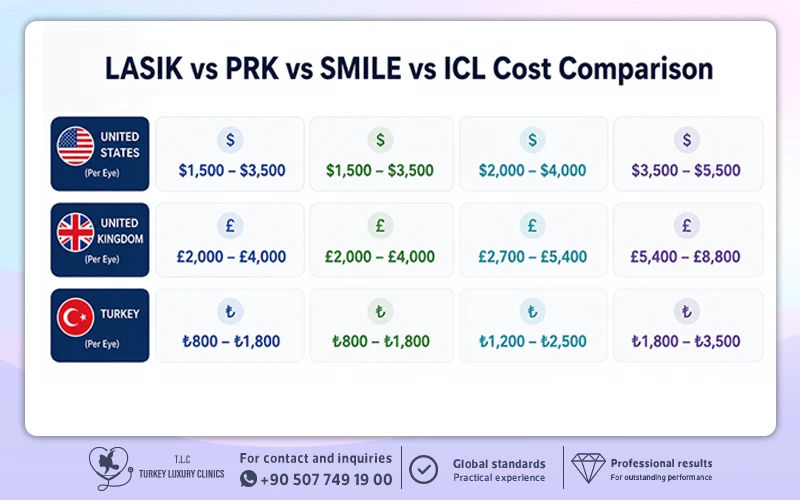
The cost of vision correction surgery varies depending on the country, surgeon experience, technology used, and whether treatment is performed on one or both eyes.
Procedure | United States (Per Eye) | United Kingdom (Per Eye) | Turkey (Per Eye) |
LASIK | $1,500–$3,500 | $2,000–$4,000 | $800–$1,800 |
$1,500–$3,500 | $2,000–$4,000 | $800–$1,800 | |
SMILE | $2,000–$4,000 | $2,700–$5,400 | $1,200–$2,500 |
EVO ICL | $3,500–$5,500 | $5,400–$8,800 | $1,800–$3,500 |
Does Insurance Cover Vision Correction Surgery?
In most countries, LASIK, PRK, SMILE, and EVO ICL are considered elective procedures and are therefore not covered by standard health insurance plans. Exceptions may exist when surgery is performed for medical rather than refractive reasons.
Are Financing Plans Available?
Many clinics offer financing programs that allow patients to spread the cost of treatment over monthly installments. Financing availability varies by country, provider, and credit requirements.
LASIK vs PRK vs SMILE vs ICL Safety, Risks, and Side Effects
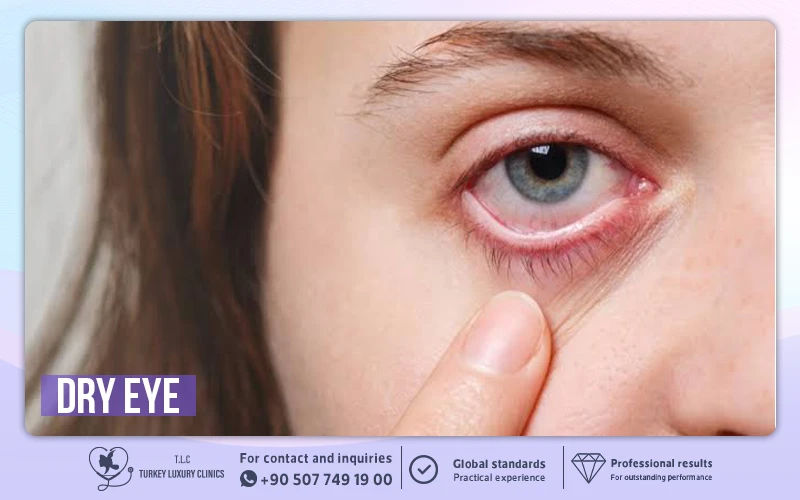
Dry Eye
Temporary dry-eye symptoms can occur after any vision correction procedure, but they are generally more common after LASIK because flap creation affects more corneal nerves. SMILE may reduce this risk in suitable candidates, while EVO ICL avoids corneal tissue removal altogether.
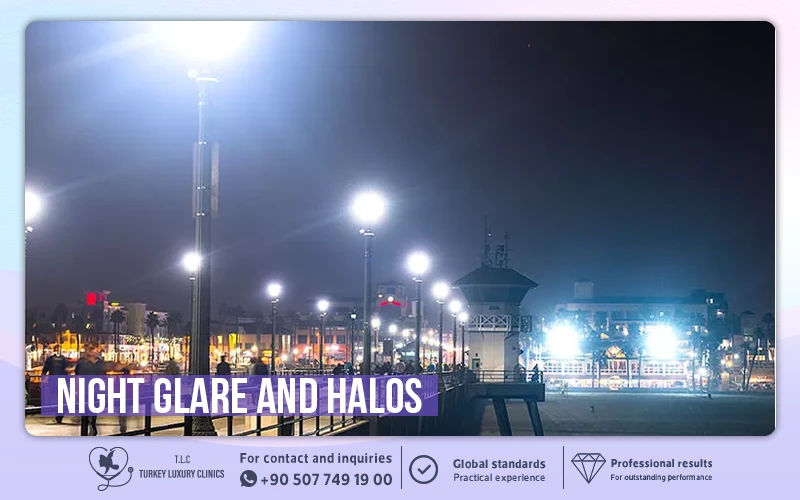
Night Glare and Halos
Some patients experience glare, halos, or starbursts around lights during the early healing period. These symptoms are usually temporary and improve as the eyes stabilize. The risk may be higher in patients with large pupils or very high prescriptions.
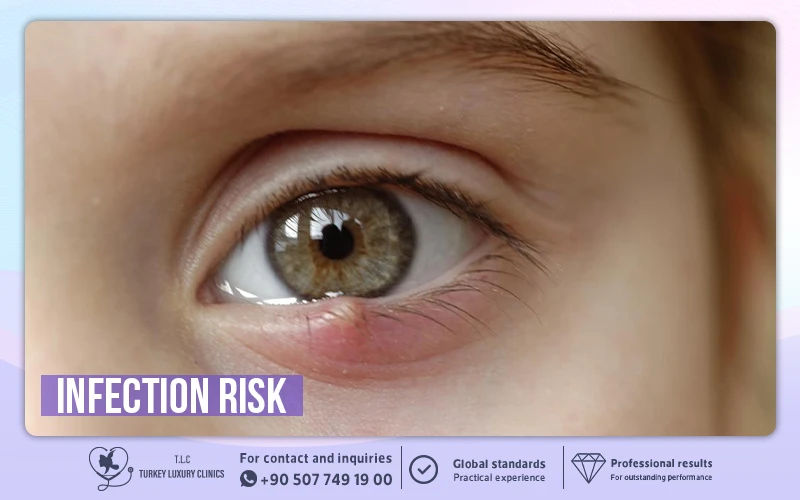
Infection Risk
Serious infections are rare after LASIK, PRK, SMILE, and EVO ICL when procedures are performed by experienced surgeons and postoperative instructions are followed carefully.
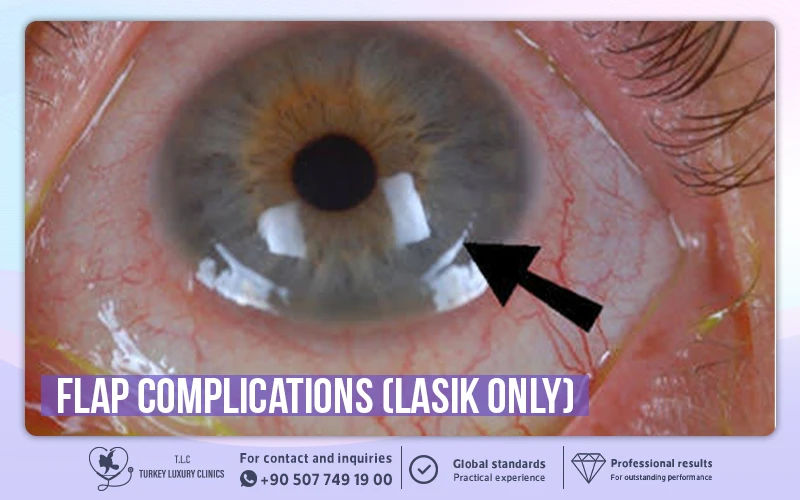
Flap Complications (LASIK Only)
Because LASIK involves creating a corneal flap, flap-related complications can occur in rare cases. Although uncommon, this remains one of the key differences between LASIK and flap-free procedures such as PRK and SMILE.
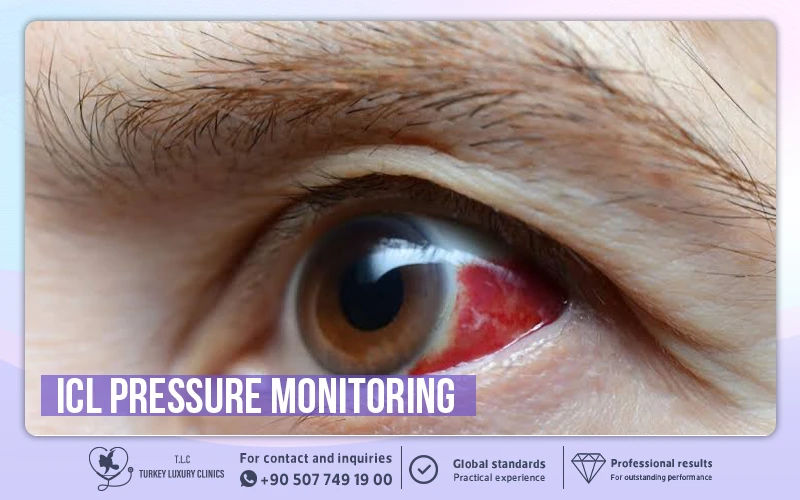
ICL Pressure Monitoring
Unlike laser procedures, EVO ICL involves placement of a lens inside the eye. Patients require routine follow-up examinations to monitor eye pressure and ensure the implanted lens remains properly positioned.
LASIK vs PRK vs SMILE vs ICL Long-Term Results
Stability of Vision
All four procedures provide excellent long-term vision correction when performed in appropriately selected candidates. Most patients achieve stable results for many years after treatment.
Enhancement Possibility
Enhancement procedures may occasionally be required if vision changes over time or if residual refractive error remains after the initial treatment. The approach varies depending on the original procedure and individual eye characteristics.
Age-Related Vision Changes
None of these procedures prevent presbyopia, the age-related loss of near focusing ability that commonly develops after age 40. Even patients who achieve excellent distance vision may eventually require reading glasses as part of the normal aging process.
Which Vision Correction Procedure Is Right for You?
No single procedure is best for everyone. LASIK, PRK, SMILE, and EVO ICL can all deliver excellent vision correction when matched to the right patient. The best choice depends on factors such as corneal thickness, prescription strength, dry-eye status, lifestyle, and long-term goals.
At Turkey Luxury Clinics, our eye specialists evaluate your corneal measurements, prescription, and eye health to help identify the most suitable vision correction procedure for your needs. Contact us today for a personalized assessment and treatment plan.
FAQs About LASIK vs PRK vs SMILE vs ICL