

- IUI vs IVF: Key Differences at a Glance
- What is the Difference Between IVF and IUI?
- How Do IUI and IVF Work?
- Cost Differences Between IUI and IVF
- Success Rate of IUI vs IVF
- Pros and Cons of IUI vs IVF
- Which Is Better: IUI or IVF?
- Key Decision Factors for IUI or IVF
- Still Deciding Between IUI and IVF?
- FAQs About IUI vs IVF
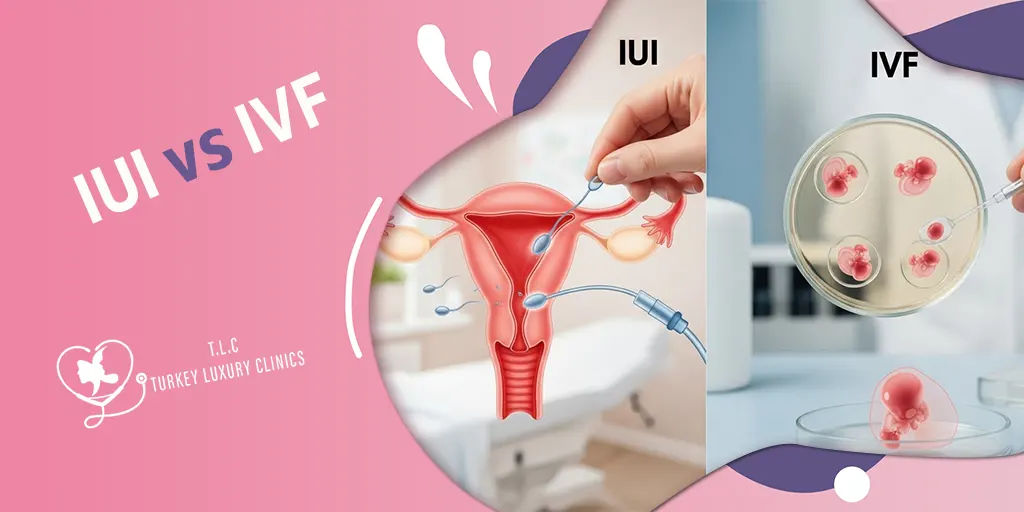
Both Intrauterine Insemination (IUI) and In Vitro Fertilization (IVF) are designed to help individuals or couples achieve pregnancy, but they differ significantly in procedure, cost, and success rates.
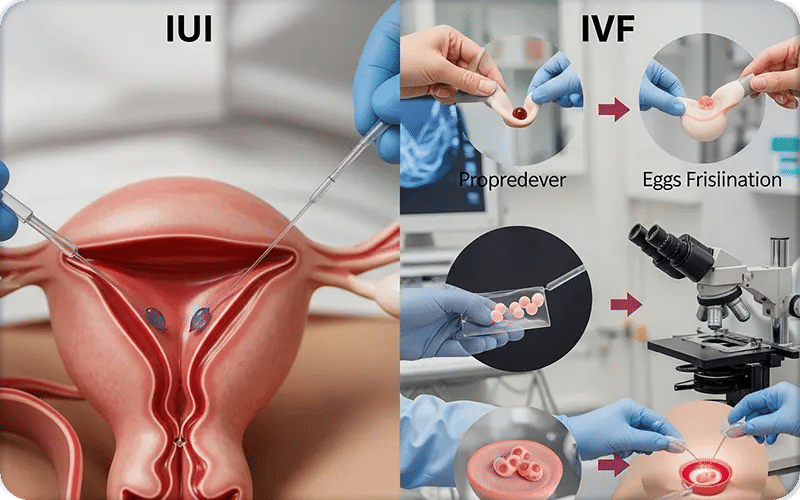
The main distinction is where fertilization occurs: inside the body with IUI, or outside the body in a laboratory with IVF.
IUI is less invasive, simpler, and less expensive, involving the placement of prepared sperm directly into the uterus. It does not require egg retrieval or embryo transfer. However, IUI generally has lower success rates per cycle, and multiple cycles may be needed.
IVF is a more complex, multi-step treatment involving ovarian stimulation, egg retrieval, laboratory fertilization, embryo development, and embryo transfer. Although more invasive and expensive, IVF generally offers higher success rates per cycle and is often used for blocked fallopian tubes, severe male factor infertility, advanced maternal age, failed IUI cycles, or when genetic testing of embryos is needed.
IUI vs IVF: Key Differences at a Glance
Point of Comparison | IUI (Intrauterine Insemination) | IVF (In Vitro Fertilization) |
Treatment Complexity | Simple, minimally invasive procedure | More complex, advanced fertility treatment |
Where Fertilization Happens | Inside the body (fallopian tube) | Outside the body (laboratory) |
How It Works | Prepared sperm is placed directly into the uterus to support natural fertilization | Eggs are retrieved, fertilized in a laboratory, and the resulting embryo is transferred to the uterus |
Level of Medical Intervention | Low | High |
Success Rate per Cycle | Lower | Higher |
Cost | Lower | Higher |
Time & Commitment | Shorter treatment timeline with fewer clinic visits | Longer process requiring more monitoring and appointments |
Best Suited For | Mild male factor infertility, unexplained infertility, and certain ovulation disorders | Severe infertility, blocked fallopian tubes, advanced maternal age, or failed IUI cycles |
Role in Treatment Plan | Often the first fertility treatment recommended | Often the next step after unsuccessful IUI cycles or the first choice for complex cases |
Embryo Control | Fertilization occurs naturally with no embryo selection | Embryos can be monitored and selected before transfer |
What is the Difference Between IVF and IUI?
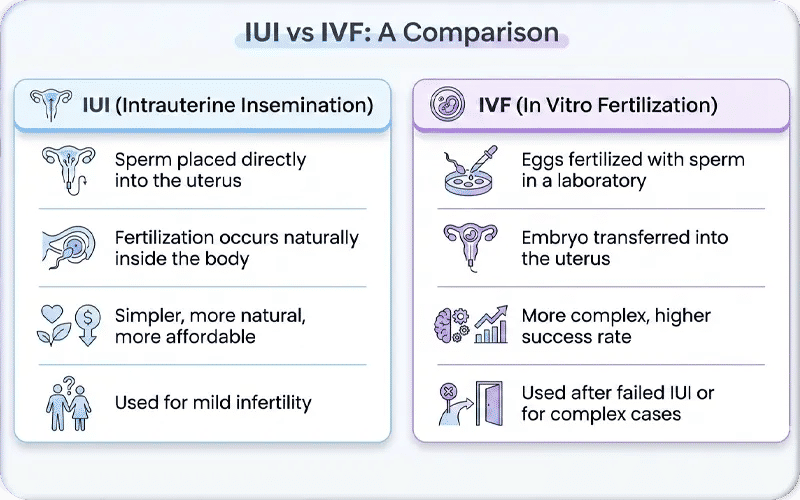
The main difference between IUI and IVF is how and where fertilization occurs. With IUI, prepared sperm is placed directly into the uterus around ovulation, allowing sperm to travel to the fallopian tube and fertilize the egg naturally. With IVF, eggs are retrieved from the ovaries and fertilized with sperm in a laboratory before an embryo is transferred to the uterus.
IUI is therefore simpler, less invasive, less expensive, and requires less medical intervention. It is commonly considered for unexplained infertility, mild male factor infertility, ovulation disorders, or when donor sperm is used.
IVF provides greater control over fertilization and embryo development and generally offers higher success rates per cycle. It may be recommended for blocked fallopian tubes, severe male factor infertility, diminished ovarian reserve, advanced maternal age, repeated IUI failure, or when preimplantation genetic testing is needed.
Key Differences Between IUI vs IVF
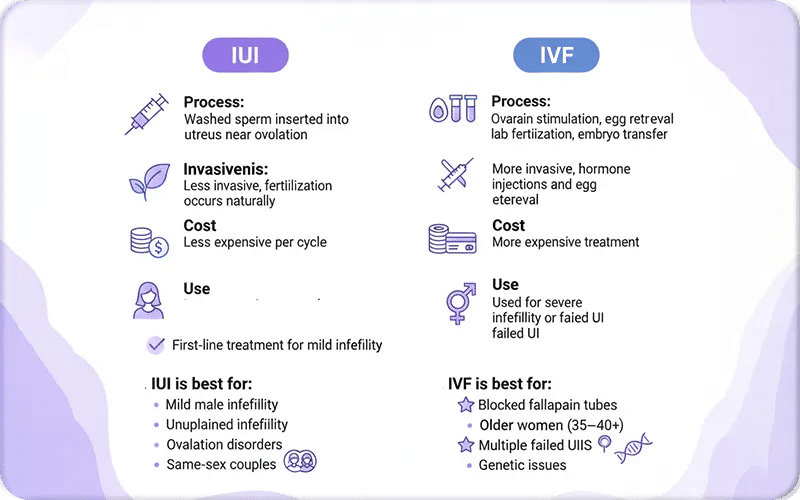
- Process: IUI involves inserting a concentrated, washed sperm sample directly into the uterus around the time of ovulation, shortening the sperm’s journey to the egg. IVF, in contrast, involves ovarian stimulation, egg retrieval, fertilization in a laboratory (“in vitro”), and then transferring the resulting embryo(s) into the uterus.
- Invasiveness: IUI is less invasive and simpler than IVF. Mild fertility medications may be used to stimulate egg production, but fertilization occurs naturally inside the body. IVF is more complex and invasive, requiring hormone injections and surgical egg retrieval.
- Cost: IUI is significantly less expensive per cycle compared to IVF, while IVF is much more costly due to its multi-step nature.
- Use: IUI is often the first fertility treatment attempted and is especially suitable for unexplained infertility or mild male factor issues. IVF offers more control, allowing doctors to select the healthiest embryos, and is used for more severe infertility cases or when IUI fails.
- IUI is best for: Mild male infertility, unexplained infertility, ovulation disorders, same-sex couples. IVF is best for: Blocked fallopian tubes, severe male factor infertility, older women (over 35-40), multiple failed IUIs, complex genetic issues.
How Do IUI and IVF Work?
Although both treatments aim to help patients achieve pregnancy, the process is very different. IUI supports natural fertilization inside the body, while IVF involves fertilization in a laboratory before an embryo is transferred to the uterus.
How IUI Works
IUI is a relatively simple fertility treatment that follows these steps:
- Ovulation Monitoring – The fertility specialist tracks ovulation to determine the best time for treatment. In some cases, fertility medications may be used to stimulate egg development.
- Sperm Preparation – A semen sample is collected and processed in a laboratory to concentrate the healthiest and most motile sperm.
- Sperm Placement – The prepared sperm are placed directly into the uterus using a thin catheter.
- Natural Fertilization – The sperm travel naturally to the fallopian tube, where fertilization may occur if an egg is present.
How IVF Works
IVF is a more advanced fertility treatment that involves several additional steps:
- Ovarian Stimulation – Fertility medications are used to encourage the ovaries to produce multiple mature eggs.
- Egg Retrieval – The mature eggs are collected from the ovaries through a minor surgical procedure.
- Laboratory Fertilization – The eggs are fertilized with sperm in a laboratory. In some cases, a single sperm is injected directly into the egg using ICSI.
- Embryo Development – The fertilized eggs develop into embryos and are monitored for several days.
- Embryo Transfer – The healthiest embryo is selected and transferred into the uterus.
- Pregnancy Testing – A blood test is performed approximately 10–14 days later to determine whether implantation and pregnancy have occurred.
Key Difference
The main difference is where fertilization takes place. With IUI, fertilization occurs naturally inside the body after sperm are placed in the uterus. With IVF, fertilization occurs in a laboratory, allowing fertility specialists to monitor embryo development and select embryos before transfer, which contributes to higher success rates in many patients.
Cost Differences Between IUI and IVF
IUI is generally more affordable than IVF when comparing the upfront price per cycle.
A single IUI cycle typically costs between $300 and $1,000, depending on medications and clinic fees. In contrast, IVF is a multi-step procedure involving ovarian stimulation, egg retrieval, laboratory fertilization, and embryo transfer, which makes it significantly more expensive.
IVF costs usually range from $10,000 to $20,000 per cycle, and additional procedures like ICSI or genetic testing can increase the total cost.
For couples seeking a lower-cost starting point, IUI is often the preferred option. However, because IUI success rates are lower, the cost of doing multiple failed rounds can add up quickly.
Success Rate of IUI vs IVF
Success rates vary significantly based on female age, ovarian reserve, sperm quality, infertility diagnosis, and clinic expertise.
IUI has a lower success rate per cycle, typically around 10–20%, which can vary based on age, fertility issues, and whether fertility medications are used. Multiple IUI cycles may be necessary to achieve pregnancy.
IVF, on the other hand, offers higher success rates per cycle, averaging 40–50%, depending on age, embryo quality, and clinic expertise.
Because IVF allows doctors to fertilize eggs outside the body and select the healthiest embryos for transfer, it generally provides couples with a greater chance of pregnancy, especially in cases of severe infertility or when IUI has failed.
IUI vs IVF Success Rates by Female Age
Female age is one of the most important factors affecting fertility treatment success. While both IUI and IVF become less effective as age increases, IVF generally maintains higher pregnancy rates across all age groups.
For younger women with good ovarian reserve, IUI may be a reasonable first step. However, many fertility specialists recommend considering IVF sooner after age 38 because fertility declines more rapidly and time becomes a more important factor.
Female Age | Average IUI Success Rate per Cycle | Average IVF Success Rate per Cycle* | Preferred Treatment Approach |
Under 35 | 10–20% | 45–55% | IUI is often considered first if fertility factors are favorable. |
35–37 | 8–15% | 40–50% | IUI may still be attempted, but IVF is increasingly considered. |
38–40 | 5–10% | 25–40% | IVF is often recommended due to declining egg quality. |
41–42 | 3–7% | 10–20% | IVF is usually preferred because IUI success rates are low. |
Over 42 | Less than 5% | Less than 10% with their own eggs | IVF may be recommended, sometimes with donor eggs, depending on ovarian reserve. |
Pros and Cons of IUI vs IVF
IUI Pros
- Less invasive procedure: IUI does not require egg retrieval or surgery. The treatment involves placing prepared sperm directly into the uterus, making it one of the least invasive fertility treatments available.
- More affordable than IVF: IUI typically costs significantly less per cycle than IVF, making it a common first-line treatment for couples who want to start with a lower-cost option.
- Shorter treatment timeline: Most IUI cycles require fewer medications, fewer clinic visits, and less monitoring compared to IVF, allowing treatment to be completed more quickly.
- Suitable for certain fertility conditions: IUI may be effective for unexplained infertility, mild male factor infertility, ovulation disorders, cervical factor infertility, and the use of donor sperm.
- Lower physical and emotional burden: Because the procedure is simpler and less intensive, many patients find IUI less physically demanding and easier to manage emotionally.
IUI Cons
- Lower success rates per cycle: Pregnancy rates are generally lower than IVF, meaning several treatment cycles may be needed before achieving a successful pregnancy.
- Not suitable for severe infertility: IUI is usually not recommended for blocked fallopian tubes, severe male factor infertility, significantly diminished ovarian reserve, or advanced endometriosis.
- Multiple cycles may increase total costs: Although each cycle is relatively inexpensive, repeated unsuccessful cycles can increase the overall cost and delay more effective treatment options.
- Less control over fertilization: Fertilization occurs naturally inside the body, which means doctors cannot directly observe embryo development or select embryos for transfer.
- Risk of multiple pregnancy: When fertility medications are used alongside IUI, the likelihood of twins or higher-order multiples may increase.
IVF Pros
- Higher success rates per cycle: IVF generally offers the highest pregnancy rates among fertility treatments, particularly for women with more complex fertility challenges.
- Effective for severe infertility conditions: IVF can help overcome problems such as blocked fallopian tubes, severe male factor infertility, advanced endometriosis, diminished ovarian reserve, and repeated IUI failure.
- Greater control over fertilization and embryo selection: Fertilization takes place in a laboratory, allowing specialists to monitor embryo development and select the most suitable embryo for transfer.
- Allows genetic testing of embryos: Preimplantation Genetic Testing (PGT) can identify certain genetic abnormalities before embryo transfer, helping some patients improve treatment outcomes.
- May reduce time to pregnancy: Because success rates per cycle are higher, IVF may help some couples achieve pregnancy faster than multiple rounds of IUI.
IVF Cons
- Higher treatment costs: IVF is significantly more expensive than IUI because it involves ovarian stimulation, egg retrieval, laboratory fertilization, embryo culture, and embryo transfer.
- More invasive process: Treatment requires hormone injections, frequent monitoring, and a minor surgical procedure to retrieve eggs.
- Greater physical and emotional demands: IVF can be more stressful due to the medications, treatment complexity, waiting periods, and financial investment involved.
- Longer treatment process: A complete IVF cycle usually requires more appointments, testing, and monitoring compared to IUI.
- Risk of complications: Although uncommon, IVF may be associated with risks such as ovarian hyperstimulation syndrome (OHSS), medication side effects, and multiple pregnancy if more than one embryo is transferred.
Which Is Better: IUI or IVF?
The best fertility treatment choice depends on individual factors such as age, underlying fertility issues, and personal goals
IUI is less invasive, more affordable, and closer to the body's natural fertilization process. It involves fewer medications, fewer clinic visits, and a simpler treatment cycle, making it a common first-line option for patients with mild fertility challenges. IVF offers significantly higher success rates per cycle and may be the better option for patients with complex fertility conditions or those who have not conceived after IUI.
When IUI May Be the Better Choice
IUI is often recommended when the reproductive system is largely functioning normally, and fertilization can still occur naturally with minimal medical assistance. Because it is less invasive, less expensive, and closer to natural conception, many fertility specialists consider IUI the first treatment option for selected patients.
IUI may be a good option if you have:
- Unexplained infertility, especially when fertility testing does not reveal a clear cause of infertility.
- Mild male factor infertility, such as slightly reduced sperm count or motility.
- Ovulation disorders, including cases that respond well to fertility medications.
- Good ovarian reserve and at least one open fallopian tube.
- Age under 35–38 years with no major fertility complications.
- A preference for a lower-cost and less invasive treatment approach.
- No previous fertility treatment attempts and a desire to start with a simpler option before considering IVF.
When IVF May Be the Better Choice
IVF may be the better choice when natural fertilization is unlikely to succeed, when fertility challenges are more complex, or when achieving pregnancy sooner is a priority. Unlike IUI, IVF allows fertilization to occur in a laboratory, giving fertility specialists greater control over fertilization, embryo development, and embryo selection.
IVF may be a good option if you have:
- Blocked or severely damaged fallopian tubes, which can prevent sperm from reaching the egg naturally.
- Severe male factor infertility, particularly when sperm count, motility, or quality is significantly reduced and ICSI may be needed.
- Diminished ovarian reserve, especially when delaying treatment could further reduce the chance of pregnancy.
- Moderate to severe endometriosis, particularly when other fertility treatments have been unsuccessful.
- Advanced maternal age, especially around age 38 or older when treatment time becomes increasingly important.
- Multiple unsuccessful IUI cycles without achieving pregnancy.
- A need for preimplantation genetic testing (PGT) before embryo transfer.
- A need for greater control over fertilization and embryo development than IUI can provide.
Key Decision Factors for IUI or IVF
Factor | IUI More Often Considered | IVF More Often Considered |
Infertility cause | Mild/unexplained | Severe/complex |
Fallopian tubes | At least one open tube | Blocked/damaged tubes |
Male factor | Mild impairment | Severe impairment/ICSI needed |
Ovarian reserve | Favorable | Diminished/individual assessment |
Previous treatment | No/limited failed IUI | Repeated failed IUI |
Age/time | Younger/favorable factors | Increasing age or time-sensitive case |
These factors are rarely considered in isolation. Fertility specialists assess the complete clinical picture to recommend the treatment option most likely to result in a healthy pregnancy.
Still Deciding Between IUI and IVF?
If you’re not sure whether IUI or IVF is the right option for you, you’re not alone. The best choice depends on factors like age, fertility diagnosis, medical history, and previous treatment attempts.
At Turkey Luxury Clinics, our fertility experts help you understand which treatment suits your situation best—whether starting with IUI or moving directly to IVF. We work with leading fertility centers in Turkey to offer personalized guidance, transparent options, and coordinated care from consultation to treatment.
You may like:
IVF After Tubal Ligation Cost in 2026: Average Prices and Breakdown
IVF Timeline: Step-by-Step Process from Start to Finish
FAQs About IUI vs IVF