

- Can You Get Pregnant After Tubal Ligation?
- IVF After Tubal Ligation
- How IVF Works After Tubal Ligation
- Step-by-Step IVF After Tubal Ligation
- IVF Success After Tubal Ligation
- Factors Affecting the Success of IVF After Tubal Ligation
- IVF Success Rate at 40 After Tubal Ligation
- IVF After Tubal Ligation vs. Tubal Reversal
- Cost of IVF after Tubal Ligation in 2026
- IVF After Tubal Ligation in Turkey
- FAQs About IVF After Tubal Ligation
Tubal ligation, commonly known as “getting your tubes tied,” is a permanent surgical procedure that blocks or seals a woman’s fallopian tubes to prevent pregnancy.
This highly effective form of long-term birth control stops sperm from reaching an egg without affecting menstrual cycles or hormones, making natural conception nearly impossible.
IVF after tubal ligation offers a reliable solution for women who wish to become pregnant. During the procedure, eggs are retrieved from the ovaries, fertilized with sperm in a laboratory, and the resulting embryos are transferred directly into the uterus, bypassing the fallopian tubes entirely.
So, you can pursue IVF, including Mini IVF, after a tubal ligation, as the procedure does not affect IVF success rates.
Turkey Luxury Clinics provide access to top fertility specialists and highly qualified embryologists, offering advanced IVF care. Our partner hospitals are JCI-accredited and fully equipped to ensure safe, effective, and successful treatments, making them a trusted choice for women planning IVF after tubal ligation.
Can You Get Pregnant After Tubal Ligation?
Yes, it is possible. Tubal ligation permanently blocks or cuts the fallopian tubes, making natural pregnancy nearly impossible. In rare cases, pregnancy can occur even after tubal ligation, but these pregnancies carry a higher risk of being ectopic, meaning the embryo implants outside the uterus, most commonly in the fallopian tube.
Some women may decide they want to become mothers after having a tubal ligation. Fortunately, pregnancy is still possible through two main options:
- Surgical Tubal Reversal: This procedure reconnects the fallopian tubes to restore natural fertility. Success depends on the type of tubal ligation, age, and tubal health. Tubal reversal carries a risk of ectopic pregnancy and requires surgical recovery.
- In Vitro Fertilization (IVF): IVF bypasses the fallopian tubes entirely, fertilizing eggs in a laboratory and transferring embryos directly into the uterus, allowing pregnancy without relying on the fallopian tubes.
IVF After Tubal Ligation
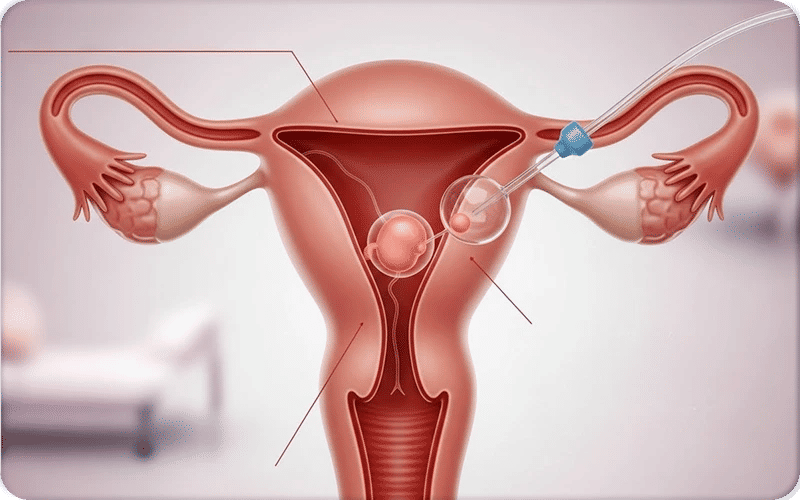
IVF, or In Vitro Fertilization, is a highly effective fertility treatment that can be used even for women who have had a tubal ligation. Although tied fallopian tubes prevent natural pregnancy, they do not prevent IVF.
IVF cannot undo or reverse a ligated tube, but it bypasses the blocked fallopian tubes by fertilizing eggs with sperm in a laboratory and then transferring the resulting embryo directly into the uterus. This makes pregnancy possible for women whose tubes were tied for birth control.
It is a popular alternative to surgical reversal because it often has higher success rates, requires no surgery, and does not depend on open tubes—functioning similarly to IVF for women without tubal ligation.
How IVF Works After Tubal Ligation
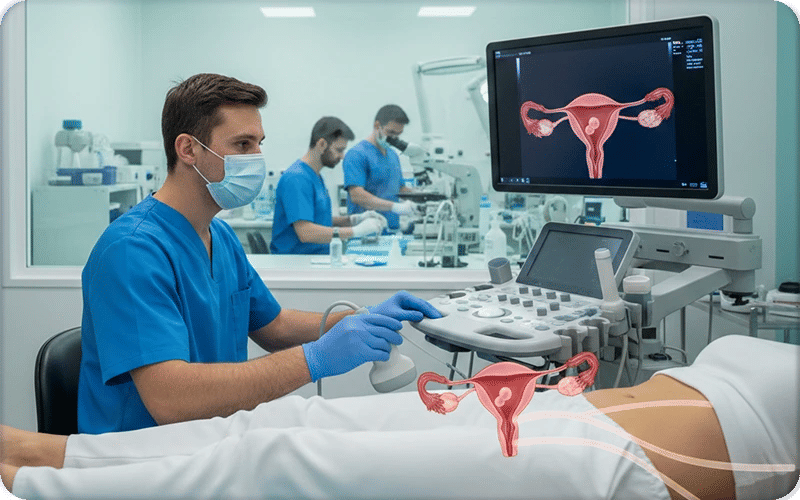
IVF works by stimulating the ovaries to produce multiple eggs, retrieving those eggs, fertilizing them with sperm in a laboratory, and then transferring the resulting embryos directly into the uterus for implantation. This process does not involve the fallopian tubes, meaning tubal ligation is not an obstacle to conception, as the blocked tubes are completely bypassed.
As a result, pregnancy can occur without relying on the fallopian tubes at all. IVF is often more reliable and less invasive than surgical tubal ligation reversal.
Step-by-Step IVF After Tubal Ligation
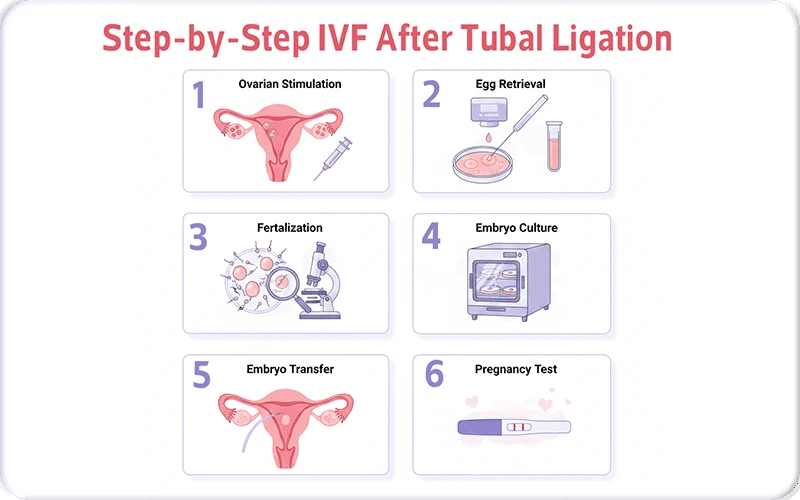
1. Ovarian Stimulation
In a natural cycle, the ovaries release only one egg per month. IVF uses fertility medications, commonly FSH, LH, or Menopur, for about 9–12 days to stimulate multiple eggs. Producing more eggs increases the chance of creating healthy embryos. During this phase, doctors monitor hormone levels (like estradiol) and follicle growth through blood tests and ultrasounds. Patients are advised to maintain hydration, eat a balanced diet, and follow medication schedules closely.
2. Egg Retrieval
Once the eggs are mature, they are collected during a minimally invasive procedure called transvaginal ultrasound-guided aspiration. A thin needle retrieves eggs from the ovarian follicles under light sedation, usually taking less than 30 minutes. Most women can go home the same day. Proper rest after the procedure and avoiding strenuous activity help recovery.
3. Fertilization
Retrieved eggs are taken to a specialized lab where they are fertilized with sperm from a partner or donor. Fertilization can occur conventionally or through ICSI (Intracytoplasmic Sperm Injection), where a single sperm is injected directly into an egg. This step bypasses the fallopian tubes entirely. Maintaining optimal lab conditions ensures the highest fertilization success.
4. Embryo Culture
Fertilized eggs, now embryos, are cultured in the lab for 5–6 days. Embryologists monitor cell division, growth rate, and quality to select embryos with the best implantation potential. Optional genetic testing (PGT) may be performed to detect chromosomal abnormalities, improving success rates.
5. Embryo Transfer
The healthiest embryo is selected and transferred directly into the uterus using a thin catheter through the cervix. This procedure is painless and does not require anesthesia. Because the embryo is placed directly in the uterus, the blocked fallopian tubes are bypassed, making IVF highly effective after tubal ligation. Patients are often advised to rest for a short period post-transfer and avoid strenuous activity for a few days.
6. Pregnancy Test
About 10–14 days after embryo transfer, a blood test measures hCG levels to confirm implantation. If positive, follow-up ultrasounds monitor the early development of the pregnancy. Patients may be given hormonal support, such as progesterone, to support implantation and early gestation.
Discover the Positive Signs After Embryo Transfer and read more about IVF timeline from start to finish
IVF Success After Tubal Ligation
The success rate of IVF after tubal ligation is very good and comparable to IVF for women without previous tubal issues. Success depends mainly on age:
- Women under 35: over 50% chance of live birth
- Women 35–37: around 40%
- Women 38–40: about 30%
- Women over 40: between 10–20%
Success rates depend mainly on maternal age, egg and sperm quality, and overall reproductive health rather than the presence of previous tubal ligation.
Factors Affecting the Success of IVF After Tubal Ligation
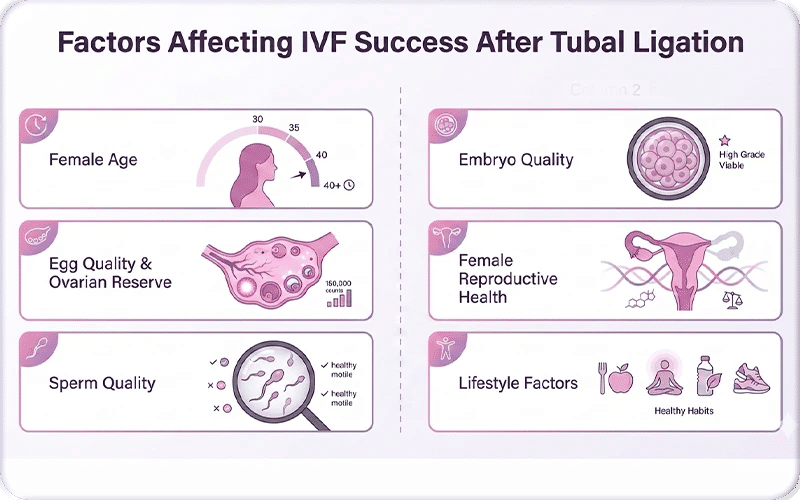
Several medical and personal factors influence the success of IVF after tubal ligation. Understanding these factors helps set realistic expectations and optimize treatment outcomes.
- Female Age: The strongest predictor of IVF success. Women under 35 generally have higher success rates due to better egg quality and quantity, while rates decline more noticeably after age 35–40.
- Egg Quality and Ovarian Reserve: Healthier eggs improve fertilization and embryo development. Tests such as AMH help evaluate ovarian reserve.
- Sperm Quality: Normal sperm count, motility, and morphology are essential for successful fertilization.
- Embryo Quality: The number and quality of embryos created directly affect implantation and pregnancy outcomes.
- Female Reproductive Health: Conditions such as endometriosis, uterine abnormalities, or pelvic scarring may influence success rates.
- Clinic Expertise: The experience of fertility specialists and embryologists plays a significant role in outcomes.
- Lifestyle Factors: Maintaining a healthy BMI, balanced nutrition, and overall wellness can positively impact IVF success.
IVF Success Rate at 40 After Tubal Ligation
IVF is a very effective option after tubal ligation at age 40, often preferred over tubal reversal due to age-related decline in egg quality. Success rates generally range from 20–30% live birth per cycle, though individual results depend heavily on egg quality and other factors. IVF bypasses the blocked tubes entirely, making it a strong choice for older women.
IVF After Tubal Ligation vs. Tubal Reversal
IVF after tubal ligation is often preferred over tubal reversal surgery due to higher success rates, faster time to conception, a lower risk of ectopic pregnancy, and the avoidance of major surgery. However, tubal reversal may still appeal to some women because it allows for natural conception and the possibility of having multiple pregnancies without repeated treatments.
While tubal reversal surgery is an option for women who wish to conceive after tubal ligation, IVF generally offers higher and more consistent success rates, particularly for older women. IVF also provides a quicker path to pregnancy, carries a minimal risk of ectopic pregnancy, and eliminates the need for invasive surgical procedures.
Tubal reversal works by reconnecting the fallopian tubes, enabling natural fertilization to occur. Despite this advantage, the procedure involves surgical recovery, carries a higher risk of ectopic pregnancy, and its success depends heavily on factors such as tubal condition and maternal age.
IVF bypasses the fallopian tubes entirely by fertilizing eggs in a laboratory and transferring embryos directly into the uterus. Success rates depend primarily on maternal age, egg and sperm quality, and overall reproductive health. Although younger women tend to achieve higher live birth rates, IVF remains an effective and reliable option for many older women as well.
Cost of IVF after Tubal Ligation in 2026
The cost of IVF after tubal ligation is generally similar to standard IVF. In the United States, a single cycle without medications typically ranges from $12,000 to $20,000.
The base IVF cycle usually costs between $10,000 and $21,000, while medications add around $1,500 to $3,000.
Additional procedures such as Intracytoplasmic Sperm Injection (ICSI), assisted hatching, genetic testing, or embryo freezing can further increase the overall cost.
In Turkey, IVF after tubal ligation is significantly more affordable. Standard cycle packages generally range from $2,000 to $6,000, while premium packages with advanced services may exceed $8,000.
IVF After Tubal Ligation in Turkey
IVF after tubal ligation in Turkey is a highly effective and increasingly popular path to pregnancy. Turkish fertility clinics provide advanced techniques, highly experienced doctors, and comprehensive care at significantly lower costs compared to many Western countries, making Turkey a preferred destination for international patients seeking IVF treatment.
Why Choose IVF in Turkey?
Turkish clinics provide all-inclusive care, often including medications, transfers, and follow-up support. With experienced specialists and JCI-accredited hospitals, patients can access high-quality IVF treatment at competitive prices, making Turkey an increasingly popular choice for international patients seeking reliable fertility solutions.
- High Success Rates & Expertise:
Turkish IVF centers combine modern technology with extensive experience, achieving high success rates even in complex cases, including women who have had tubal ligation.
- Cost-Effectiveness:
IVF in Turkey is generally more affordable, offering excellent value for international patients without compromising quality or safety.
- Convenient Location & Accessibility:
Turkey’s strategic geographic location, modern airports, and well-developed travel infrastructure make it easy and convenient for patients from around the world.
- Comprehensive Care:
Clinics provide personalized treatment plans, advanced procedures such as ICSI (Intracytoplasmic Sperm Injection) and PGD (Preimplantation Genetic Diagnosis), and continuous patient support before, during, and after the IVF process
Many women in Turkey have achieved pregnancy through IVF after tubal ligation, with real success stories reported by Turkey Luxury Clinics. These stories show how IVF can provide a reliable path to motherhood for women who thought natural conception was no longer possible. Contact us now to start your own success story!
FAQs About IVF After Tubal Ligation