

- What Is the IVF Process?
- IVF Process Step by Step
- If the test is positive, repeat beta-hCG testing and an early pregnancy ultrasound may be scheduled to confirm that the pregnancy is progressing appropriately. If it is negative, the fertility specialist reviews the cycle and discusses possible next steps, including the use of any available frozen embryos.
- IVF Process Timeline Table: Day by Day
- What Tests Are Done Before IVF?
- How Long Does the IVF Process Take?
- Plan Your IVF Treatment in Turkey
- FAQs About IVF Process
The IVF process (in vitro fertilization) is a fertility treatment in which mature eggs are collected from the ovaries and fertilized with sperm in a laboratory to create embryos. A selected embryo is then transferred into the uterus with the goal of achieving pregnancy.
The active IVF treatment cycle usually takes about 2–3 weeks, from ovarian stimulation to egg retrieval, fertilization, embryo development, and embryo transfer. The complete IVF process may take around 6–8 weeks when preparation and pregnancy testing are included. In some protocols, preparation starts during the previous menstrual cycle with medications that prepare or regulate the ovaries before stimulation begins.
The process starts with ovarian stimulation using hormone injections, usually for 8–14 days, while the ovaries are monitored with ultrasounds and blood tests. Once the eggs are ready, a trigger shot is given, followed by egg retrieval about 34–36 hours later. A sperm sample is collected, and the eggs are fertilized in the laboratory using conventional IVF or ICSI.
The resulting embryos develop and are monitored in the laboratory for several days before a selected embryo is transferred into the uterus or suitable embryos are frozen for later use. After embryo transfer, a beta-hCG pregnancy blood test is usually performed around 9–14 days later.
This guide explains the IVF process step by step, the IVF timeline from start to finish, and what women can expect at each stage of treatment.
What Is the IVF Process?
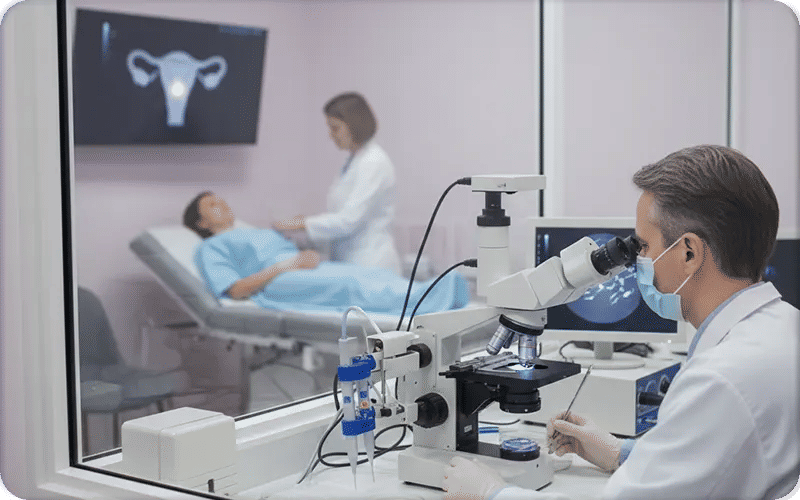
IVF, or In Vitro Fertilization, is a fertility treatment in which eggs are fertilized with sperm in a laboratory dish (“in vitro”), and the resulting embryo is then transferred to the uterus to achieve pregnancy. IVF offers hope for couples facing infertility challenges such as blocked fallopian tubes, male factor infertility, ovulation disorders, or unexplained infertility.
The IVF treatment process is carried out as a personalized, carefully planned cycle. It follows a precise, day-by-day protocol that includes hormone treatments, close medical monitoring, and clinical evaluations, all supervised by gynecologists specialized in reproductive medicine.
Related topics: IVF after tubal ligation, the best chance for pregnancy in tight fallopian tubes
IVF Process Step by Step
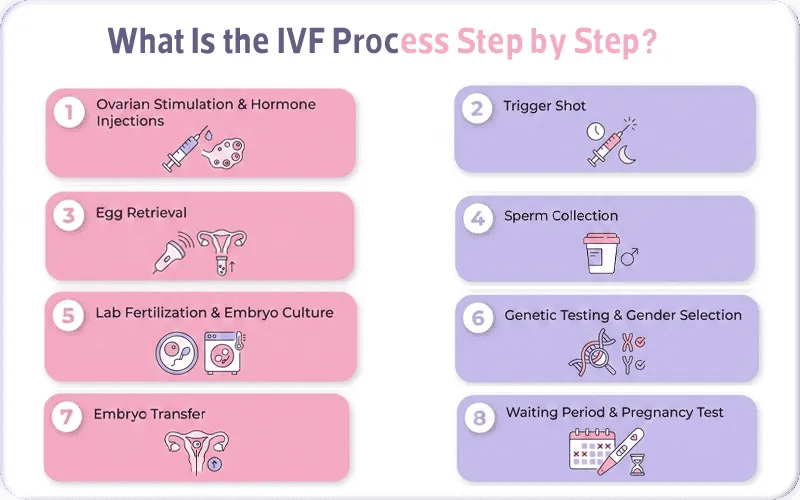
The IVF process involves several stages, beginning with fertility testing and treatment planning and continuing through ovarian stimulation, monitoring, egg retrieval, sperm collection, laboratory fertilization, embryo development, embryo transfer, and pregnancy testing.
The main steps of the IVF process are:
- Initial consultation and fertility testing
- Ovarian stimulation
- Monitoring and trigger shot
- Egg retrieval
- Sperm collection
- Fertilization with conventional IVF or ICSI
- Embryo development and monitoring
- Embryo transfer
- Implantation period and pregnancy test
The active IVF cycle typically takes about 2–3 weeks, although the complete process may take around 6–8 weeks when pretreatment, preparation, and pregnancy testing are included.
Step 1: Initial Consultation and Fertility Testing
Before ovarian stimulation begins, the fertility specialist evaluates both partners and creates a personalized IVF treatment plan. Testing may include ovarian reserve tests such as AMH, FSH and antral follicle count (AFC), transvaginal ultrasound, uterine assessment, and semen analysis.
Depending on the IVF protocol, medications may also be started during the preceding menstrual cycle to prepare or regulate the ovaries before stimulation.
Step 2: Ovarian Stimulation
Ovarian stimulation encourages the ovaries to develop multiple mature eggs instead of the single egg typically released during a natural menstrual cycle.
During this stage, hormone injections—usually gonadotropins such as FSH or hMG—are taken for approximately 8–14 days. GnRH agonists or antagonists may also be used to prevent premature ovulation and control the timing of egg retrieval.
The medication and dosage are individualized according to factors such as age, ovarian reserve, and response to treatment.
Some women experience temporary effects such as bloating, breast tenderness, mild cramping, mood changes, or discomfort at the injection site.
Step 3: Monitoring and Trigger Shot
During ovarian stimulation, the fertility team monitors follicle growth and hormone levels using transvaginal ultrasounds and blood tests. The results help determine whether medication doses need adjustment and when the eggs are ready for final maturation.
Once the follicles reach the appropriate stage, a trigger shot, commonly containing hCG or a GnRH agonist such as leuprolide (Lupron), is given to induce final egg maturation.
Egg retrieval is usually scheduled about 34–36 hours after the trigger shot, before ovulation occurs.
Step 4: Egg Retrieval
Egg retrieval (oocyte retrieval) is a minimally invasive procedure used to collect mature eggs from the ovarian follicles. It is usually performed under sedation or anesthesia using a thin needle guided through the vagina by transvaginal ultrasound.
The procedure commonly takes around 15–30 minutes and is performed approximately 34–36 hours after the trigger shot.
The collected eggs are then examined by the embryology laboratory and prepared for fertilization.
Step 5: Sperm Collection
A sperm sample is usually collected from the partner or donor on or around the day of egg retrieval and prepared in the laboratory to select suitable sperm for fertilization.
When sperm cannot be obtained through ejaculation, surgical sperm-retrieval techniques such as PESA, TESA, TESE, or MicroTESE may be considered depending on the cause of male infertility.
Step 6: Fertilization With Conventional IVF or ICSI
After egg retrieval and sperm preparation, the mature eggs are fertilized in the laboratory using either conventional IVF or intracytoplasmic sperm injection (ICSI).
- Conventional IVF: Eggs are placed together with prepared sperm in a laboratory culture dish, allowing fertilization to occur.
- ICSI: An embryologist injects a single sperm directly into a mature egg. ICSI may be recommended in certain cases, particularly when sperm-related fertility problems are present.
Approximately 16–20 hours later, embryologists check the eggs for signs of fertilization, including the presence of two pronuclei (2PN).
Step 7: Embryo Development and Monitoring
Successfully fertilized eggs begin developing into embryos and are monitored in laboratory incubators over the following several days.
Embryologists assess embryo development and quality as the embryos progress through early cleavage stages and, when development continues appropriately, toward the blastocyst stage around day 5–6.
Depending on the treatment plan, suitable embryos may then be transferred to the uterus, frozen through cryopreservation for future use, or biopsied for preimplantation genetic testing (PGT).
Optional: Preimplantation Genetic Testing (PGT)
If PGT is planned, a small number of cells are usually biopsied from an embryo at the blastocyst stage and tested for specific genetic or chromosomal abnormalities, depending on the type of PGT being performed.
Embryos undergoing PGT are commonly frozen while testing is completed, with a suitable embryo transferred during a later frozen embryo transfer cycle.
Step 8: Embryo Transfer
After embryo assessment, a selected embryo may be transferred into the uterus. Depending on embryo development and the treatment plan, transfer may occur during the same IVF cycle as a fresh embryo transfer, while other embryos may be cryopreserved for later use. Some treatment plans instead use a frozen embryo transfer (FET) in a later cycle.
During embryo transfer, the embryo is passed through the cervix into the uterus using a thin, flexible catheter, usually with ultrasound guidance.
The procedure is generally quick and does not usually require anesthesia. Mild pressure or cramping may occur.
Step 9: Implantation Period and Pregnancy Test
After embryo transfer, the embryo may attach to the uterine lining (endometrium) and begin implantation. During this period, patients generally continue any prescribed medications, including progesterone or other luteal-phase support, according to their fertility specialist's instructions.
Some women experience mild cramping, bloating, or spotting, while others experience no symptoms. These symptoms alone cannot confirm whether implantation has occurred.
A beta-hCG blood pregnancy test is usually performed approximately 9–14 days after embryo transfer, depending on the clinic and treatment protocol.
If the test is positive, repeat beta-hCG testing and an early pregnancy ultrasound may be scheduled to confirm that the pregnancy is progressing appropriately. If it is negative, the fertility specialist reviews the cycle and discusses possible next steps, including the use of any available frozen embryos.
IVF Process Timeline Table: Day by Day
This is an example of a typical IVF timeline. Exact days vary depending on the treatment protocol and ovarian response.
Day | Typical IVF Milestone |
Day 1 | Baseline assessment and start of ovarian stimulation |
Day 5 | Follicle monitoring |
Day 8 | Ultrasound, blood tests, and medication adjustment |
Day 10–12 | Final monitoring and trigger shot |
Day 12–14 | Egg retrieval and sperm collection |
Day 13–15 | Fertilization check |
Day 15–17 | Embryo development |
Day 17–20 | Blastocyst development and possible embryo transfer |
Following days | Implantation period and luteal support |
9–14 days after transfer | Beta-hCG pregnancy test |
What Tests Are Done Before IVF?
Before starting IVF, both partners usually undergo a fertility consultation and pre-IVF testing to assess reproductive health and create a personalized treatment plan. Baseline testing may be performed early in the menstrual cycle, often around days 2–5, although the exact timing depends on the test and IVF protocol.
These tests help the fertility specialist assess ovarian reserve, hormone levels, uterine health, and sperm quality, select the appropriate ovarian stimulation protocol and medication doses, and determine whether additional procedures such as ICSI or preimplantation genetic testing (PGT) may be appropriate.
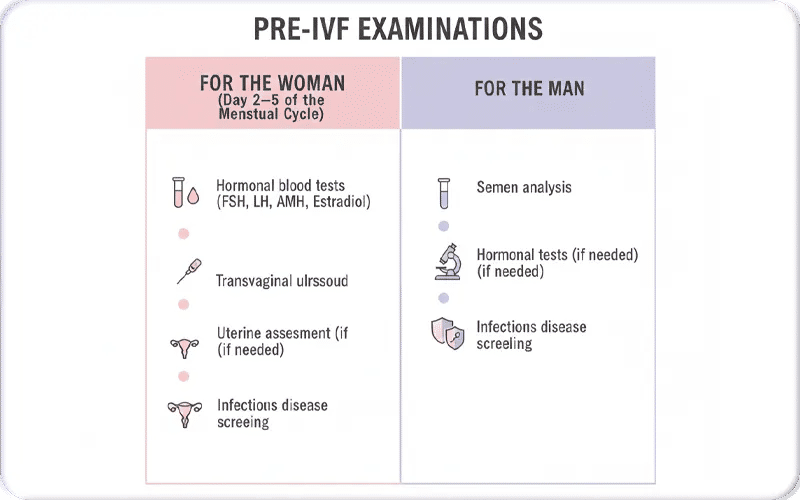
For the Woman (Day 2–5 of the Menstrual Cycle):
- Hormonal blood tests (FSH, LH, AMH, Estradiol) to assess ovarian reserve and hormone balance
- Transvaginal ultrasound to evaluate the ovaries, count antral follicles, and assess the uterus
- Uterine assessment if needed (such as hysteroscopy or saline ultrasound)
- Infectious disease screening as part of routine safety protocols
For the Man (Before or During the Same Cycle):
- Semen analysis to evaluate sperm count, motility, and morphology
- Hormonal tests to determine if sperm parameters are abnormal
- Infectious disease screening
These baseline tests allow the IVF specialist to design a personalized treatment plan, determine medication dosages, and decide whether additional proceduresو such as ICSI or genetic testingو are required.
Once all results are reviewed and the body is hormonally ready, the IVF cycle officially begins with ovarian stimulation in the following weeks.
How Long Does the IVF Process Take?
The active IVF cycle usually takes about 2–3 weeks, beginning with ovarian stimulation and continuing through egg retrieval, fertilization, embryo development, and fresh embryo transfer when planned.
However, the complete IVF process can take around 6–8 weeks when pretreatment, initial preparation, and the waiting period before the pregnancy test are included. The timeline may be longer when embryos undergo PGT, are frozen for later transfer, or when additional preparation is needed before a frozen embryo transfer.
Plan Your IVF Treatment in Turkey
Turkey Luxury Clinics can help you connect with experienced fertility specialists in Turkey and plan a personalized IVF treatment journey based on your medical needs.
Get guidance on treatment options, IVF scheduling, ICSI or PGT when medically indicated, and the practical steps involved in planning your treatment in Turkey.
Request a personalized IVF consultation.
Related articles
IVF vs IUI: Discover when to choose each one
How Successful is IVF? Success by Age, Cycles & Frozen Embryos
FAQs About IVF Process