

- Embryo Transfer Success (2026 Data)
- What Are Embryo Transfer Success Rates?
- Factors Affecting Embryo Transfer Success Rates
- Embryo Transfer Success Rates by Age
- Frozen vs. Fresh Embryo Transfer Success Rates
- Embryo Transfer Success Rate by Developmental Stage
- Frozen Embryo Transfer Success Rates
- Fresh Embryo Transfer Success Rates
- Transfer Embryo Grading and Success Rates
- Success Rates Based on Number of Embryos Transferred
- Ready to Take the Next Step in Your IVF Journey?
- FAQs About Embryo Transfer Success Rates
Embryo transfer success rates refer to the likelihood of achieving a successful pregnancy or live birth per transfer. Embryo transfer is a key component of the overall IVF process, often showing higher success rates than the overall full IVF success rates because they reflect the potential of already-created embryos rather than the entire stimulation and retrieval process.
Understanding all factors that influence the embryo transfer success rate helps you make informed decisions regarding your IVF process to enhance both pregnancy and live birth success.
You can get a personalized plan by contacting our team to assess IVF specialists and top IVF clinics accredited by JCI and TMH, equipped with advanced labs and techniques for an optimized IVF environment.
Embryo Transfer Success (2026 Data)
Factor | Typical Success | Key Benefit |
Day 5 Blastocyst | ~50–55% | Best synchronization with the uterus |
Day 3 Cleavage | ~30–40% | More embryos available; fewer cycle cancellations |
Frozen Transfer (FET) | ~45–52% | More natural hormonal environment |
Fresh Transfer | ~35–45% | Immediate transfer; no thaw risk |
High-Quality Embryo (Grade 1) | ~60–70% | Highest implantation & live birth rates |
Single Embryo Transfer (SET) | ~40–50% | Lower risk of multiple pregnancy |
PGT-A Tested Embryo | ~55–65% | Reduces miscarriage; higher success |
Optimal Endometrial Thickness | >8 mm | Increases implantation potential |
What Are Embryo Transfer Success Rates?

Embryo transfer success rates vary widely but typically range from 20% to over 50% per transfer. Outcomes are strongly influenced by factors such as patient age, embryo quality (Day 3 vs. Day 5 blastocyst), fresh versus frozen transfer, and clinic protocols.
Younger patients, especially those under 35, and transfers involving high-quality Day 5 blastocysts generally achieve the highest live birth rates, often around 40–50% or higher, while success rates tend to decline with increasing age or lower-quality embryos.
Also, higher success rates for embryo transfer are shown with cumulative treatment cycles, frozen embryo transfers, preimplantation genetic testing (PGT-A), and single embryo transfer (SET) protocols.
Embryo Transfer Success Rate Depends On:
- Maternal age and egg quality
- Embryo development stage and grading
- Fresh vs. frozen cycles
- Single vs. multiple embryo transfer
- Uterine receptivity and transfer technique
- PGT-A testing and medical history
- Lifestyle factors and clinic expertise
Factors Affecting Embryo Transfer Success Rates
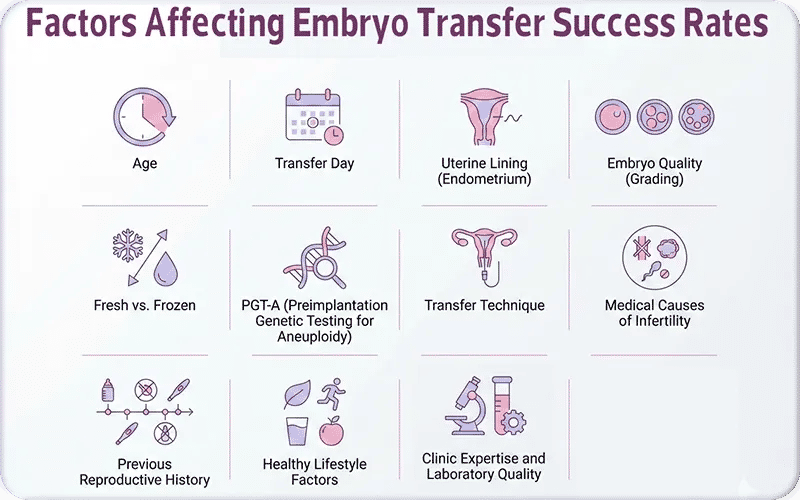
Embryo transfer success hinges on embryo quality, uterine receptivity, and transfer technique, all of which are influenced by patient age, the stimulation protocol, and the clinician’s skill.
Key factors include:
1. Age: The most critical factor, with younger patients (under 35) experiencing significantly higher live birth rates.
2. Transfer Day: Blastocyst embryo transfer success rates (on Day 5) are generally higher compared to Day 3 transfer.
3. Uterine Lining (Endometrium): The endometrium must be receptive for implantation, with a thickness greater than 8 mm generally considered optimal.
4. Embryo Quality (Grading): High-quality embryos have a live birth rate of roughly 79%, compared to 28% for poor-quality embryos, regardless of developmental stage.
5. Fresh vs. Frozen: Frozen embryo transfers (FETs) often achieve better results due to enhanced uterine receptivity and reduced hormonal stress, especially when using PGT-A tested embryos.
6. PGT-A (Preimplantation Genetic Testing for Aneuploidy): Selecting euploid embryos through genetic testing increases success rates and reduces miscarriage risk.
7. Transfer Technique: Gentle, precise placement near the uterine fundus using a soft catheter, guided by ultrasound, is vital. Removing mucus and blood and flushing the cervix can improve results. Avoid touching the fundus or using instruments like a tenaculum, as these can reduce success.
8. Medical Causes of Infertility: Conditions such as polycystic ovary syndrome (PCOS) or uterine lining issues may affect outcomes.
9. Previous Reproductive History: Prior pregnancies, miscarriages, or recurrent pregnancy loss can influence success rates.
10. Healthy Lifestyle Factors: Maintaining ideal body weight, balanced nutrition, and avoiding smoking and alcohol support better outcomes.
11. Clinic Expertise and Laboratory Quality: The experience of fertility specialists and the use of advanced IVF lab technology play a crucial role in embryo transfer success.
Embryo Transfer Success Rates by Age
Age Group | Fresh Embryo Transfer Success Rate | Frozen Embryo Transfer (FET) Success Rate |
Under 35 | 45–55% | 50–60% |
35–40 | 35–45% | 40–50% |
Over 40 | 15–25% | 20–30% |
From the table, embryo transfer success rates in both fresh and frozen embryo transfer significantly decrease with age, with the highest rates in women under 35 (around 40–50% per cycle), dropping to 20–25% for ages 38–40, and below 15% for those over 40.
The reason is that as women get older, the number and quality of their eggs decline, which increases the risk of chromosomal problems, lowers implantation rates, and raises miscarriage chances.
Older eggs often struggle with proper cell division, reducing the chance of a viable embryo, even if the uterus is healthy.
Frozen vs. Fresh Embryo Transfer Success Rates
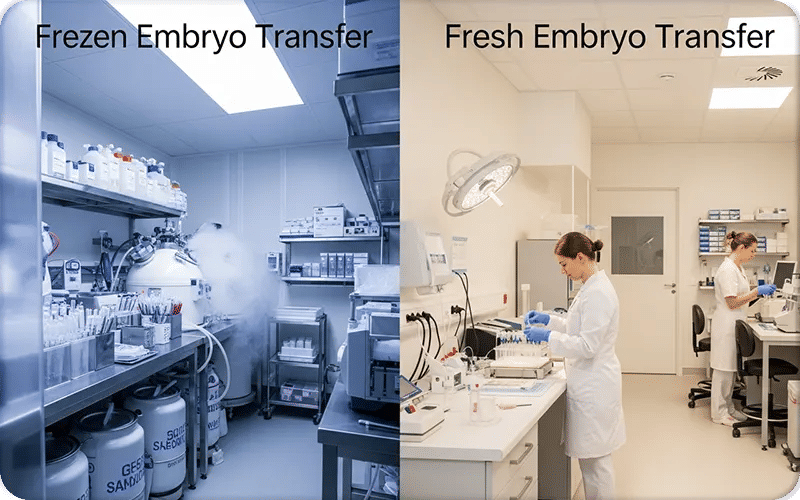
Fresh embryo transfer is performed 3–5 days after egg retrieval during the same stimulation cycle. Frozen embryo transfer (FET) can be performed months or even years later, after the embryos have been cryopreserved and thawed for transfer.
Frozen embryo transfers (FETs) often show higher or comparable success rates compared to fresh transfers, especially for older women or high responders, with better live birth rates, lower miscarriage rates, and fewer preterm births.
According to data presented by the Colorado Center for Reproductive Medicine (CCRM), women using frozen embryos had a live birth rate of 74.5% compared to 53.7% for women using fresh embryos in that particular study, especially when combined with comprehensive chromosomal screening (CCS).
The higher success rates of frozen embryo transfers are largely due to better uterine lining synchronization and the avoidance of immediate hormonal impacts, which can potentially improve outcomes over time.
Fresh transfers, on the other hand, offer quicker results but carry a higher risk of complications such as ovarian hyperstimulation syndrome (OHSS).
For both fresh and frozen embryo transfers, other factors, including maternal age, blastocyst quality, egg and sperm quality, overall maternal health, and transfer technique, remain critical and play a crucial role in the overall success rate.
Embryo Transfer Success Rate by Developmental Stage
Embryo Transfer Type | Success Rate (Pregnancy/Live Birth) |
Day 3 Fresh ET | 30–50% |
Day 5 Fresh ET | 40–60%+ |
Day 3 Frozen ET (FET) | 30–50% |
Day 5 Frozen ET (FET) | 40–70% |
Day 6 Frozen ET (FET) | 40–65% |
Day 3, 5, and 6 embryo transfers refer to the stage of development of the embryo at the time of transfer to the uterus or freezing in FET cycles.
- Day 3 (Cleavage Stage): Early 6–8 cell embryo, less developed.
- Day 5 (Blastocyst Stage): More advanced, with over 100 cells and distinct layers forming the fetus and placenta.
- Day 6 (Late Blastocyst): Slightly delayed blastocyst, often transferred for better embryo selection.
Day 3 vs. Day 5 Embryo Transfer Success Rates
Day 5 frozen transfers, where embryos are frozen at the blastocyst stage, often show the highest success rates, around 66–67%, while Day 3 transfers (fresh or frozen) are typically lower, around 45–46%.
Although Day 5 blastocysts have higher per-transfer success, only 30–50% of fertilized eggs usually survive to reach this stage. Waiting until Day 5 therefore carries the risk that no embryos will be available for transfer, making Day 3 transfers a better option for women with low embryo numbers.
Day 5 transfers generally achieve higher success rates, with better implantation, clinical pregnancy, and live birth outcomes by 9–13% compared to Day 3 or Day 6 transfers. This is largely because blastocysts allow for better selection of the most viable embryos.
Day 6 transfers, while slightly lower in overall success compared to Day 5, can still produce strong results, with clinical pregnancy rates around 54–65% and live birth rates typically in the 40–55% range.
Frozen Embryo Transfer Success Rates
Frozen embryo transfers (FETs) often show higher or comparable success rates compared to fresh transfers, especially for older women or high responders, according to multiple studies and clinical reviews. Research indicates that FETs can result in better live birth rates, lower miscarriage rates, and fewer preterm births.
Outcomes depend heavily on patient age at egg retrieval or freezing, embryo quality (with blastocyst-stage embryos performing better), and endometrial receptivity.
Frozen embryo transfers have better success rates due to improved synchronization between the embryo and uterine lining and the avoidance of immediate hormonal stress caused by ovarian stimulation in fresh cycles. FETs allow the uterus to return to a more natural hormonal environment, which can enhance implantation potential and reduce complications such as ovarian hyperstimulation syndrome (OHSS).
Women who have better success rates with frozen embryo transfers include:
- Older women
- High responders to ovarian stimulation
- Patients using preimplantation genetic testing (PGT-A)
- Women with irregular cycles or endometrial issues
- Those planning elective embryo transfer (freeze-all approach)
Natural Frozen Embryo Transfer (FET) Success Rates
Natural cycle frozen embryo transfer (NC-FET) success rates vary but generally fall in the 30–60% range per transfer for pregnancy or live birth.
Recent analyses suggest that NC-FET often results in higher live birth rates and fewer miscarriages compared to medicated or programmed cycles (AC-FET). In one study, live birth rates were significantly higher in the NC-FET group at 43%, compared to 30% in the AC-FET group.
Fresh Embryo Transfer Success Rates
Fresh embryo transfer success rates vary significantly but generally range around 40–50% live birth rates.
Although frozen embryo transfers (FETs) generally show higher success rates, some studies indicate that fresh transfers may result in higher live birth rates for women with a low prognosis for IVF success.
Day 3 fresh embryo transfers typically show clinical pregnancy rates of 30–50%, with live birth rates often around 20–30%. In contrast, high-quality Day 5 (blastocyst) embryos have much higher success rates, ranging from 60–79%, which is why many clinics prefer Day 5 transfers for better embryo selection.
Day 5 fresh embryo transfers often achieve higher success than Day 3 transfers because they allow for better selection of viable embryos. However, when the number of embryos is low, some clinics may choose Day 3 transfers to reduce the risk of having no embryos available for transfer.
Transfer Embryo Grading and Success Rates
Embryos are evaluated based on their appearance and quality using the Gardner grading system, which relies on three key components:
- Blastocyst development stage (graded 1–6): Higher numbers indicate a more advanced, hatching-ready embryo.
- Inner Cell Mass (ICM): The part that forms the fetus, graded A–C.
- Trophectoderm (TE): The cells that form the placenta, graded A–C.
For example, a 4AB embryo is a well-developed blastocyst with excellent ICM quality (A) and good trophectoderm quality (B).
General success rates of embryo transfer by grade:
- Grade 1 Excellent (e.g., 4AA, 5AA): ~60–70%+
- Grade 2 Good (e.g., 4AB, 4BB): ~40–60%
- Grade 3 Average (e.g., 4BC, 3AB): ~30–40%
- Grade 4 Poor (e.g., 3BC, 3CC): <20–30%
However, other factors such as maternal age, uterine lining state, and transfer technique still play a major role.
For women over 40, IVF success rates significantly decline due to egg quality, but transfer of Grade 1 (excellent), Grade 2 (good), or Grade 3 (fair) embryos still offers chances, though lower than the same grades for younger women.
Success Rates Based on Number of Embryos Transferred
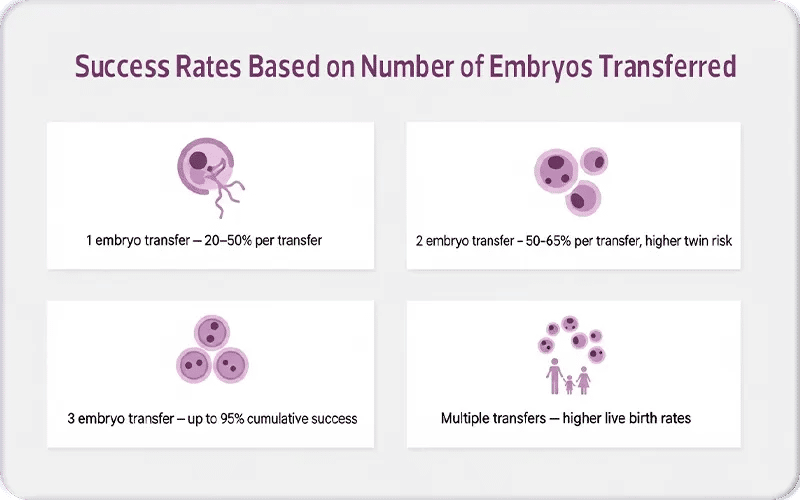
- 1 embryo transfer success rates
- First embryo transfer success rates vary significantly but generally range from 20–50% per transfer.
- IVF 2 embryo transfer success rates
- IVF success rates for transferring two embryos (double embryo transfer or DET) generally range from 50–65% per transfer. Double embryo transfer increases the chance of pregnancy per transfer but also raises the risk of multiple gestation.
- 3 embryo transfer success rates
- Transferring three embryos can further increase the chance of pregnancy per transfer, with studies showing up to 95% cumulative success across up to three transfers for genetically normal (euploid) embryos. Note that cumulative success refers to success achieved over multiple transfer attempts, not a single transfer.
- Multiple embryo transfer success rates
- Multiple embryo transfers generally increase live birth rates compared to single transfers. Double transfers often show 50–70% per transfer, but cumulative success rates can be even higher if multiple transfers are performed.
Ready to Take the Next Step in Your IVF Journey?
If you’re preparing for an embryo transfer or considering IVF, having the right guidance can make all the difference. Our experienced fertility specialists are here to provide personalized advice, answer your questions, and help you plan your treatment for the best possible outcomes. Contact us today to schedule a consultation and take the next step toward your dream of parenthood.
You may like:
Is IVF Painful? Pain Levels, Egg Retrieval & Embryo Transfer
When Does Implantation Occur After FET? Timeline, Expectations, and Results
Positive Signs After Embryo Transfer: Early Pregnancy Clues
IVF Timeline: Step-by-Step Process from Start to Finish
FAQs About Embryo Transfer Success Rates